
How live TV quietly exited my life
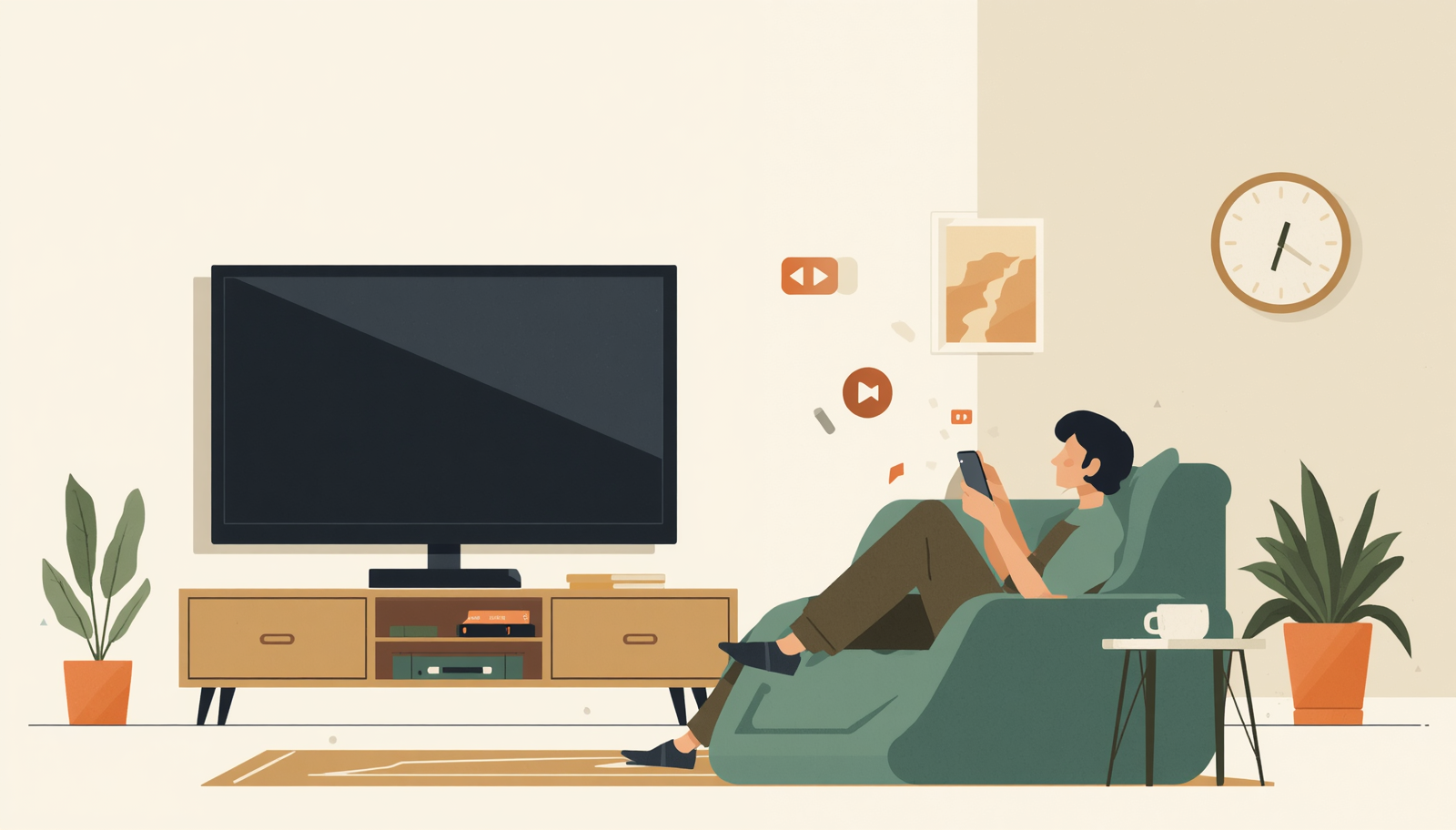
There are two smart TVs in my home, and they are mostly silent. The one in the living room comes alive only when my son streams YouTube Shorts on it. The Samsung in my bedroom has not been switched on in months, possibly years; I honestly cannot remember the last broadcast it showed me. They are good machines, the kind I would have considered a small miracle twenty years ago, and yet live television, the thing those screens were built for, has slipped out of my days so gradually that I cannot point to the moment it left. It has been more than ten years now. I want to figure out whether this is just me, or whether a lot of us are sitting in living rooms with expensive screens that have quietly become furniture.
A ritual I grew up with
Television used to have weight. Back home, watching with my family was a fixed point in the evening, almost a small ceremony. When I moved out and started living on my own, the TV and, for a good while, the DVD player kept that sacred status. They sat at the center of the room, and the room arranged itself around them. I am telling you this so you understand that I am not someone who never cared. I cared a lot. The habit just stopped feeding me at some point, and I let it go without a fight.
What replaced the evening routine
The shift was not dramatic, which is probably why I never noticed it happening. Fiber arrived, and the connection became stable and cheap. Streaming turned from a novelty into the default. Social platforms, mostly TikTok and YouTube in my case, took over the slot that used to be reserved for whatever was on at nine in the evening. For information, I pay for an online newspaper. For the very rare live event I actually want to see, I stream it on a laptop because the smaller screen keeps me close to the thing and away from the distractions a big living room invites. For pure entertainment, I open an app. Somewhere in that quiet rearrangement, the television lost its job. If you want the longer version of how those platforms reshaped all of our attention, I wrote about it in the five shifts that changed social media forever.
I am not alone, and the numbers say so
Here is where it gets reassuring, in a slightly unsettling way. The screens going dark are a global pattern, not a personal quirk. Kantar Media found that the share of adults who mainly watch traditional linear channels fell from 12 percent in 2021 to 7 percent in 2025. In the United States, streaming passed the combined total of cable and broadcast for the first time around May 2025, and by late 2025, some measurements put streaming at roughly 60 percent of all television viewing time. In Germany, the share of adults who stream (87 percent) edged past those who watch linear TV (86 percent). More than 80 million American households have cut the cord, and only about 30 percent still watch through traditional cable or satellite.
So the rectangle is not switched off only in my home. It is dimming across entire countries, one evening habit at a time.
The generational tell
My son and his screen, full of Shorts, are a statistic, too. According to Activate Consulting’s outlook for 2026, 43 percent of Gen Z reach for YouTube and TikTok before traditional TV or even streaming. That age group watches around two hours of TV content a day, less than half of what boomers put in. There is even a format built for the way they watch, the so-called microdrama, scripted in one or two-minute episodes, already pulling in tens of millions of viewers in the United States alone. My attention span has shortened considerably over the years, and I used to feel slightly guilty about it. Turns out I moved a little early in the direction a whole generation is now heading.
The Italian situation is its own animal
Italy deserves its own paragraph because the picture here is different from that in the States. Linear TV is bruised but stubborn. Italians still spend close to three hours and twenty minutes a day in front of the broadcast schedule, and the yearly decline is modest, somewhere around 2.7 percent. Streaming is rising, yet it does not fully offset the losses of traditional channels. The detail that explains my own boredom, though, is the audience’s age. The average age of Italian viewers ranged from about 52 in 2016 to roughly 57 a few years later. Around 65 percent of Rai’s audience is over 55, nearly 88 percent of the over-64 crowd watches the state channels every single day, and the probability that a 15- to 24-year-old tunes in to a Rai program is about 3 percent. The schedule is, quite literally, made for someone’s grandparents.
Same shows, three decades later
This is the part I find hard to forgive. When I do switch on, out of curiosity or stubbornness, I meet the same formats I watched in my twenties, with a fresh coat of paint and not much else. The nostalgic music nights, the parade of veteran TV faces, the talk shows that stretch a ten-minute idea across two hours, the dating shows, the quiz shows whose questions and set design feel pickled in time. I have nothing against any of it in principle. The problem is that I can get the music on Spotify, the famous faces on social media, and the single interesting moment of a three-hour program as a forty-second clip the next morning. The long, slow broadcast asks for patience I no longer have and gives back very little in return.
Movies and series do not save it either
The usual rescue argument is about content: the films and the series. It does not hold for me. I can stream a film whenever the mood strikes, so the idea of waiting for a scheduled broadcast, sliced up by ad breaks, feels almost quaint. Series are the same, and my loyalty sits with older titles that the contemporary output, weirdly repetitive and a bit shallow, rarely matches. I tested this theory by rewatching a couple. Friends still holds up, warm and well built. Desperate Housewives was a harder sit, full of things that have not aged well, inconsistencies, and plots that quietly fall apart if you look at them twice. Memory is generous. The rewatch is honest.
The format moved, not the appetite.
What strikes me most is that the appetite for live, communal viewing has not died. It has migrated. People still gather around a screen in real time; they do it inside an app, with a chat scrolling next to the action. I watched this happen with sport, which I wrote about in tennis is the new soccer, but in tech, and with commerce, where live selling now converts at rates that traditional shopping can only envy, the subject of live shopping, the new eCommerce. The living room broadcast did not get replaced by silence. It got replaced by something more interactive, more on demand, and more in my pocket.
A little grief, and a resale plan
I will admit to a thread of nostalgia in all this. I am a touch sentimental about the objects and rituals that technology retires, which is probably why I once spent an afternoon walking old neighborhoods through a map app, a habit I confessed in a Google Street View to memories. But sentiment is not a reason to keep two large screens earning their keep as dust collectors. I am seriously thinking about reselling the old appliances and reclaiming the space, the wall, the corner of the room they have been holding hostage. The smart TV that survives, if one does, will keep doing the one job my household actually asks of it: to play whatever we choose, when we choose it.
So, to answer my own question: no, it is not just me. The black rectangle is going dark in a lot of homes, faster in some countries than in others, and in Italy, the schedule keeps speaking mostly to an audience that is, politely put, a generation ahead of me. I have made my peace with the silence. The remote can finally rest. The advertising on that screen is a whole separate grievance, and one I’ve completely changed my mind about over the years, so that I will save it for its own piece. Watch this space.
Related sources
- Kantar Media, Linear TV viewing decline 2021 to 2025: Señal News
- Streaming surpasses linear TV in the United States: NewscastStudio
- Streaming overtakes linear TV in Germany: VideoWeek
- 43 percent of Gen Z prefer YouTube and TikTok, microdramas trend: Variety
- Cord-cutting statistics 2025, household and cost data: TV Tech
- Italian TV consumption and streaming, 2025 figures: Advanced Television
- Italian TV audience continues to decline: Advanced Television
- Mediaset overtakes Rai amid continued TV decline: Broadband TV News
- Aging of the Italian TV audience, average viewer age: TrueNumbers
- YouTube as the leading platform on the TV screen: Cord Cutters News
