
The quiet habit of grieving and smiling through Google Street View
There is a small ritual I do when I miss someone, and I suspect you do it too. I open Google Maps, drag the little orange pegman onto a street I used to know by heart, and I start scrolling through the years. Not the present version of the place, but the older photos, the ones layered underneath. That is where the people are.
In a 2021 frame, I can recognize my father’s car. The license plate is blurred, and his face is a smudge of pixels, but I know that walk. He had just parked, and he was heading home, the way he did a thousand times, the way he would not do again. I do not need a sharp image. The posture is enough.
A time machine that nobody marketed as one
The feature that makes this possible is almost an accident. Google added historical Street View to its desktop site in 2014, then finally brought it to phones in 2022, when Street View turned fifteen. The archive in some places stretches all the way back to 2007. Google built it so you could see how a neighborhood changed, how a shop became another shop, how a road was widened. What we actually do with it is visit our dead.
You tap “see more dates,” and a little carousel of years appears, and suddenly you are standing in front of your grandparents’ house in a summer that has already gone. The technology was designed for navigation. We turned it into a séance, a photo album, and a confessional all at once.
What I find when I go back
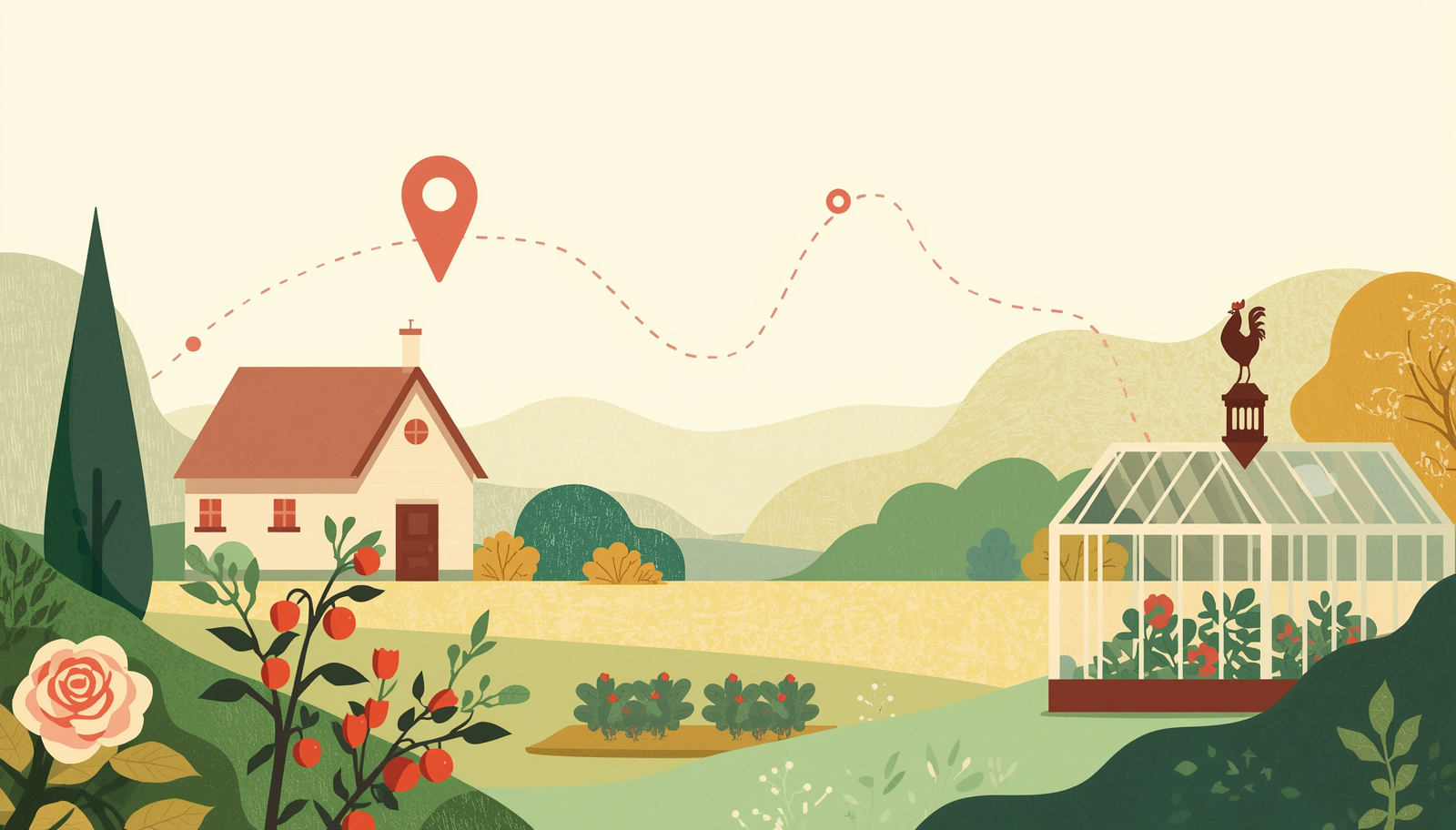
When I walk to my nonni’s house in Umbria, the Street View car caught it on a good day. The pictures I see are from around 2010, which is its own small miracle, because the house was sold back in the ’90s, after my grandfather passed. By rights, none of it should still be there. And yet my grandfather’s roses are blooming. His little orchard is heavy with ripe tomatoes. On top of the small greenhouse sits the handmade iron rooster he welded himself, still pointing north, still doing its one job. The new owners kept all of it unchanged. I have no idea who they are, I have never met them, and I am so thankful to them for leaving my grandfather’s small world exactly as he built it.
Near my apartment in Milan, there is something even stranger and sweeter. For the past two or three years, the imagery has shown a much younger version of my now-teenager, waving with both arms at the Google car. I remember the day. He came home buzzing, announcing that he had seen the Google car drive past while he walked, and that he had said hi. He is half a head taller now. The boy in the photo is still waving, frozen mid hello, and I get to keep him.
So I do what most of us do. I drop a few tears, I take a screenshot, and then I get on with my day. The whole thing is melancholic and a little crushing, and somehow refreshing too.
I am very much not alone in this
For a long time, I thought this was a private weirdness. It is, in fact, a movement. In 2019, a woman named Leslie Yajaira tweeted that she had found her late grandfather sitting on his farm in Mexico, captured by the Street View car. The post collected more than 400,000 likes and tens of thousands of shares, and the replies turned into a flood of strangers posting their own ghosts. The writer Sherri Turner started a similar thread that did the same thing, an outpouring of joy and heartbreak in equal measure.
It has since become a full social media genre. On TikTok, people film themselves scrolling to a parent or a grandparent, and the clip almost always rides the same soundtrack, Eric Church’s “Springsteen,” because apparently grief on the internet has a house band now. Essays have been written by people who went looking for a dead mother in the panoramas. Whole communities in Vietnam and beyond have made “returning to childhood through Google Maps” into a shared pastime, and the videos pull in tens of millions of views.
Why does it work on us so completely?
There is real science under the lump in the throat. Researchers like Constantine Sedikides and Clay Routledge have spent two decades rehabilitating nostalgia, which was once treated as a disorder and is now understood as a psychological resource. Their work shows that nostalgia tends to be triggered by loneliness, sadness, and a sense of meaninglessness, and that, once triggered, it pushes back, raising our sense of social connectedness, continuity, and meaning in life. We do not scroll Street View because we are stuck in the past. We do it because the past steadies us.
That steadying matters more now that our memories live almost entirely on screens. Around 1.8 trillion photos are taken every year, roughly five billion a day, and well over 90 percent of them come from phones. Almost none get printed. One set of figures put it at about three percent. We have replaced the photo album with a camera roll of nearly three thousand images that most of us never actually open. Street View, oddly, becomes the one archive we did not curate and cannot accidentally delete, so it catches the ordinary moments we never thought to photograph.
Not only sorrow: detectives and ghost hunters
The habit is not always tearful. Plenty of people use Street View as a puzzle box. There are well-documented cases where a frame captured a suspect, a missing vehicle, or even a person on the very day they vanished, walking down a road, giving investigators a direction to search. Urban explorers, the urbex crowd, use Street View to scout abandoned buildings before deciding whether a place is worth the trip, checking the state of a door without ever setting foot on private land. Others invent stories about the blurred strangers, the man forever frozen, climbing out of a hedge, the dog mid-leap. The same archive holds grief, comedy, and mystery, depending on who is looking.
And now AI brings the photos to life
Street View was only the beginning. The same impulse, the need to see a face again, is now fuelling a whole category of AI tools, and the trend keeps growing because of it. Back in 2021, MyHeritage launched Deep Nostalgia, which animated still photographs of relatives, making them blink, smile, and tilt their heads. People animated more than a million photos in the first 48 hours, over ten million within weeks, and the app shot to the top of the App Store. Today, the toolkit has gone much further. AI routinely restores cracked and faded prints, colorizes black-and-white portraits, sharpens a blurry grandmother, and stitches a few seconds of movement onto someone who has been gone for decades.
It is tender and unsettling in the same breath, and I understand both reactions. The same AI that now writes, edits, and generates so much of our content is being pointed straight at our grief, and the results can feel like a gift or like a haunting depending on the day. Either way, the appetite is clearly there. We will use whatever tool gets us one more look.
What this really tells us about ourselves
I write about how technology rewrites our habits, from the comeback of flip phones to the long road from fax machines to AI, and how the screens in our hands have quietly rewired our attention. The Street View ritual fits that story perfectly. We let technology replace the film roll, the videocassette, the shelf of CDs, every physical thing we used to hold and label and lose, and we traded all of it for something weightless that lives in the cloud.
And yet here we are, dragging a pegman across a map at midnight to stand outside a house that no longer holds the people we love, to feel close to them for a second. The media keep changing faster than any of us can keep up with. We use them because they do not move at all. We are still, deep down, a species that needs to tell stories and hold on to the ones who made us.
Related sources
- VnExpress International, “Google Maps enable nostalgic trip down memory lane with photos from the past”: https://e.vnexpress.net/news/life/trend/google-maps-enable-nostalgic-trip-down-memory-lane-with-photos-from-the-past-4912684.html
- BuzzFeed News, “Heartwarming Twitter Thread Shows Deceased Loved Ones On Google Maps’ Street View”: https://www.buzzfeednews.com/article/skbaer/google-maps-street-view-loved-ones-twitter
- Slate, “Catching a glimpse of a dead loved one on Google Street View”: https://slate.com/technology/2020/01/google-street-view-deceased-loved-ones.html
- OneZero (Medium), “A Viral Tweet Sent Me Searching for My Dead Mom on Google Street View”: https://onezero.medium.com/searching-for-the-dead-in-google-street-view-d3cbb117f4fa
- Google Blog, “Go back in time with Street View”: https://blog.google/products/maps/go-back-in-time-with-street-view/
- TechCrunch, “Google Maps Street View celebrates 15 years with historical imagery on mobile”: https://techcrunch.com/2022/05/24/google-maps-street-view-celebrates-15-years-with-historical-imagery-on-mobile-new-camera-and-more/
- Routledge, Wildschut, Sedikides & Juhl, “Nostalgia as a Resource for Psychological Health and Well-Being” (Social and Personality Psychology Compass, 2013): https://www.southampton.ac.uk/~crsi/Routledge,%20Wildschut,%20Sedikides,%20&%20Juhl,%202013,%20Compass.pdf
- Routledge et al., “The past makes the present meaningful: nostalgia as an existential resource” (PubMed): https://pubmed.ncbi.nlm.nih.gov/21787094/
- Newsweek, “MyHeritage Deep Nostalgia AI That Brings Old Photos to Life Used Over 10 Million Times”: https://www.newsweek.com/myheritage-deep-nostalgia-ai-brings-old-photos-life-10-million-1574008
- Photutorial, “Photo statistics: How many photos are taken every day?”: https://photutorial.com/photos-statistics/
- Bored Panda, “Mysteries That Were Finally Solved After Clues Were Spotted On Google Maps”: https://www.boredpanda.com/times-google-maps-saved-the-day-and-helped-crack-unsolved-mysteries-and-crimes/
