
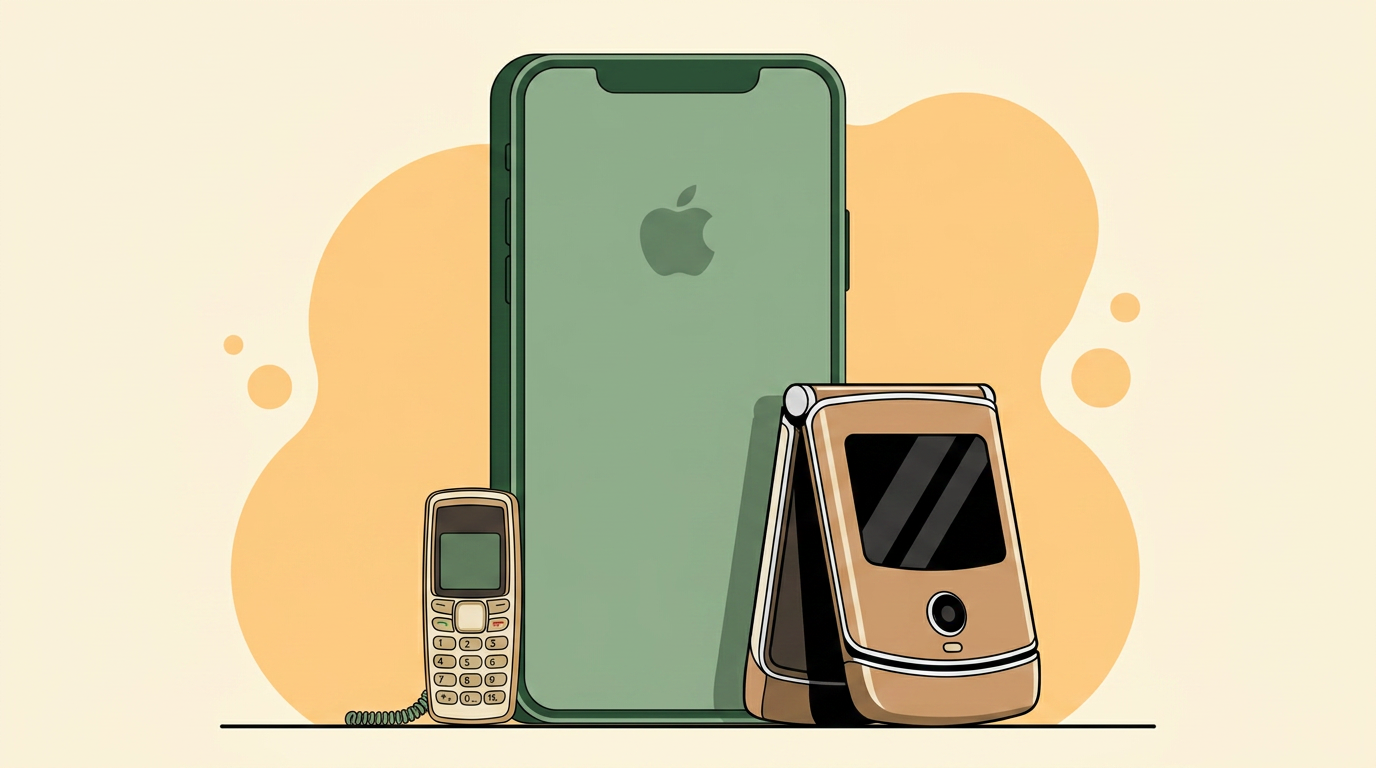
In a phone shell: the flip phone is back, and it never really left
There is something almost theatrical about a flip phone. The satisfying snap of closing a call. The clean silhouette in your pocket. The sense that a phone should feel like something, not just be a featureless glass rectangle you stare at for seven hours a day. For years, that drama was gone, swallowed whole by the touchscreen revolution. But it is coming back, hinge and all.
Small was beautiful: the miniaturization era
Before we had phones the size of paperback books, we had the opposite ambition: how small can we go?
The Nokia 8210, launched in 1999, was the answer to that question. At 79 grams, it was the world’s smallest and lightest phone of its time, with no protruding antenna, removable coloured covers, and a cool factor that made it the must-have accessory of the late nineties. It was not just a phone; it was a statement. You wore it like jewelry.
This obsession with miniaturization defined the entire decade. From the mid-1990s through the mid-2000s, handsets shrank relentlessly. The goal was to disappear into your life, to slip into a jacket pocket without a trace. Motorola was doing its own version of this theatre with the StarTAC, launched in 1996, widely considered the first clamshell phone to enter mainstream culture. At just 88 grams, it folded shut with the kind of mechanical satisfaction that is genuinely difficult to describe to someone who never owned one. Celebrities carried them. Wall Street carried them. It was the flip phone’s first golden age.
Then came the Motorola RAZR V3 in 2004, razor-thin, brutally elegant, selling over 130 million units worldwide. For a moment, thin was the new small, and Motorola owned that moment completely.
The giant that forgot to look up: Nokia’s fall
Nokia is the cautionary tale that the flip phone revival quietly inherits. At the turn of the millennium, Nokia was the world’s largest phone manufacturer, controlling roughly 50% of the global mobile market. The Nokia brand was synonymous with reliability, good design, and reach. It sold phones in 150 countries. In 2007, when Apple launched the iPhone, Nokia’s market share still stood at 50%, while Apple’s was a modest 5%.
And yet, within six years, Nokia’s smartphone share had collapsed to below 3%.
The reasons are almost painfully familiar in retrospect. Nokia clung to Symbian, its aging operating system, long after it had become uncompetitive. The company had been so dominant for so long that its internal culture had calcified: bad news was suppressed, middle management shielded executives from uncomfortable truths, and the urgency of the iPhone threat was consistently downplayed in internal communications. Research later confirmed that Nokia engineers knew Symbian was losing ground; they could not surface that knowledge upward in a way that led to action.
When Nokia finally attempted to respond, it made its worst strategic decision: rejecting Android, which would have placed it in the same ecosystem as every other manufacturer competing on price and differentiation, in favor of an exclusive partnership with Microsoft and its Windows Phone platform. The new CEO, Stephen Elop, pushed the deal through in 2011. By 2013, Windows Phone had failed to gain meaningful market share, and Nokia’s handset division was sold to Microsoft for $7.2 billion, a fraction of what the company had once been worth.
Nokia failed not because it did not see the smartphone revolution coming, but because its size, success, and culture made it structurally unable to respond. It confused hardware excellence with total product mastery. I thought the phone was the product. The ecosystem was the product. As I explored Italian shelf brands as digital products, incumbent power and distribution advantages can prop up a brand long after the market has already moved on.
The status symbol that became a relic: the BlackBerry story
While Motorola owned cool, Research In Motion owned power.
At its peak in 2011, BlackBerry had 85 million subscribers worldwide, holding over 50% of the US smartphone market and 20% of the global market. The device was nicknamed “CrackBerry”, not as a joke, but as an accurate description of its addictive pull. Executives, politicians, and financiers were never seen without one. A BlackBerry was not a phone; it was a credential. The physical QWERTY keyboard let you fire off emails at speed, the device had end-to-end encryption before most people knew what that meant, and the always-on push email made it feel like carrying the office in your pocket.
Then Apple released the iPhone in 2007, and BlackBerry’s leadership famously dismissed it. Their CEO, Mike Lazaridis, reportedly could not see how a touchscreen without a physical keyboard could work for email. They were wrong, spectacularly and fatally so.
The collapse was swift. BlackBerry’s market share fell from 20% in 2010 to 0.6% by 2013. By 2016, it had dropped to 0.2%. In Q4 2016, BlackBerry sold approximately 207,900 units, a figure subject to statistical rounding. The company pivoted to software and security services, and its final hardware devices were discontinued in January 2023.
What killed BlackBerry was a combination of three things: refusing to adapt its form factor, clinging to enterprise customers. At the same time, consumers drove the market, fundamentally misreading what a smartphone was for. Apple understood that a phone was no longer a communication device; it was an entertainment platform, a camera, a social identity. BlackBerry thought the keyboard was the product. The keyboard was never the product.
How the iPhone reversed everything
The iPhone did not just change phones. It inverted twenty years of design logic.
The miniaturization era ended almost overnight. The original iPhone’s 3.5-inch capacitive touchscreen, double the resolution of most smartphones at the time, introduced multi-touch gestures and made a larger screen feel not bigger, but better. Content needed space. Apps needed real estate. The screen was the phone now, and bigger screens meant better phones.
Manufacturers followed Apple’s lead with increasing boldness. By 2014, Apple itself had fully capitulated to large-screen demand with the iPhone 6 (4.7 inches) and iPhone 6 Plus (5.5 inches). By 2020, flagship phones routinely exceeded 6.5 inches. The phone had transformed from a device that fit in your hand to one that dominated it, a glowing slab commanding your Attention and your pocket.
Apple executed this transition with extraordinary consistency. The iPhone’s design language has been deliberately, almost stubbornly, stable: the same clean rectangles, the same minimal industrial aesthetic, the same sense that this object has been resolved and needs no further argument. It won the design market by refusing to play it. Every iteration is a refinement, rarely a reinvention. The result is a brand so visually coherent that the iPhone 16 and the iPhone 6 could share a shelf and tell the same story. Google pulled off something similar, though far more visibly: when it redesigned its Workspace icons, it changed the shapes while keeping the color logic users had internalized for years, making a major visual overhaul feel almost imperceptible. I wrote about that calculated restraint in The Google icons redesign.
But coherence, over time, becomes familiarity. And familiarity, in design, is the first step toward invisibility.
The flip is back, and this time it is a smartphone
The flip phone revival did not begin with nostalgia. It began with a genuine engineering problem: how do you make a large-screen smartphone pocketable again?
The answer, as it turns out, is the same one Motorola found in 1996. You fold it.
Samsung launched the Galaxy Z Flip series in 2020, betting that consumers wanted the cinema-screen experience without the cargo-shorts requirement. The bet has largely paid off: Samsung commands an estimated 45–50% of the foldable smartphone market. Motorola followed with its reimagined Razr line, leaning into its own heritage. Oppo (6–10% market share), Huawei (15–20%), and others have entered the space, making the flip form factor a genuine category rather than a novelty.
The global flip foldable smartphone market was valued at $26.9 billion in 2024, with projections reaching $74 billion by 2030. Growth has not been entirely smooth: Counterpoint Research reported a 12% year-on-year decline in 2024, with some markets experiencing steeper declines. But DSCC projects a 30% rebound in 2026 as the technology matures and prices fall.
There is also a parallel trend worth noting: sales of basic, non-smart flip phones, the kind that call and text, surged by 15,369% among Gen Z in 2024, driven by a desire to reduce screen dependency. Sales of “brick phones” among 18–24 year-olds increased 148% between 2021 and 2024, while smartphone use in that age group dropped 12%. The flip phone is being reclaimed not just as a gadget upgrade, but as a lifestyle statement, a small rebellion against the attention economy. If you want to understand just how fractured our relationship with Attention has become, please, if you will, go into the science behind it.
The one that made me want to fold
Which brings me to the Motorola Razr 50 Ultra, and its 2026 successor, the Motorola Razr 60 Ultra.
Not a nostalgic product. A thoroughly modern one that happens to know its history.
The Razr 50 Ultra packs a 7.0-inch Super HD pOLED inner display with a 165Hz refresh rate, triple 50MP cameras, a 4700mAh battery with 68W TurboPower fast charging (a full day’s power in 8 minutes), and 16GB of RAM on a Snapdragon 8 Elite processor. It folds open almost completely flat, with a barely noticeable crease. It comes in suede-effect vegan leather with an IPX8 waterproof rating. By any reasonable measure, a flagship phone, one that happens to fit in a coat pocket when closed.
What the Razr offers that no slab phone can is a three-act experience: closed, with its external display showing notifications and controls without opening the phone; half-open, for hands-free video calls and content; and fully open, for the full large-screen experience. A genuinely different relationship with a device.
And something connects. There is a tactile memory in a flip phone, a muscle memory almost, that slabs are erased. Closing a call still feels decisive in a way that tapping a red button never will.
The new design challenge: building apps for a phone that bends
Here is where things get complicated for everyone who is not the consumer.
The original flip phones of the StarTAC era were not smartphones. They called people. They sent texts. The design challenge was zero: there was no app, no interface to adapt, no developer to worry about. The phone was the product, and the product was simple.
Modern flip smartphones inherit none of that simplicity. A foldable screen means multiple states, folded, half-open, fully open, each with different dimensions, aspect ratios, and use cases. Developers who have spent fifteen years designing for a fixed 390×844px rectangle now have to account for an interface that physically transforms in the user’s hands.
The requirements are demanding. Apps must seamlessly resize between folded and unfolded modes without visual breaks or content loss. If someone is watching a video when they unfold the phone, the content needs to pick up precisely where it left off, at the new dimensions, without a reload. One-handed use in folded mode requires simplified, reachable interfaces. The half-open “flex mode”, where the hinge acts like a laptop hinge, demands layouts that work with the screen split horizontally.
For developers and designers, this means more testing, more layout variants, and inevitably higher build costs. Google introduced foldable-specific APIs for Android to help, and Samsung has its own optimization guidelines, but adoption across the app ecosystem remains uneven. Many apps still look like a letterbox on an open flip screen, which is the foldable equivalent of a website that hasn’t been updated since 2009.
Websites face a similar reckoning. Responsive design, which solved the desktop-to-mobile transition, now has a third dimension to account for: a screen that changes shape mid-session. The flip phone represents a new user behavior, one that screen size alone cannot capture. The principles of UX writing become even more critical here: when the interface physically transforms, the words and microcopy guiding users through that transition carry more weight than ever.
Conclusion
The arc of phone design is, in retrospect, a long loop. We started with devices too big to ignore, miniaturized them into jewelry, blew them back up into televisions we carry in our pockets, and now we are folding them in half so we can pretend they are small again.
But something is different this time. The flip phone of 2025 resolves a tension that has been building since 2007. We want big screens and pocketable phones. We want powerful cameras and devices that do not dominate a table when set down. We want technology that disappears when we want it to and performs when we need it to.
Nokia taught us that size without agility is fragility. BlackBerry taught us that form without foresight is fatal. Apple taught us that restraint is a design language. And the Razr, then and now, taught us that the most satisfying technological experience is often a physical one. The click of a hinge. The snap of a close.
So here we are, back where we started, just smarter, faster, and with significantly better cameras.
In a nutshell, or in a phone shell: the flip is back, and this time, it is not going anywhere.
Related sources
- Motorola Razr 50 Ultra, full specifications, GSMArena
- Motorola Razr Ultra 2026, official product page, Motorola
- Flip phone popularity trend in 2026, Accio Business Intelligence
- Are flip phones coming back? 2025 trend analysis, Accio Business Intelligence
- 2024 Samsung flip phone trends: sales drop and market growth, Accio Business Intelligence
- The rise and fall of BlackBerry, Harvard Digital Innovation and Transformation
- Victim of success: the rise and fall of BlackBerry, Knowledge at Wharton
- Top 11 reasons why Nokia failed, StartupTalky
- Why did Nokia fail? Creatrz
- Nokia 8210, Wikipedia
- How foldable screens are changing the UI/UX landscape in 2024, iCreatives
- Designing UX/UI for foldable phones, Socket9
- The evolution of mobile app design: from flip phones to foldable smartphones, Medium/EitBiz
