
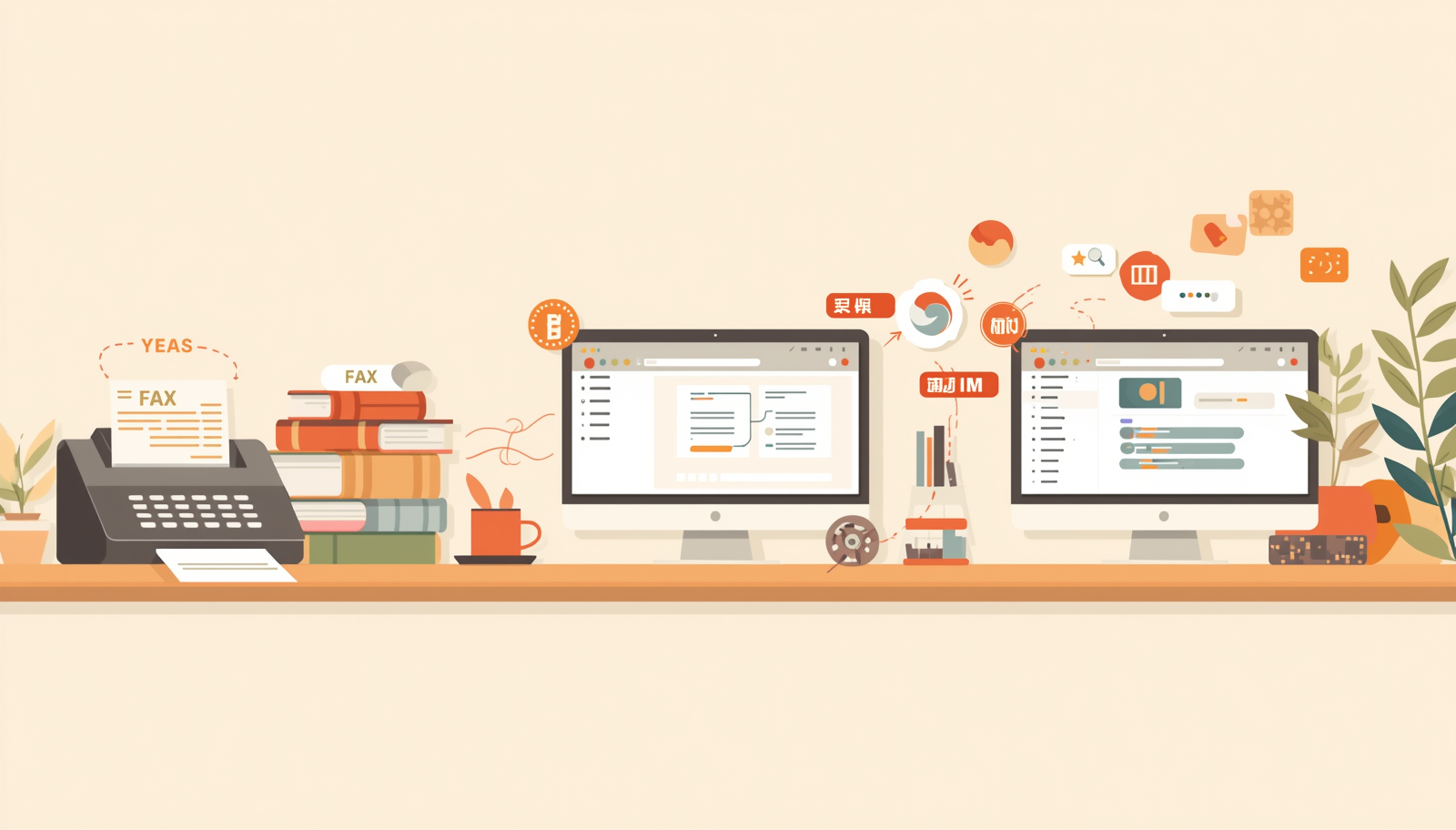
It was 1999. I had a Philips phone and fax machine sitting on my desk, surrounded by a pile of bilingual dictionaries that I reached for dozens of times a day. Every morning, I would check the fax for new jobs arriving on that smooth, slippery thermic paper. When a long document came through, the roll would unfold all the way down to the floor, and my tiny chunky dog, Salomè, would bark at it as if it were an intruder. A client somewhere in the world had sent me a source text, and my job was simple: translate it, format it in Microsoft Word, and email it back as an attachment. That was localization in the late ’90s.
Twenty-five years later, I lead a team of roughly 50 subtitlers for a Language Service Provider based in Los Angeles. I specialize in transcreation for global brands, and the fax machine is long gone. But something at the core of what I do has not changed: my love for clarity, my attention to detail, and my belief that effective communication always starts with a human who cares.
This is the story of how I got here, and how the industry transformed around me along the way.
The early days: Word documents and fax rolls
When I started out, translation was a solitary craft. You received your source text, opened Word, typed your translation, and delivered it. There was no shared memory, no glossary database, no cloud. You relied on your own notes, your dictionaries, and your instinct for the right word.
The process was slow by today’s standards, but there was something satisfying about it. You owned every word. The flip side was that you constantly repeated yourself. If the same sentence appeared in ten different documents, you translated it ten separate times, hoping for consistency.
The CAT tool revolution
That changed when Computer-Assisted Translation (CAT) tools entered the picture. A CAT tool is software that breaks a source text into segments, usually sentences, and stores each translated segment in a database called a translation memory. The next time the same or a similar sentence appears, the tool suggests your previous translation. This was transformative: it improved consistency, reduced repetitive work, and allowed translators to handle larger volumes without sacrificing quality.
I started with Trados in the early 2000s, which was the dominant tool at the time, and later moved to Idiom. These were desktop applications, sometimes clunky, sometimes frustrating, but they fundamentally changed how translators worked. For the first time, your past work became a reusable asset.
From tools to platforms: the rise of the TMS
As companies went global and content volumes exploded, standalone CAT tools were no longer enough. The industry needed systems that could manage entire localization workflows, from content intake and assignment to translation, review, and delivery, all in one place. That is how Translation Management Systems (TMS) came about.
I have worked with several over the years: Smartling, Lokalise, and Phrase. Each brought its own strengths, but the common thread was a shift in mindset. Localization was no longer about translating documents one at a time. It became about orchestrating complex, multilingual content pipelines at scale, often integrated directly into a company’s CMS or product development cycle.
The role of the localization professional shifted accordingly. Where I once spent my days choosing the perfect word, I now spend much of my time thinking about workflows, automation, context delivery, and how to get the right content to the right linguist at the right time. The focus has moved from pure translation, which today is increasingly handled by machine translation engines or outsourced to a global translator ecosystem, toward orchestration and context-appropriate localization, with a constant emphasis on velocity alongside quality.
Transcreation: where creativity meets localization
One area where human expertise remains absolutely central is transcreation. This is where I have found my niche, and where I feel most energized.
Transcreation sits at the intersection of translation and creative writing. When a brand launches a campaign in a new market, a literal translation almost never works. The tone, the humor, the cultural references, the emotional resonance: all of these need to be reimagined for a different audience. The original intent must be preserved, but the words, the images, and sometimes even the concept itself may change entirely.
This is work that no machine can do well, because it requires cultural fluency, creative instinct, and a deep understanding of what makes a message land. Transcreation and multimedia localization are currently among the fastest-growing segments in the language services industry, expanding at roughly 12 to 13% per year according to recent market analyses. As consumers worldwide expect personalized, culturally resonant experiences, the demand for this kind of work continues to grow.
I am no longer a translator in the traditional sense. But transcreation lets me stay close to language, to creativity, and to the craft that drew me into this field in the first place.
Transcription and subtitling: the streaming era
Another area that has grown enormously is transcription and subtitling. The rise of streaming platforms like Netflix, Amazon Prime Video, and Disney+ has created a massive need for accurate, timely, and culturally sensitive subtitles in dozens of languages. The global subtitling and captioning market was valued at around $4.7 billion in 2024 and is projected to nearly double over the next decade, driven by the globalization of media and stricter accessibility regulations worldwide.
I currently lead a team of roughly 50 transcribers, and I see firsthand how this work blends speed with precision. AI-powered speech recognition has made the initial transcription process faster, but human oversight remains essential for accuracy, especially when dealing with accents, overlapping dialogue, specialized terminology, or culturally specific expressions. Studies show that around 40% of Netflix users keep subtitles enabled at all times, and 80% activate them at least once a month. Subtitles are no longer an afterthought: they are a core part of the viewing experience.
Technology as a partner, not a replacement
People sometimes ask me whether AI and automation will replace localization professionals. I understand the question, but I think it misses the point.
I like to compare what has happened in localization to what has happened in surgery. Robotic surgical systems and advanced imaging tools have given surgeons capabilities that would have seemed like science fiction a few decades ago. Results are faster, more precise, and more consistent. But nobody suggests that the robot should operate without the surgeon. The technology extends what humans can do. It does not replace judgment, experience, or the ability to adapt in real time.
The same is true in localization. Machine translation, AI-powered quality checks, and automated workflows make me better and faster at what I do. They handle the repetitive, high-volume tasks so that I can focus on the work that truly requires a human touch, whether that is crafting a transcreation, reviewing a nuanced subtitle, or making a judgment call about cultural appropriateness. Human supervision remains indispensable and unparalleled in quality.
Looking back, looking forward
My career has taken me from thermic paper faxes to cloud-based platforms, from Word documents to AI-assisted workflows, from solo translation to leading a team across time zones. The tools have changed beyond recognition. But the fundamentals have not.
A keen eye for detail. A love for clarity. A commitment to communication that actually works. These are the things that got me into this field 25 years ago, and they are still at the heart of everything I do today. The technology around me has become more sophisticated, and that sophistication has made me a specialist in ways I could not have imagined in 1999.
I feel lucky to work in an industry that keeps reinventing itself without losing sight of what matters most: helping people understand each other across languages and cultures.
Related sources
- Nimdzi Insights, “The Nimdzi 100 — 2024 Edition.” Reports the global localization industry reaching $71.7 billion in 2024, projected to grow to $75.7 billion in 2025.
- CSA Research, “Ten Post-Localization Trends for 2025.” Explores the evolving role of AI, data privacy, and procurement in global language services.
- Mordor Intelligence, “Translation Service Market Size, Drivers & Opportunities, 2026–2031.” Notes transcreation and multimedia localization are growing at a 12.79% CAGR.
- Coherent Market Insights, “Localization Strategies Market Size & Trends, 2025–2032.” Projects the market crossing $7.79 billion by 2032, growing at 7.5% CAGR.
- GM Insights, “Software Localization Market Size & Share, 2025–2034.” Values the market at $4.9 billion in 2024 with a 12.4% CAGR, and profiles leading TMS platforms including Smartling, Phrase, and Lokalise.
- Growth Market Reports, “Subtitling and Captioning Market Research Report, 2025–2033.” Values the global market at $4.7 billion in 2024, projected to reach $9.1 billion by 2033 at 8.2% CAGR.
- Sonix, “11 Subtitle Generation Trends, 2026.” Reports that 40% of Netflix users keep subtitles enabled and 80% activate them monthly; the AI subtitle generation market is valued at $1.03 billion in 2023, projected to reach $7.42 billion by 2032.
- U.S. Bureau of Labor Statistics, Occupational Outlook Handbook. Project employment of interpreters and translators to grow 20% from 2021 to 2031.
- Slator, “2024 Language Industry Market Report.” Reports 25% of enterprises now prioritize AI dubbing, reflecting rapid adoption of AI-driven voice and video localization.
- VisTaTEC, “Five Localization Trends to Watch in 2025.” Discusses the evolving role of linguists, the integration of AI in workflows, and the continued growth of employment in interpretation and translation.
Chiara Bonifazi is a Branded Content Strategist, UX Writer, and Content Designer with over 25 years of experience in the digital industry. She helps brands bridge the gap between digital products and their audiences across cultures and languages.
