
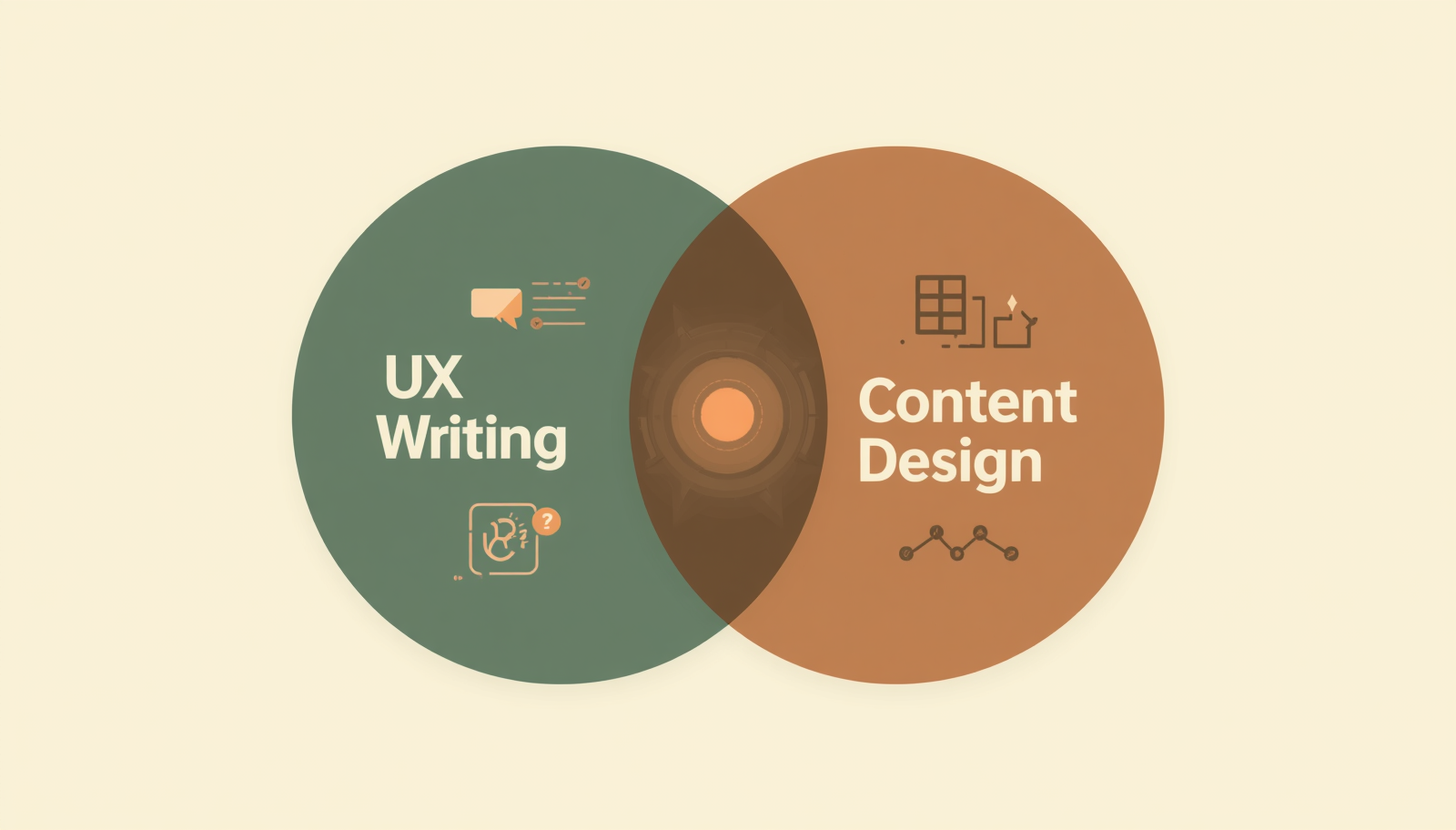
The two terms get swapped, merged, and misused in job posts, team structures, and LinkedIn bios every single day. UX writing and content design sound as if they belong to the same family, and they do. But treating them as synonyms creates real problems: blurred responsibilities, undervalued skill sets, and teams that never quite figure out who owns what.
Let’s untangle this.
What UX Writing Actually Is
UX writing is the craft of writing the words people read inside a digital product. Button labels, error messages, onboarding instructions, tooltips, empty states, confirmation screens, push notifications. All of that microcopy that guides users through a flow, reassures them when something breaks, and nudges them toward the next step.
A UX writer’s work lives at the interface level. It is precise, constrained, and deeply collaborative. You’re working inside a design file, negotiating character limits with developers, aligning every string with the brand’s voice and tone guidelines, and testing whether “Continue” performs better than “Next” in a checkout flow. According to UX Writing Hub, job posts for UX writers are remarkably consistent in what they ask for: microcopy skills, collaboration with product designers, proficiency in design tools, and participation in user research.
The scope is focused. The value is enormous. Every word in an interface either reduces friction or adds it, and UX writers are the people who make sure the balance tips the right way.
What Content Design Actually Is
Content design starts where UX writing starts, but it doesn’t stop at the screen. A content designer owns the broader question: what content should exist, in what format, structured how, delivered where, and governed by whom?
Where UX writers work inside the interface, content designers work across the product experience. They map user journeys, decide whether a piece of information belongs in a tooltip or a dedicated help page, define content types and their relationships, build voice and tone documentation, establish governance models, and create the systems that allow content to scale without losing coherence.
As UX Content Collective frames it, content design in 2026 is increasingly about systems-level thinking. Content designers are expected to operate beyond individual screens, working at the product, system, and organizational level. Dave Connis, Lead Content Designer at OutSystems, argues that content designers need to engage deeply with design systems, governance, and code, because the craft of writing alone is no longer a sufficient value proposition.
This doesn’t mean writing stops mattering. It means writing becomes one tool among many in a larger toolkit.
The Core Difference, Simplified
Think of it this way. A UX writer asks: “What should this button say?” A content designer asks: “Should there be a button here at all, and if so, how does it connect to every other touchpoint the user encounters?”
Both roles write microcopy. Both follow brand guidelines. Both rely on user research. Both sit within design teams. The Working in Content comparison puts it plainly: there is significant overlap in the day-to-day tasks, but content designers frequently operate as the content strategy function too, making decisions about governance, publishing workflows, and long-term content maintenance.
UX writing is a discipline. Content design is a discipline that contains UX writing and extends well beyond it.
Why the Confusion Exists
The terminology itself contributes to the blur. “Content design” originated in UK government design teams and became the standard across the British public sector and parts of Europe and India. “UX writing” emerged from Google’s design team in the US and gained traction in North and South America. As Richard Furlong notes, people who use English as a second language often gravitate toward “UX writing” because it is more descriptive and less likely to be confused with graphic or multimedia design.
The result is that two professionals doing very similar (or very different) work may carry either title depending on their geography, their employer, or the year they entered the field. Job posts labeled “content designer” sometimes describe pure UX writing roles. Posts labeled “UX writer” sometimes expect full content strategy and systems thinking. This inconsistency benefits nobody.
Where Content Systems Enter the Picture
The distinction between UX writing and content design becomes sharpest when you look at content systems.
A content system is the connective tissue that holds a product’s entire content layer together: the voice and tone guidelines, the component-level content patterns, the taxonomy and metadata structures, the governance rules that define who can publish what and when, the documentation that allows twenty writers across four time zones to produce content that sounds like one brand.
Building and maintaining content systems is a responsibility of content design. UX writers contribute to those systems by following and refining them, but the architecture itself belongs to someone thinking at the system level.
I’ve written in depth about how AI can accelerate the creation of content systems, from drafting governance frameworks to structuring taxonomies.
This is also where AI is beginning to reshape the role. Content designers who document their patterns, voice guidelines, and decision-making criteria thoroughly can train AI tools on that documentation to create internal writing assistants, style-checking copilots, or content generation workflows that maintain brand consistency at scale. Designers who skip documentation will find that AI has nothing meaningful to learn.
As I explored in a previous post on content creation in the era of AI, the critical thinking and strategic decisions remain human work, while AI handles the heavy lifting of research, validation, and structural scaffolding.
What This Means for Teams and Hiring
If your team needs someone to write clear, effective microcopy inside an existing product with established guidelines and a functioning design system, you need a UX writer. If your team needs someone to define what content should exist across the entire product experience, build the systems and governance that support it, and ensure that content scales as the product grows, you need a content designer.
The mistake many organizations make is hiring for one while expecting the other. A UX writer asked to build a content system from scratch without the mandate, the time, or the organizational buy-in; the effort will burn out. A content designer hired to only write button labels will disengage. Clarity about the scope prevents both outcomes.
For content professionals navigating their own careers, the question is worth asking honestly: Do you thrive at the sentence level, finding the perfect three words that make a flow intuitive? Or do you thrive at the systems level, orchestrating how content works across an entire product? Both are valuable. They are not the same skill, and pretending otherwise sells both short.
Looking Ahead
The field is moving toward a model where the distinction sharpens rather than dissolves. Content design is expanding into systems thinking, AI governance, and cross-functional strategy. UX writing is deepening its focus on inclusive language, conversational interfaces, and the growing complexity of multi-modal interactions.
The most effective product teams will have both people who obsess over the right word in the right place and people who design the systems that make the right word possible at scale.
Understanding which one you need, which one you are, and how the two work together is the first step toward building content that actually serves people.
Related sources
- LogRocket: UX Isn’t Complete Without Content Design
- UX Writing Hub: UX Writing vs. Content Design
- UX Content Collective: Content Design in 2026
- UX Content Collective: What 7 Content Designers Predict for 2026
- Working in Content: Compare Content Design to UX Design
- Richard Furlong: Content Design and UX Writing, What’s the Difference?
- Contentsquare: Content Design, Why It Matters
Chiara Bonifazi is a Branded Content Strategist, UX Writer, and Content Designer with over 25 years of experience in the digital industry. She helps brands bridge the gap between digital products and their audiences across cultures and languages.
