
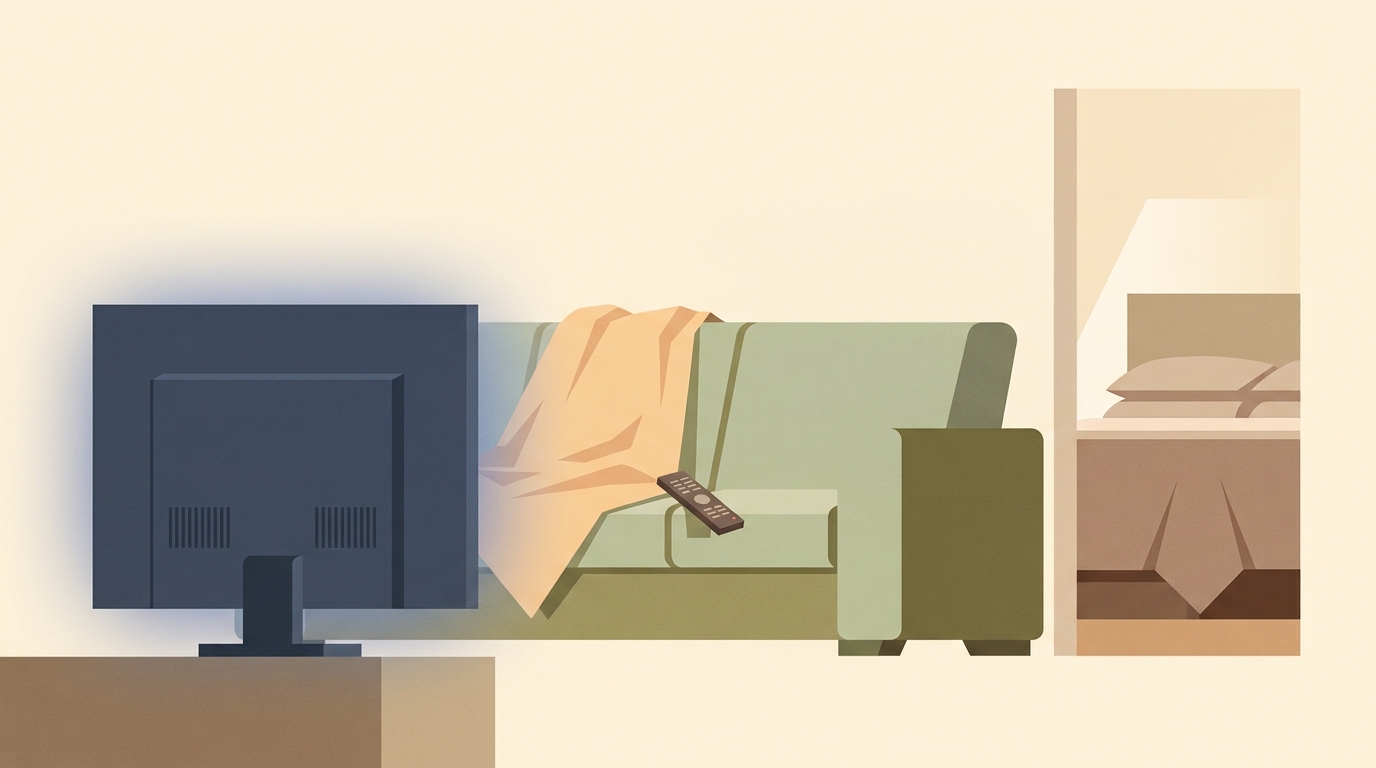
Sleep turns up on the sofa and walks out in the bedroom
The scene repeats itself with almost comic punctuality. The head starts to nod, the plot of the film becomes an abstract matter, the remote control slides out of a loosening hand. Someone suggests the most reasonable thing in the world: go to bed. Five minutes later, under the covers, the eyes are wide open and drowsiness has withdrawn its offer. If anything, it looks as though we turned the offer down ourselves, with the swagger of a Deal or No Deal contestant who thanks the banker, presses on, and regrets it a quarter of an hour later.
The physiological account is familiar to anyone working in sleep medicine. Wakefulness builds up a biological push towards rest, the homeostatic pressure described by Borbély in his two-process model. Those minutes of dozing in front of the television, usually more than one and almost always unnoticed, burn off a share of it. Whoever gets up from the cushions reaches the bedroom with the appetite already half satisfied.
The walk to the bedroom switches the system back on
Then comes the transfer, which nobody counts as an activity although it plainly is. Standing up, switching on a lamp, checking the door, brushing teeth, hunting for the charger, settling the alarm. The body moves, temperature shifts, the eyes take in light, the mind reopens its diary. Very little is needed to put the organism back into daytime mode.
Add the most self-defeating gesture of all: looking at the clock. 23.48 is still harmless, 00.17 begins to feel like a reproach, by 1.06 the arithmetic of remaining hours is well under way. Hard to drift off while auditing one’s own wakefulness.
Evening interfaces have no point of arrival
This is where the craft of writing content for digital products comes in, because part of the mechanism is something we design ourselves.
Every well built artefact holds a final state. A form ends with a confirmation screen, a page closes with a footer, a novel has its last line, a film its credits. The platforms that keep us company in the evening have replaced that boundary with a five-second countdown and the following episode already running. The feed, for its part, has no bottom by definition.
Research on binge viewing by Exelmans and Van den Bulck points to a factor beyond screen brightness: the mental activation preceding rest, fuelled by narrative involvement and by tension left hanging. A cliffhanger, after all, is a call to action dressed up as plot.
Designers know this perfectly well. The rewarded metric is time spent, and a product that invites people to leave looks like a product giving up. I have written elsewhere about attention and about presence: the absence of a closing signal remains an editorial choice before a technical constraint.
How my own evening works, flaws included
Let me declare the conflict of interest straight away: I cannot fall asleep without a lit screen either. I scroll through the phone or watch a series, following to the letter everything the manuals advise against.
When drowsiness genuinely arrives, though, I keep the earbuds in, carry on listening and stop looking. The video stays where it is, I do not. Then I sleep, and at least I sleep in the bedroom: the only victory I claim in this story is geographical.
Read with a professional eye, that move is a change of state I have built for myself. I cut the visual channel, hold on to the auditory one, taper the stimulus instead of severing it abruptly. It is precisely the soft transition the product fails to offer and that I improvise by hand every night.
The bed can learn to keep us awake
One last piece concerns associations. The brain links places to behaviours: once the sheets become the spot for working, answering messages, watching episodes and above all worrying about not resting, the bond between bedroom and sleep loosens. Another one hardens in its place, between bedroom and alertness.
Cognitive behavioural therapy for insomnia, CBT-I, calls stimulus control the technique meant to rebuild that link. No barracks, no martial protocols: it simply means avoiding long stretches spent awake, irritated and demanding an outcome. Sleep does not answer summonses.
When wakefulness becomes obvious, getting up helps, moving to a dimly lit room, taking up something undemanding and returning under the covers as soon as the torpor comes back. Without a stopwatch, since counting the minutes elapsed belongs to the problem.
What the people designing these products could do
Some instruments already exist. Sleep timers, audio-only mode, automatic dimming, the “are you still watching?” prompt. The trouble lies in how they are handled: buried in settings, switched off by default, or triggered after three consecutive episodes, by which point the question sounds like mockery.
A more candid design idea would place the ending on the main path. Microcopy that offers a believable farewell at the close of an episode instead of a countdown. An evening mode that steps video down to audio without obliging anyone to go looking for it. A line of text acknowledging the hour, with the same ease certain services show when reminding us to refresh a password. Call it design courtesy, the kind we bring to bear when drafting error messages that help rather than blame.
The same holds for anyone measuring everything with a wristband: wearable devices gladly report how many hours we have rested, far less gladly which interface took them away.
When the difficulty deserves medical advice
A necessary closing note. If falling asleep or staying asleep turns into a problem lasting for months, trailing fatigue, irritability, poor concentration or daytime sleepiness, the matter leaves the territory of evening habits and belongs with a doctor. Other possible causes deserve consideration: pain, reflux, waking to urinate, restless legs syndrome, anxiety, low mood, medication, alcohol, caffeine, nocturnal breathing disorders. Loud snoring, pauses in breathing reported by whoever sleeps alongside, waking with a choking sensation and morning headache all warrant specialist assessment.
For chronic insomnia, American and European guidelines name CBT-I as the first-line treatment, well ahead of any over-the-counter remedy.
What remains is that the right moment for going to bed always arrives slightly earlier than we find convenient to admit: usually once the storyline has gone astray and the screen is talking to itself. Noticing it is a matter of personal attention. Making it easy would be the job of whoever designs that screen.
Related sources
- Borbély AA, Daan S, Wirz-Justice A, Deboer T, The two-process model of sleep regulation: a reappraisal, Journal of Sleep Research, 2016
- Edinger JD et al., Behavioral and psychological treatments for chronic insomnia disorder in adults: an American Academy of Sleep Medicine clinical practice guideline, Journal of Clinical Sleep Medicine, 2021
- Riemann D et al., The European Insomnia Guideline: an update on the diagnosis and treatment of insomnia 2023, Journal of Sleep Research, 2023
- Exelmans L, Van den Bulck J, Binge Viewing, Sleep, and the Role of Pre-Sleep Arousal, Journal of Clinical Sleep Medicine, 2017
- Levato G, Sul divano crollo. A letto resuscito, Mondosanità, 2026
