
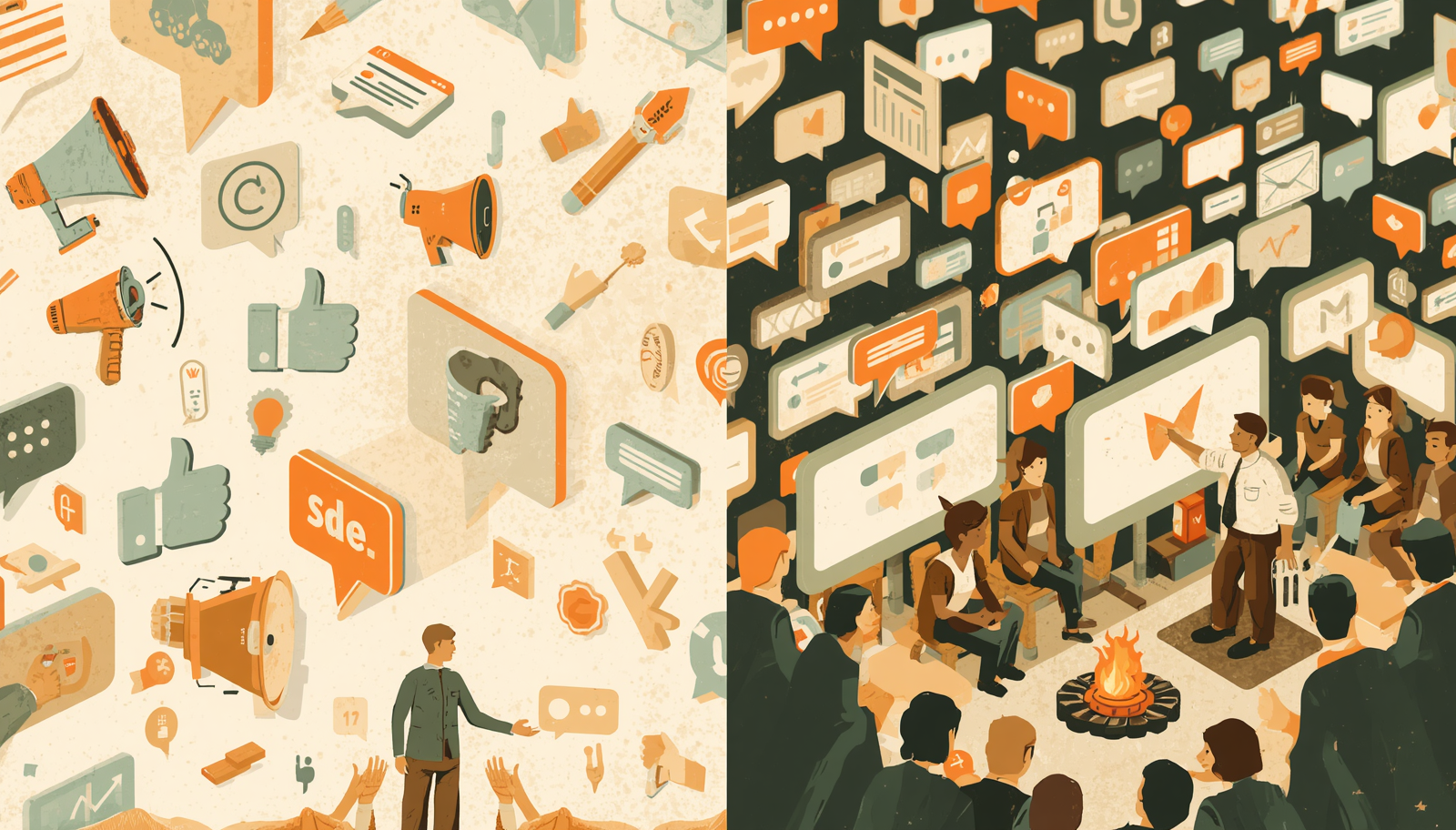
Social media in 2026 looks nothing like the playground marketers fell in love with a decade ago. The platforms are the same names on our screens, but the rules underneath have been rewritten so thoroughly that entire strategies built between 2012 and 2018 now feel like relics. If you manage a brand’s presence online, or if you are building one from scratch, understanding these five shifts is no longer optional. They define how audiences behave, how algorithms distribute content, and how trust is built or lost.
1. Social media is no longer the Customer Support Alter Ego.
There was a time when tweeting at an airline or tagging a telecom company on Facebook was the fastest way to solve a problem. Brands set up dedicated handles, hired community managers, and turned public complaints into public wins. Customers loved the speed and transparency; companies loved the low cost compared to traditional call centers.
That dynamic has quietly eroded. According to a 2025 YouGov survey, only 4% of consumers now choose social media as their preferred contact method for customer service. Even among Gen Z, the figure barely reaches 8%. The channel that was once hailed as the future of support has slipped behind phone, email, and live chat across nearly every demographic. Sprout Social’s Index data show that while consumers still expect a response within 24 hours when they reach out on social, many have stopped reaching out altogether. Managing high volumes of requests has become the top challenge for customer care teams, and a customer-service-filled feed can distract from campaigns and brand storytelling.
What happened? Partly, the platforms themselves shifted focus. Algorithmic timelines buried public complaints under sponsored posts and viral Reels. Chatbots and automated replies replaced the human touch that made social support appealing in the first place. And as brands scaled their social operations, the personal, almost intimate quality of a real-time Twitter exchange gave way to templated responses and frustrating loops. Consumers adapted by moving to live chat widgets and messaging apps, where conversations are private, immediate, and uninterrupted by the noise of a public feed.
The lesson for brands is not to abandon social support entirely, but to stop pretending it can be the backbone of their service strategy. Social media is still a listening post, a place where complaints surface and sentiment becomes visible. But the heavy lifting of resolution belongs in dedicated channels that offer real personalization and speed, without forcing customers to express their frustrations in public.
2. Organic reach has collapsed. Visibility is now a paid sport.
This is the shift that stings the most, because it happened gradually enough that many brands kept posting long after their content stopped reaching anyone. In 2012, an average Facebook page post reached roughly 16% of its followers. By 2025, that number had cratered to somewhere between 1% and 2%. Instagram tells a similar story: average post reach dropped to 3.5% of followers, and Facebook dipped as low as 1.65%. On LinkedIn, where organic visibility once felt like a gift, reach fell 34% between 2024 and 2025 alone.
The numbers are brutal across the board. A Hootsuite analysis found that Instagram’s average reach in 2024 was just 4.0%, down 18% year over year. Social media strategists who once built thriving communities through consistent, high-quality posts have watched their engagement plummet without changing anything about their approach. One LinkedIn marketer tracked her reach declining from 35,000 views per post in 2017 to around 500 by late 2024. Another reported that a retail client’s Facebook organic reach had shrunk from 8% of followers to less than 3% in just two years.
The causes are structural. Content saturation is the most obvious: billions of posts compete for attention every day, and algorithms have to decide what surfaces. But platform monetization plays an equally large role. Facebook, Instagram, and their peers generate revenue from advertising, and their algorithms naturally favor paid content over organic updates. Global social media ad spend reached $219.8 billion in 2024, almost 30% of all digital advertising. The platforms have become pay-to-play environments, and pretending otherwise means posting into a void.
This does not mean organic content is worthless. It still builds credibility over time, gives paid campaigns authentic material to amplify, and serves as the creative testing ground where brands discover what resonates before putting money behind it. But relying on organic reach alone for discoverability or lead generation is no longer a viable strategy. The brands that thrive treat organic and paid as two parts of the same engine: organic to build trust and test ideas, paid to scale what works.
3. Audiences assume everything is an ad. Relevance is your only antidote.
Consumer skepticism toward social media content has reached a tipping point. According to the Edelman Trust Barometer, only 44% of consumers globally trust businesses to do what is right. A 2024 survey found that 71% of global consumers stated they trust companies less than the year before. And when it comes to social media specifically, the Ipsos Global Trustworthiness Monitor found that only 22% of the public trusts social media companies at all. Television advertising holds a 46% trust rating; social media sits at 19%.
This skepticism is not irrational. Years of blurred lines between editorial and sponsored content, undisclosed partnerships, misleading product claims, and outright misinformation have taught audiences to approach everything they see on a feed with suspicion. PwC found that 59% of consumers have stopped buying from a brand they felt was dishonest in its advertising. The era of glossy brand messaging that expects to be taken at face value is over.
So what actually works in an environment where the default audience assumption is “someone is trying to sell me something”? Relevance. Not relevance as a buzzword, but relevance as a discipline: understanding what your audience genuinely needs, what problems they face, and what conversations they are already having, then showing up with content that adds value to those conversations rather than interrupting them. Brands that focus on educational content, genuine storytelling, and community participation outperform those that push promotions, because the former earns attention while the latter demands it.
The shift also demands restraint. The temptation to insert your brand into every trending topic or to dress up sales pitches as helpful posts erodes trust faster than silence does. Consumers can spot the difference between a brand that speaks because it has something to say and one that speaks because it has something to sell. In a world where every message is scrutinized for hidden motives, the brands that earn trust are those that prioritize usefulness over visibility.
4. Real-time marketing is fading. Continuous conversation is what lasts.
Oreo’s “Dunk in the Dark” tweet during the 2013 Super Bowl blackout is still cited in marketing textbooks as a masterclass in real-time marketing. When the lights went out at the Mercedes-Benz Superdome for 34 minutes, Oreo’s team posted a simple image with the caption “You can still dunk in the dark.” It earned 15,000 retweets during the game, 20,000 Facebook likes within an hour, and over $525 million in earned media impressions. For a moment, it seemed like the future of marketing was all about speed: whoever could react fastest to a cultural moment would win the internet.
What followed was a wave of brands trying to replicate that lightning-in-a-bottle moment, and most of them failed. The rush to newsjack every event got so excessive that AdAge published a piece headlined “Go Home, Real-Time Marketing. You’re Drunk.” Even Lisa Mann, the former VP of cookies at Kraft, who approved the original Oreo tweet, later acknowledged that the walls had closed: too many brands chasing the same moments, too many forced attempts that came across as inauthentic. As she put it, if Oreo ran that exact tweet again today, it would barely make a splash.
The concept of the “war room,” where social media teams huddled around screens during major events, waiting to pounce on the next trending topic, has been largely retired. What has replaced it is something quieter but far more effective: continuous, consistent conversation with your audience. New data from Endear shows that personalized messaging to existing customers is up more than 50% year over year, and that the year’s highest email open rates no longer cluster around big retail events. Retail messaging is becoming an always-on layer of operations rather than a periodic tactic.
Wendy’s understood this shift early. While Oreo had a singular viral moment, Wendy’s built an ongoing social media personality through daily, witty interactions with followers and even competing brands. People did not just follow Wendy’s for announcements; they followed to see what the brand would say next. That kind of sustained engagement creates a relationship that no single clever tweet can match. The brands winning on social media today are the ones that show up every day with a consistent voice, treating their audience as a community rather than a crowd to surprise.
5. Influencer credibility is eroding. Your own voice is your strongest asset.
The influencer marketing industry is now worth $24 billion globally, and yet the trust that once fueled its growth is visibly cracking. The BBB National Programs’ Influencer Trust Index, based on a survey of more than 3,700 U.S. consumers, found that only 74% trust influencer content to some extent, compared to 87% who trust general advertising. Just 5% of consumers said they trust influencer content completely. A Harvard Business Review article noted that while 88% of consumers say authenticity matters, nearly half believe most influencers are fake. Morning Consult tracked a 5-percentage-point decline in influencer trust among young consumers between 2023 and 2024, a notable reversal after years of steady growth.
The trust killers are well-documented. Eighty percent of consumers cite influencers who are not genuine or transparent as their biggest concern. Seventy-one percent are put off by content that promotes unrealistic lifestyles. And 70% feel deceived when they discover a partnership that was never disclosed. A Clutch survey from 2025 found that 53% of consumers trust a product recommendation less when they know the influencer was paid, and nearly half of respondents had not purchased a single product recommended by an influencer in the previous year.
This does not mean influencer partnerships are dead, but the era of renting someone else’s credibility through a one-off sponsored post is ending. Imperial College Business School researchers concluded that brands that treat influencers as genuine partners rather than media channels, and consumers as communities rather than impression targets, will earn lasting credibility. Everyone else will simply add to the noise.
The deeper opportunity lies in developing your own brand voice. The brands breaking through in 2025 and 2026 are the ones investing in storytelling, founder-led content, employee advocacy, and behind-the-scenes narratives that feel human and unfiltered. When an employee shares their genuine experience with a product, or when a founder walks through the reasoning behind a business decision on LinkedIn, audiences respond with a level of trust that even the most polished influencer campaign struggles to replicate. Your story, told in your voice, is the one asset that no algorithm change, platform shift, or competitor can take from you.
The road forward
These five shifts share a common thread: social media has moved from a space where reach was cheap and attention was easy to earn into one where trust is the scarcest resource and relevance is the only currency that holds value. The brands that will thrive are the ones that accept this new reality and build their strategies around it. Invest in owned channels. Treat paid and organic as partners, not competitors. Speak when you have something meaningful to say. Build relationships that compound over time instead of chasing moments that evaporate. And above all, remember that in a landscape drowning in noise, the most powerful thing a brand can do is tell the truth, consistently, in a voice that is unmistakably its own.
Sources
- YouGov, “How Americans Prefer to Contact Businesses for Customer Service” (March 2025) — https://business.yougov.com/content/51802-how-americans-prefer-to-contact-businesses-for-customer-service
- Sprout Social, “The 2025 Sprout Social Index, Edition XX” (January 2025) — https://sproutsocial.com/insights/data/index-2025/
- Sprout Social, “Social Media Customer Service Statistics for 2025” — https://sproutsocial.com/insights/social-media-customer-service-statistics/
- Hootsuite, “Social Media Statistics” (2026) — https://blog.hootsuite.com/social-media-statistics/
- SocialInsider / Outfame, “75 Instagram Growth Statistics” (February 2026), citing organic reach at 3.5% and global ad spend at $219.8 billion — https://www.outfame.com/blog/instagram-growth-statistics
- Edelman, “2025 Trust Barometer” (January 2025) — https://www.edelman.com/trust/2025/trust-barometer
- Ipsos, “Trust in Social Media” / Global Trustworthiness Monitor (2022–2023) — https://www.ipsos.com/en/trust/trust-social-media
- PwC, “Experience Is Everything: Here’s How to Get It Right” — https://www.pwc.com/us/en/services/consulting/library/consumer-intelligence-series/future-of-customer-experience.html
- Endear / PR Newswire, “The End of the Marketing Blast: Retail Enters the Conversation Era” (May 2026) — https://www.prnewswire.com/news-releases/the-end-of-the-marketing-blast-retail-enters-the-conversation-era-302760467.html
- BBB National Programs, “Influencer Trust Index: Consumer Insights 2025” — https://bbbprograms.org/media/insights/blog/influencer-trust-index
- Morning Consult, “The 2025 Influencer Marketing Guide” — https://pro.morningconsult.com/analyst-reports/influencer-marketing-guide-2025
- Duffek, Eisingerich & Merlo (Imperial College Business School / Georgia State University), “How to Do Influencer Marketing That Customers Actually Trust,” Harvard Business Review (December 2025) — https://hbr.org/2025/12/how-to-do-influencer-marketing-that-customers-actually-trust
- Duffek, Eisingerich, Merlo & Lee, “Authenticity in Influencer Marketing,” Journal of Marketing (2025) — https://journals.sagepub.com/doi/10.1177/00222429251319786
Chiara Bonifazi is a Branded Content Strategist, UX Writer, and Content Designer with over 25 years of experience in the digital industry. She helps brands bridge the gap between digital products and their audiences across cultures and languages.
