
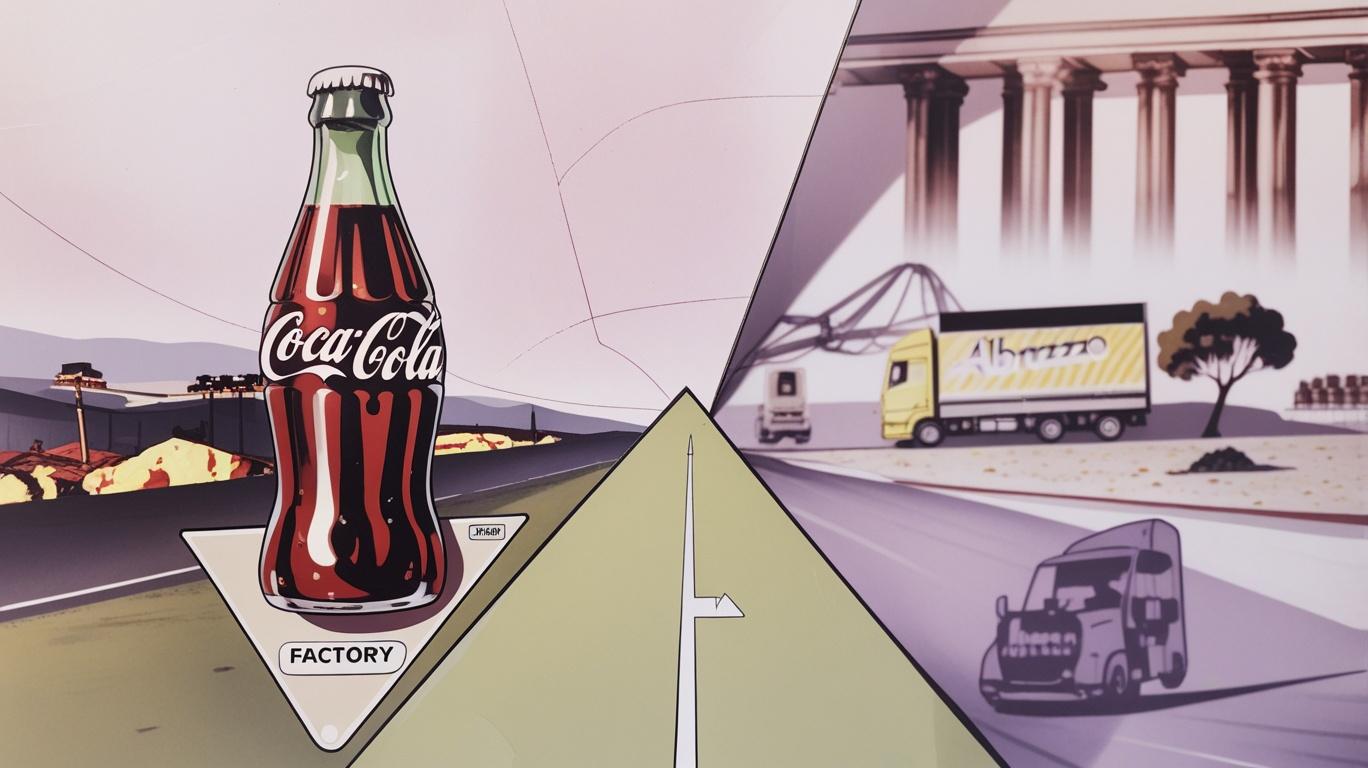
The big landmark in Pescara
There was an enormous glass bottle on the Tiburtina road, marking the entrance to the Coca-Cola plant in Pescara. I went there on a school trip as a child, and that shape, mounted on a triangular pedestal, stuck with me more than anything I saw inside the factory itself: conveyor belts, cans filling up at a dizzying pace, the sickly-sweet smell of syrup. That sign was proof that an everyday drink, the one you’d enjoy at the beach with friends, was born in a warehouse a few kilometers from home.
That Pescara plant, expanded in the 1980s, closed for good in 2011, one of many industrial restructurings that have redrawn Coca-Cola’s production map in Abruzzo over the past decades. Today, everything that used to be spread across multiple sites, between Pescara and Fara Filiorum Petri, has been concentrated in Oricola, in the province of L’Aquila. And the reason it happened right here isn’t just industrial: it’s geographic, too.
Why Abruzzo is the hub of Central-Southern Italy
Oricola sits just a few kilometers from the border with Lazio, along the route that connects Rome to the Adriatic coast. On a map of Italian distribution logistics, that position is worth more than many locational perks: from here, Lazio, Marche, Umbria, and much of the South can be reached within a few hours without having to ship goods from plants farther north or south.
That’s exactly what Coca-Cola HBC Italia set out to do, leveraging more than 18 million euros invested over 2025-2026 to modernize Oricola’s production systems. At the centre of it are two new canning lines, now fully operational thanks to a total investment of 40 million euros (42 million if you count the whole 2023-2025 period): one dedicated to the historic The Coca-Cola Company brands, Coca-Cola, Fanta and Sprite, the other entirely reserved for Monster, with 37 recipes and more than 80 different products, the first time the company has produced energy drinks in Italy.
Having a single canning hub for Central Italy, instead of shipping that format in from other plants across the country, has a direct and measurable effect: roughly 240,000 kilometers of travel are avoided, along with the emissions reduction that comes with it. It’s the kind of efficiency you only see when you look at the whole supply chain rather than a single factory: a well-positioned plant doesn’t just produce more, it also travels less.
Sustainability moves onto the factory floor
The other pillar of the investment concerns the plant’s direct environmental impact. Oricola has introduced a system to recover the water used to backwash its carbon filters, saving nearly 5.5 million liters of water and forecast to surpass 9 million liters in 2026. It isn’t an isolated case: at the same plant and in Nogara, Coca-Cola HBC Italia is implementing water-recovery technologies, while at the group level, 100% of wastewater is treated before being returned to the local environment.
This fits into a broader commitment, laid out in the 22nd edition of the company’s Sustainability Report, reviewed by Deloitte & Touche according to GRI standards: in 2025, 100% of the grid electricity purchased by Coca-Cola HBC Italia came from renewable sources, and since 2023, every plastic bottle in the portfolio has been made with 100% recycled PET (excluding cap and label). In that sense, Oricola isn’t a one-off efficiency story but rather one piece of an industrial strategy that ties together water savings, clean energy, and the circular economy across every Italian plant.
“Our goal is to make the plant increasingly efficient by progressively cutting our water and energy consumption,” said Giuseppe Giovane, director of the Oricola plant, noting that these investments guide every production decision, from operational quality to the safety of the people who work there.
A multiplier of 8 jobs
Then there’s the part that concerns the wider territory. A study by Bocconi University found that Coca-Cola’s investments in Abruzzo have created nearly 2,000 jobs: for every direct employee, almost 8 more are generated across the regional supply chain, among suppliers, logistics, and related businesses. The overall economic impact in 2024 was estimated at nearly 50 million euros, or 0.1% of Abruzzo’s regional GDP.
These are the numbers that explain why the logistical choice to bet on a single production hub in Abruzzo, rather than consolidating elsewhere, isn’t just an internal industrial decision: it’s news that affects the economy of an entire region, in an area where food manufacturing carries more weight than it does elsewhere.
What’s left of the bottle on the Tiburtina
That giant bottle is gone now, or at least I haven’t seen it in the years since I last drove down that road. But the thread linking that school trip to today’s announcements about Oricola is more direct than it seems: the same company, the same region, a production that relocated and consolidated instead of disappearing, simply following the logic of a company that understood Abruzzo, thanks to its position, can serve a huge chunk of Italy from right here.
It isn’t an isolated case. I wrote about this when discussing Italian heritage brands making their presence felt, when De Cecco opened its first store in Pescara: there too, a historic brand chose Abruzzo to tell the public a story of local roots that would be harder to make credible anywhere else. The same goes for new wine marketing and the Citra case: territory, supply chain, and communication are increasingly intertwined, with Abruzzo no longer just a low-profile production site but a strategic asset worth telling its story.
And when it comes to brands that stay in your personal memory long after they’ve left the market, the same applies to Coca-Cola as to what I wrote about Alfa Romeo, a family legend, or what I mentioned in when ads were short films, about Carosello, where Coca-Cola’s own commercials were among those capable of staying with people for decades, far longer than today’s six seconds.
Related resources
- Il piano di Coca-Cola per l’Abruzzo: a Oricola il polo italiano per produrre energy drink – Il Centro
- Coca-Cola Hbc Italia investe oltre 42 milioni di euro nella fabbrica abruzzese di Oricola – Coca-Cola Hbc Italia
- I nostri stabilimenti: Oricola – Coca-Cola Hbc Italia
- Coca-Cola HBC Italia accelera sulla sostenibilità con 175 milioni di euro di investimenti – Food Affairs
- “Coca Cola” – Pescara (PE), ampliamento anni ’80 – Di Gioacchino Architetto
