
Telling your story pays: De Cecco, Made in Italy, and the value of drawing people closer
There’s a piece of news that, as someone born in Pescara, I read with a particular smile. On June 24, De Cecco opens its first official Store in Pescara, my hometown and the place where I spend long stretches of the year when I’m not in Milan. We’re talking about a Gallery designed by Studio Francesco Faccin, conceived as an immersive journey in which materials, light, and visual storytelling convey the values that have guided the company for nearly two centuries. It’s an open tribute to Abruzzo and to the roots of the De Cecco family, and at the same time a choice of method: a brand tells its story before it sells anything.
It would be easy to file this away as an image exercise, a luxury a historic brand can afford. The data says something more concrete. Telling the brand’s story is one of the highest-return investments in the medium and long term, and by now we can measure its impact.
The story is worth more than the product
The most elegant experiment on this is called Significant Objects. In 2009, Rob Walker and Joshua Glenn bought cheap trinkets for a total of $128.74, asked a group of writers to invent a short story for each one, and resold them on eBay. The same objects, paired with a story, sold for $3,612.51, a 2,700% jump. A ceramic horse bust bought for 99 cents went for nearly $63. What changed was the narrative, not the object.
The same mechanism appears in brand experience research. Consumers exposed to a brand story describe the product with words like “high quality”, “interesting”, “pleasant”, while those who don’t receive it reach for “mundane” or “of little value”. More importantly, they’re willing to pay more: in one experiment, every participant who read the story accepted the list price, against barely half of those who hadn’t. I came back to this theme when I wrote about ads being short films, from Carosello to Barilla to Coca-Cola, because the advertising that truly moved us has always been about telling a story.
From story to price: emotional connection pays
A story builds an emotional connection, and an emotional connection turns into numbers. According to Motista, customers emotionally bonded to a brand have a 306% higher lifetime value than merely satisfied ones, stay loyal longer (5.1 years versus 3.4), and recommend the brand four times as often. The Harvard Business Review reaches the same conclusion by another route: emotionally connected customers are 52% more valuable than satisfied ones, buy more often, and care less about price.
This closes the loop. Less attention to price means a higher margin, and a margin defended year after year is exactly what justifies an investment like a Store. Telling your story today protects your books tomorrow.
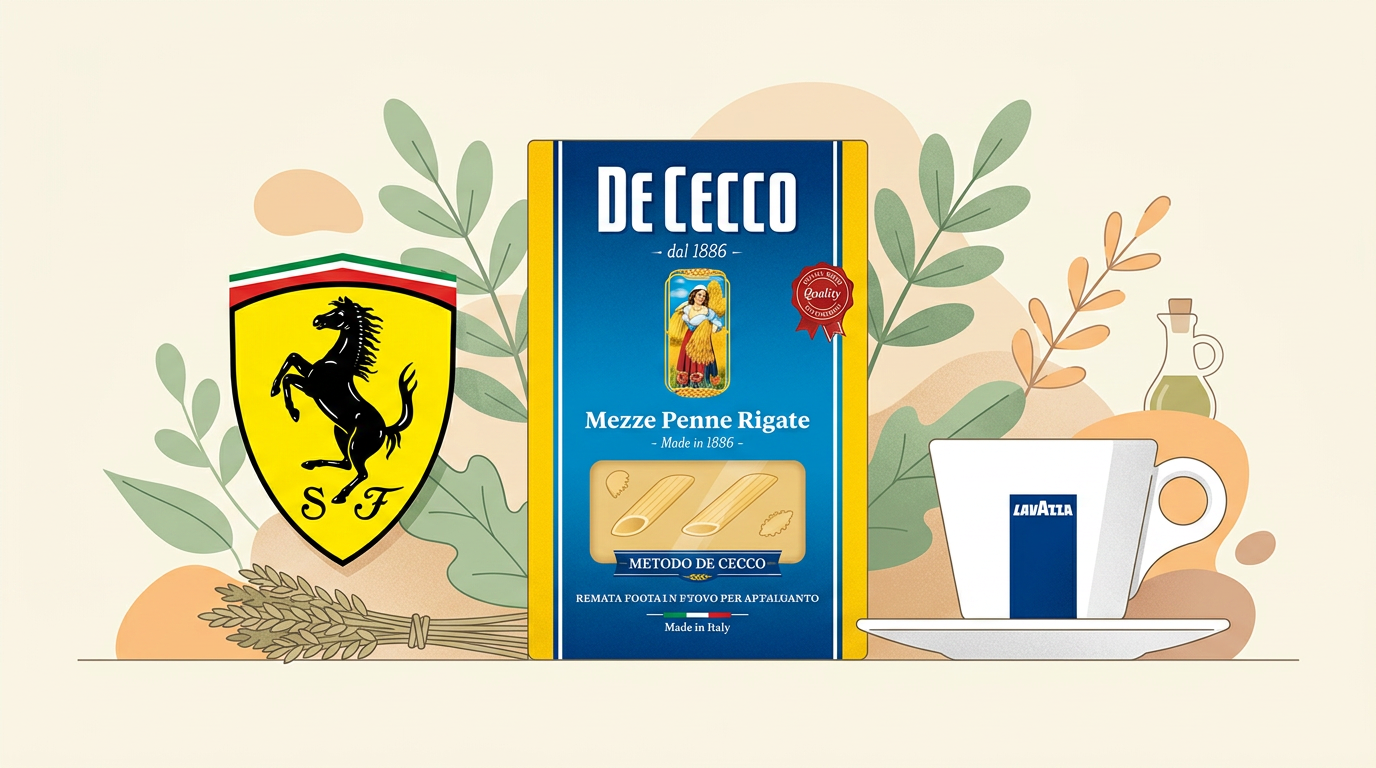
Made in Italy, three times over: De Cecco, Lavazza, Ferrari
Italy understood before others that brand heritage works like a destination. The corporate-museum phenomenon proves it: the Museimpresa association brings together more than 150 company museums and archives and estimates that it attracts roughly one million visitors a year.
Lavazza is a shining example. The Lavazza Museum in Turin spans more than 1,100 square meters of themed areas with a multimedia approach, turning an everyday icon like Italian espresso into an experience that draws in international tourists and brings them into the brand.
Ferrari carries the same principle into the territory of desire. The Maranello museum welcomes several hundred thousand visitors a year on average, guiding them through Formula 1 single-seaters, sports prototypes and GTs, all the way to the shuttle that takes them out to the Fiorano track. The brand story becomes almost a pilgrimage, and the desirability it creates is the same force that sustains the price positioning.
And now De Cecco, which, with the Pescara Store, takes the same step into the world of pasta, the food that symbolizes Italian identity at the table. Staying home in Abruzzo, instead of betting on a metropolitan showcase, is part of the story: the brand’s credibility is tied to the place it comes from. Three brands, three sectors as distant as food, coffee, and automotive, united by a single insight. Made in Italy sells a story of place, of hand,s and of time, and stories, as we’ve seen, carry a price.
What the comparison from abroad tells us
Outside Italy, the direction is just as clear. Dublin’s Guinness Storehouse is Ireland’s most-visited paid attraction, with 1.65 million visitors in 2024. Atlanta’s World of Coca-Cola tops a million visitors a year. The big global food and beverage brands turned their heritage into physical places long ago. De Cecco joins that path, holding a card neither Guinness nor Coca-Cola can play in quite the same way: the authenticity of a Made in Italy rooted in a specific territory.
What I learned in digital: people want to experience
On this point, I hold a conviction born of direct experience. I worked for years in digital, and the most surprising lesson was exactly this: the more the product lived online, the more users asked for a physical, tangible presence.
I saw it clearly in the events in the eBay and PayPal worlds. People were happy to take part in fairs and gatherings in person, to shake hands, to see the brand off the screen. They were essentially asking us to be physically present in their lives, a real presence they could interact with, rather than a logo inside an app. That contact created a bond that no online campaign could replicate on its own.
The numbers say the same thing. 91% of consumers say they’re more likely to buy after participating in a live brand activation, and the same share feel more positive about a brand after an event. 70% become repeat customers, with a lifetime value 20-40% higher. No surprise that 77% of marketers plan to grow their experiential marketing budgets in 2026. And the point goes beyond single events: even brands born online are opening physical spaces, the so-called clicks to bricks shift, because 65% of consumers now prefer a phygital experience that weaves the physical and the digital together.
Why does all of this matter now
We’re living an interesting paradox: in a world that’s dematerializing, the tangible becomes more valuable. The De Cecco Store in Pescara is the heritage version of this principle. Digital brands open physical spaces to gain the depth a screen can’t give, while a nearly two-hundred-year-old brand opens a physical space to give depth back to what it already owns, its own story.
Telling the brand’s story is how a company turns its past into a future competitive advantage, building the emotional connection that generates loyalty, a price premium, and value over time. De Cecco does it starting from home, from Pescara, from a story nearly two centuries long. And it does it at the right moment, because whether it’s pasta, coffee, cars, or an event at a trade fair, people need to touch what they believe in. Digital taught me this better than anything else: physical presence is an investment in the brand’s future.
Related sources
- De Cecco opens its first official Store in Pescara (Food Affairs)
- How the Significant Objects experiment proved the economic value of storytelling (Entrepreneur)
- The Significant Objects project (official site)
- The impact of storytelling on the consumer brand experience (ResearchGate)
- Leveraging the value of emotional connection (Motista, PDF)
- Emotionally-connected consumers are 3 times more valuable (Luxury Daily)
- Museimpresa, the Italian corporate museums and archives association
- Lavazza Museum (Museimpresa)
- Ferrari Museums (Ferrari.com)
- Guinness Storehouse, Ireland’s most visited attraction (Travel Extra)
- World of Coca-Cola (Wikipedia)
- Experiential marketing ROI statistics (The Trust Agency)
- From clicks to bricks (Pobuca)
- When ads were short films (Content Benefit)
- Tennis is the new soccer, but in tech (Content Benefit)
- Content Designer vs. Strategist (Content Benefit)
