
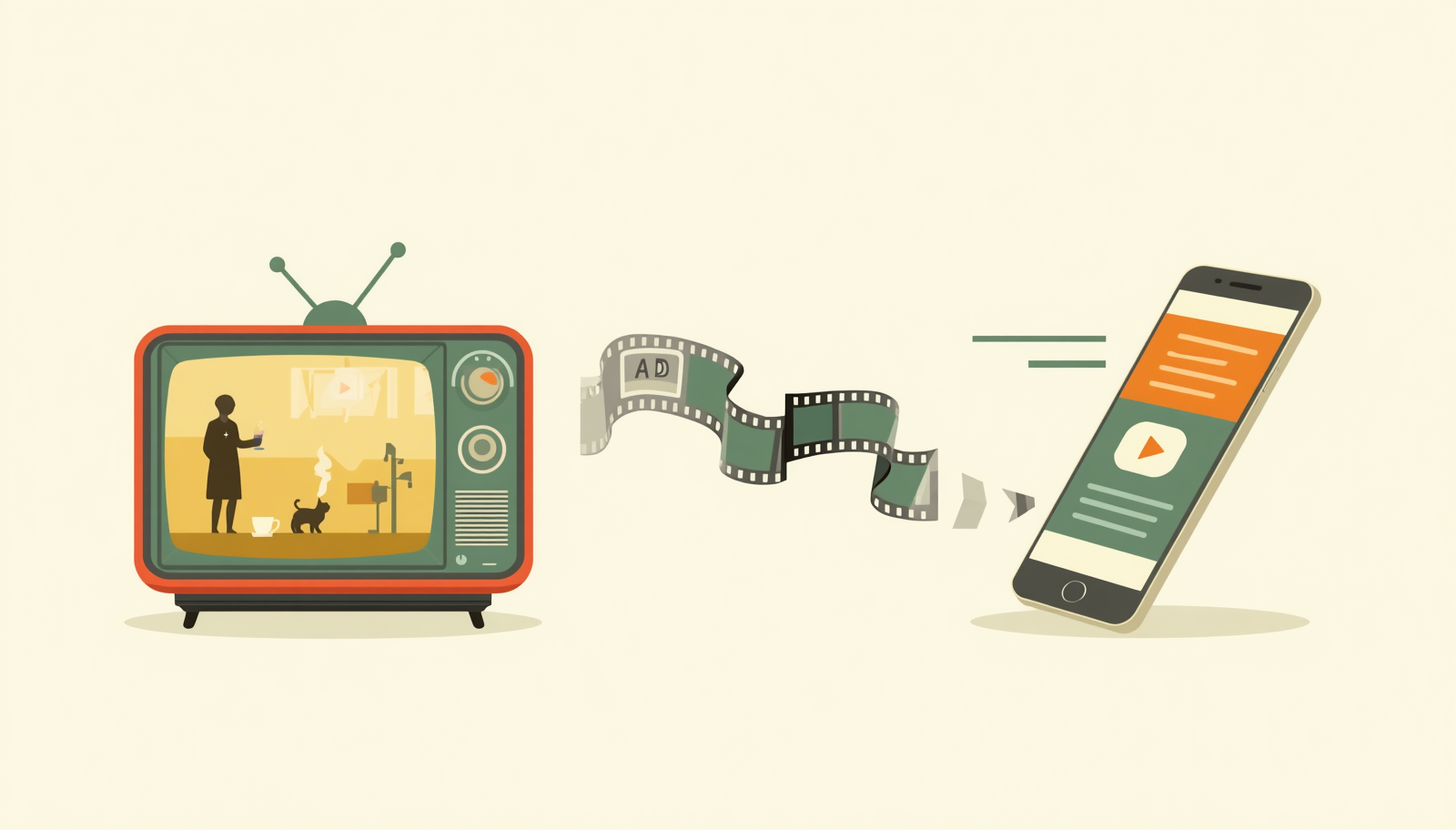
I have a sharp memory from childhood: dinner would end, and nobody left the table before the commercials. The ads were part of the evening, sometimes the part we waited for most. The little girl walking home in the rain holding a kitten, the Mulino Bianco flute, and the family reuniting in the kitchen. They were tiny films, with a story, a soundtrack, and an ending that left something with you. Now I switch on the TV (when I switch it on at all, something I have written about elsewhere) and the ads slide past me without leaving a mark. Something has genuinely shifted, and it is not just my own nostalgia talking.
When advertising was an appointment
In Italy, advertising had a founding moment that few countries can match for sheer cultural weight: Carosello, running from 1957 to 1977. These were two-minute sketches in which the product barely appeared, usually at the very end, after a little story worth watching on its own. Children went to bed “after Carosello”, which had quietly become a unit of family time. Advertising did not interrupt the evening; it gave it rhythm.
From then on, brands kept thinking big. In the Eighties, Barilla handed its spots to real directors. The famous “Alta società ” from 1985 was directed by Federico Fellini, with music by Nino Rota, arranged by Nicola Piovani: a couple in an extremely elegant restaurant, the maître reeling off refined dishes, and the lady cutting him off with a flat “Rigatoni”. Thirty seconds, but with an auteur behind them. It is not every day that an Oscar winner shoots a pasta commercial.
The characters who joined the family
The most charming thing about those years is that ads created recurring characters, with their own continuity from one episode to the next. The Little White Miller in his mill-laboratory, Coccolino the bear, Mastro Lindo, the little Dutch girl of Mira Lanza, Susanna Tutta Panna. You recognized them, you waited for them, you knew how they behaved. They were narrative characters in every sense, not simple spokespeople.
Mulino Bianco, born within Carosello in 1976, with nursery rhymes recited by a mother to her daughter, built an entire idealized rural world during the Eighties. The ad was not selling a biscuit; it was selling a harmonious, almost fairytale way of life, a refuge during years of frantic modernization. Buying those biscuits meant buying a small piece of that world. That is the work I still try to do with a well-written brand character, as I described in my case study about writing copy for Deadpool without knowing the character at all.
Christmas had a soundtrack
Then there is the Coca-Cola chapter, which is an international masterclass in emotional construction. In 1971, “Hilltop”, the ad with young people of every nationality on a hillside (shot in Italy, as it happens) singing “I’d like to teach the world to sing”, reached the heart of an entire era. The song became a real radio hit, and the company received more than 100,000 letters. An advertisement that people asked to hear again.
And since 1995, there has been “Holidays Are Coming”, the illuminated trucks that, for a great many people, still mark the official start of Christmas. A jingle, a promise, a ritual repeated almost unchanged for thirty years. Try to think of an ad made today that could lodge itself so deeply into people’s emotional calendar.
What changed, measured in seconds
The shift can be measured, quite literally, in seconds. In the Fifties and Sixties, the sixty-second spot dominated, with plenty of room for an elaborate production. The Seventies brought the thirty-second format, allowing broadcasters to sell more inventory within the same break. The late Eighties saw the rise of the fifteen-second spot, driven by cost and frequency. Today, with digital and TikTok as the model, we have arrived at six seconds.
The trouble is that length is not neutral. According to industry analysis, a six-second spot delivers roughly 60% of the impact of a thirty-second one, and six seconds leave no time for an emotional story. The same data show that longer formats remain ideal for building long-term memory. On top of that, we live inside a flood of stimuli: on Instagram, you can hit more than forty ad breaks per hour, against roughly six on TV. Generation Z loses interest in an ad after about 1.3 seconds, and almost half skip skippable ads within five seconds.
The science backs up the nostalgia.
Here comes the part I enjoy most, because it lifts the conversation out of “things were better back then”. Les Binet and Peter Field analyzed nearly a thousand campaigns honored by the IPA between 1980 and 2010. The finding, gathered in The Long and the Short of It, is unambiguous: emotional campaigns are almost twice as likely to drive long-term profit growth. Rational messaging works beautifully for the immediate effect, but it fades fast. Emotion works slowly and builds value, pricing power, and loyalty.
From that comes the famous 60/40 rule: roughly 60% of the budget to brand building, 40% to sales activation. Eighties advertising, without knowing it, lived squarely in that 60%. Today’s tend to live almost entirely in the 40%.
Why ads bore us now
The reason so many current ads tire us out, in my view, is exactly that imbalance. Brand campaigns are hard to attribute to revenue, so they are the first to be cut when the market gets nervous. Spending has moved en masse toward performance, where every euro promises a measurable result: pure-play digital now accounts for around 73% of global advertising. The outcome is a direct, captioned, functional spot, built to push one specific action in a handful of seconds.
There is nothing wrong with that in itself, quite the opposite: a good call to action is worth gold, and short formats have their own logic, like the new grammar of live shopping or the five shifts that changed social media. The point is that by endlessly optimizing “buy now,” we have stopped telling stories. And a message that tells you nothing, however efficient, is forgotten quickly. Advertising stopped being entertainment, and entertainment was precisely the Trojan horse that got it into our homes.
A personal note: Kijiji at Sanremo
On this theme, I have a memory I hold dear. In 2014, I helped develop the TV spot for Kijiji. The idea was built around “Sarà perché ti amo” by Ricchi e Poveri, with the lyrics rewritten for the occasion, telling small stories of buyers and sellers on the back of the payoff “Chi compra, chi vende, Kijiji” (whoever buys, whoever sells, Kijiji). The spot aired during the evenings of the 2015 Sanremo Festival, and on Twitter, a few users wrote that the Kijiji ad was the best song of the whole contest. It had, perhaps, that retro quality people warmed to: a familiar melody, micro-narratives, a warm tone instead of the usual list of features. It is proof, at least to me, that the appetite for stories and emotion has not left the audience, only the briefs.
Can we go back to telling stories?
I do not think we should go back, and we could not anyway. But I believe the story still carries enormous value, even inside short, new formats. The brands that stick in my head today are the ones that manage to slip in a character, a touch of irony, a small human truth, even in a few seconds, and to do it consistently. It is a writing job before it is a budget job. I see it in the seemingly minor details, from a 404 page turned into a branding moment to a brief that demands irony and timing like my “Culomba” case.
Those short films from my childhood worked because someone decided it was worth telling a story to sell biscuits. I would love that idea to come back into fashion, even in a six-second version.
Related sources
- Binet, L. & Field, P., The Long and the Short of It (IPA): summary by Alex Murrell and IPA page
- MNTN Research, on the impact of ad length: Ad length impact on attention
- AdWave, data on optimal TV commercial length: How long should a TV commercial be
- eMarketer, on Generation Z attention: Gen Z has a 1-second attention span
- eye square / OMD, attention and ad-stimulus analysis: 2.3 seconds of magic
- Raconteur, on the shift of budgets toward performance: Brands shift ad spend online
- Barilla Historical Archive, the Fellini “High Society” spot: Campaign: Fellini †“High Society
- Mulino Bianco, history of the brand’s advertising: The 1970s ads
- The Coca-Cola Company, the origins of “Hilltop”: I’d like to buy the world a Coke
- Campaign, on the Coca-Cola Christmas tradition: Coca-Cola Christmas: the 70s
