
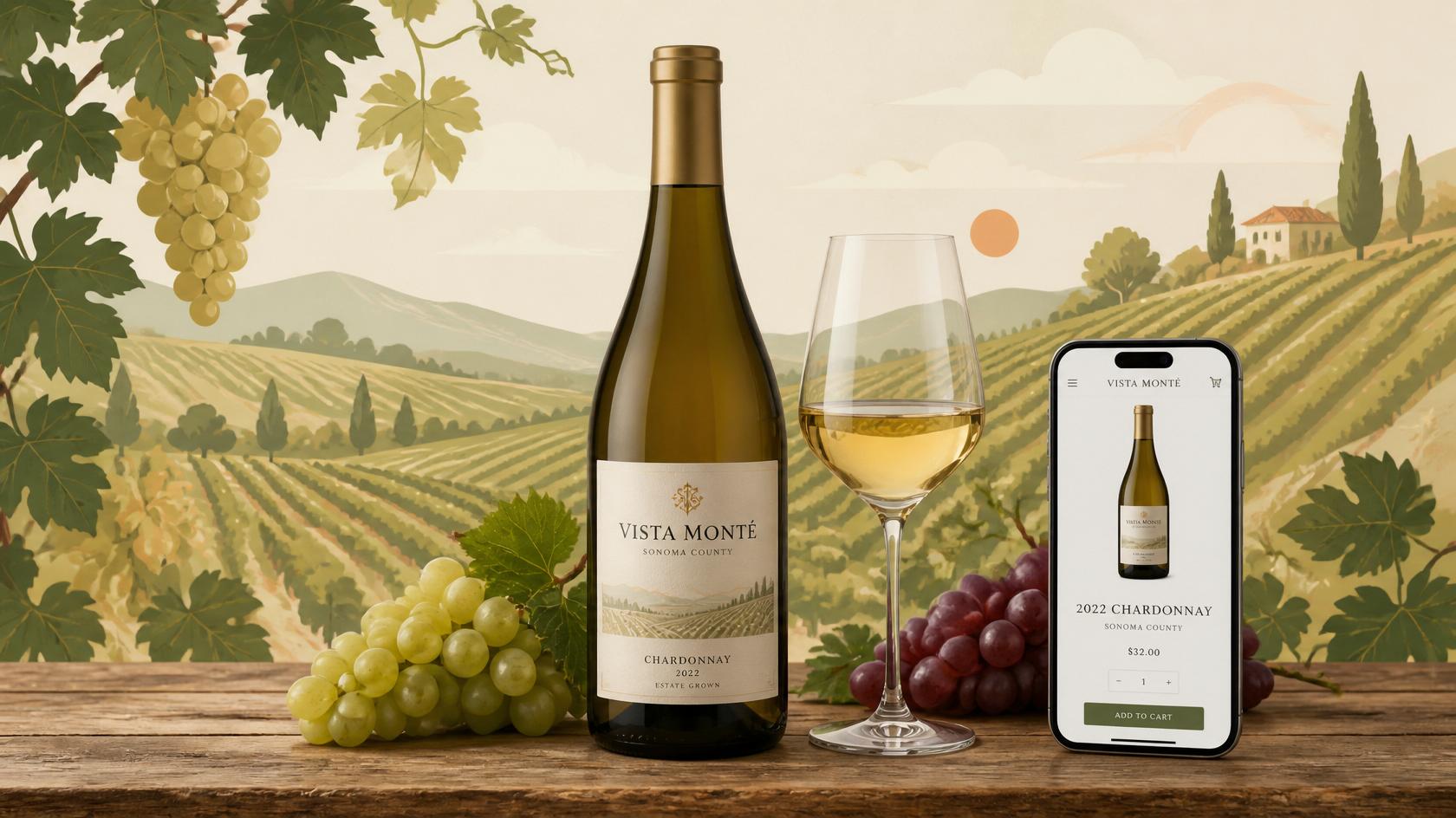
How wine marketing has changed in Italy: from the wine shop to the click
Every now and then, my phone rings, and on the other end is Count Piccolomini, offering me his latest vintage. It feels like a scene from another decade, yet it still happens in 2026, as I scroll through an Instagram feed full of wineries selling bottles through a link in bio. Wine marketing in Italy has undergone a profound transformation over the past twenty years, and watching it unfold up close, somewhere between an old-fashioned phone call and an online cart, seems like a good way to tell the story of how an entire industry changes when the way people buy changes.
From the wine shop to the supermarket cart
For generations, the trusted wine shop was the reference point for anyone looking for a good bottle: the owner knew the customers, suggested the right pairing, and told the story behind the producer. That model is losing ground today. According to the Mediobanca 2025 report, sales at wine shops and wine bars lost 8.4% in value in 2024, dropping to a 5.7% market share. Large retail remains the leading channel, though, with over 60% of wine purchases now going through supermarkets and discount stores.
The picture isn’t simple for large retail either. Circana data released for Vinitaly 2026 describe a difficult 2025, with still wines down 3.4% in volume and 1.1% in value on supermarket shelves, while sparkling wines grew slightly. Over the past four years, large retail has lost around 10% of overall consumption. Circana analysts suggest that chasing volume no longer pays off, and that the sector needs to rethink its strategies around perceived quality rather than quantity.
The phone that still rings
There’s a piece of wine’s commercial history that never really disappeared, though: direct sales, built on personal relationships. Count Piccolomini calling me every so often to offer a case of his production represents a business model rooted in decades of trust built one phone call at a time. It’s marketing made of voice, of mutual acquaintance, of a bond that predates any recommendation algorithm.
This relational dimension, far from shelves and banner ads, remains irreplaceable for many small producers and many loyal customers. I experience it myself from another angle: my friends at Cantine Testa know very well that the gift I appreciate most is always a good bottle, chosen with care, accompanied by the story of where it comes from and who made it. No newsletter or social campaign can replace that kind of attention, and that’s probably why, despite all the digitalization the industry has gone through, direct sales and word of mouth remain among the most effective channels for building loyalty.
The vineyard aperitivo as an experience
If direct sales rely on personal relationships, wine tourism has turned that relationship into a shared experience, often literally among the rows of vines. Vineyard aperitivos, guided tastings, and visits to family-run wineries have become among the sector’s strongest growth drivers. According to Nomisma Wine Monitor data presented at Vinitaly 2026, Italian wine tourism is already worth 3.1 billion euros, accounting for 21% of tourist wineries’ revenue.
The numbers point to steady growth: the Wine Suite Enoturismo 2025 Observatory reports that visitors are up 15.3% and direct winery sales are up 18.8% compared to 2024, with average spending per experience rising to 136 euros. Even more telling is a figure reported by AITE, the Italian Association for Food and Wine Tourism: for the first time on record, visiting a family-run winery ranks as the single most popular wine tourism experience, ahead even of buying wine at a good price. Loyalty, in turn, is built on hospitality: 68% of visitors say they return to a winery they already know because of the staff’s professionalism, not the wine itself.
Major events like Cantine Aperte, organized by the Movimento Turismo del Vino, have reinvented themselves in exactly this direction: no longer just tastings, but yoga among the vines, e-bike routes, workshops for children, moments of conviviality designed to turn the vineyard into a place to experience with all the senses, as president Violante Gardini Cinelli Colombini points out when describing a wine tourism increasingly oriented toward wellbeing and slowness.
Wine goes digital
Alongside the physical experience, the digital one continues to grow. Wine e-commerce in Italy hasn’t reached the levels seen in other European markets, such as the UK, where online sales account for nearly 12% of the total. Still, it’s moving with determination: according to the Trovaprezzi.it Observatory, searches related to wine online topped 657,000 in the first quarter of 2026, up 10% year over year, after the category reached 2.67 million total searches in 2025.
Wine tourism itself has become deeply digital: 68.7% of winery visit bookings now occur through automated channels, and over a third of bookings arrive in the evening or at night, when offices are closed. Without a booking tool active around the clock, many wineries would risk losing a substantial share of demand. AI is also entering the wine tourism customer journey. According to Phocuswright data cited by AITE, over half of American tourists already use AI tools to find travel inspiration, and Italy’s wine sector is closely watching this trend.
Citra, an Abruzzo case that tells the story of change
If I had to point to a concrete example of how a large consortium can navigate all these shifts while staying true to its territory, Citra would come to mind right away, the leading wine producer in Abruzzo. Founded in 1973 in Ortona, in the province of Chieti, my hometown, Citra today brings together eight cooperative wineries and roughly three thousand grape-growing families, for a production that approaches 22 million bottles, distributed across more than 50 markets worldwide.
What strikes me about Citra, from a communication standpoint, is its ability to hold together roots and innovation. In packaging, for instance, the consortium has invested heavily in storytelling: for its fiftieth anniversary it won the Special Technology and Innovation Award at the Vinitaly Design International Packaging Competition for a signature bag in box dedicated to Pecorino, with a label illustrated by creative designer Pina D’Eusanio that depicts the symbols of Ortona in a metaphorical key, from clouds hung with grape clusters to fish that seem to fly through a clear sky. It’s an interesting example of how even a format often considered less prestigious, the bag-in-box, can become a piece of design capable of communicating a sense of place.
On the awards front, Citra’s track record includes medals and honors from international competitions such as the Concours Mondial de Bruxelles, the Decanter World Wine Awards, Mundus Vini, the Berliner Wein Trophy, and the Sélections Mondiales des Vins Canada, as well as recognition at the Merano Wine Festival and Vinitaly’s 5StarWines. Montepulciano d’Abruzzo remains the flagship product, described by president Sandro Spella himself as one of the most widely poured red wines in the world. However, in recent years, attention has also grown toward native white varieties such as Pecorino, Passerina, and Cococciola, promoted through dedicated campaigns aimed at boosting their recognition in international markets.
Equally significant is the commitment to sustainability, now woven into the brand’s storytelling: since 2021, Citra has held Equalitas sustainable-business certification, part of the wider “Coltiviamo valori per il futuro” project, a path that began in 2011 with a 200-kilowatt solar plant that powers the entire production facility. On the financial side, consolidated revenue reached 62 million euros in 2024, up 55% over the past three years, a figure president Spella explicitly ties to targeted communication and territorial value strategies, at a time of general decline in consumption across the whole sector.
Two new headwinds: health and the road
Telling the story of wine marketing today also means reckoning with two trends weighing on consumption. On one hand, growing awareness of the link between alcohol and cancer, reiterated by WHO’s IARC, which classifies ethanol as a Group 1 carcinogen and estimates around 10,000 new cancer cases a year in Italy tied to alcohol. This figure also helps explain why daily wine consumption with meals has dropped from 33.3% in 1999 to around 19% today (Istat, ISS). On the other hand, stricter drink-driving rules have been tightened further by Italy’s new highway code, which has been in force since December 2024, with heavier penalties for driving after drinking and the introduction of the alcolock device for repeat offenders. Both factors are pushing more and more wineries to focus on quality of consumption over quantity, and on occasions like wine tourism, where the glass comes with an experience that doesn’t require getting behind the wheel afterward.
Wine knocks on the front door
Alongside all these channels, a quieter but equally significant phenomenon has taken hold in recent years: wine delivered straight to the door, often in remarkably little time. It’s the so-called quick commerce that has radically reshaped buying habits in the beverage sector, too. Winelivery, a Milan-based startup founded in 2016 on the idea of delivering wine, beer, and drinks at the right temperature within 30 minutes, is probably the most representative case in Italy: starting from just over 20,000 euros in revenue its first year, it now operates in more than 60 Italian cities and is aiming for 18 million euros in revenue by 2027, pairing its delivery service with a chain of physical wine bars.
Major food delivery players have moved in this direction too: Glovo, which in Italy is aiming for 3.1 million quick commerce users, saw orders grow 30% between 2023 and 2024 and a further 26.3% the following year, with wine and spirits now a stable category within the app’s supermarket section. It’s a clear sign that the line between traditional e-commerce and instant delivery is blurring: wine, once a product to be chosen unhurriedly at the wine shop, can now arrive at the door in the time it takes to make a phone call, much like Count Piccolomini’s, just with a digital go-between in place of the voice.
Looking at all these changes together, it seems to me that wine marketing in Italy is living through a new balance between technology and proximity. On the one hand, e-commerce, digital bookings, and AI tools applied to the customer journey continue to grow. On the other hand, wine tourism data show that people increasingly seek hospitality, authentic stories, and direct contact with the people who actually make the wine.
Maybe that balance holds the most interesting lesson for anyone who, like me, works in communication. A brand like Citra manages to compete in sophisticated international markets without losing its bond with the land and with the grape-growing families who are its soul, the same land where I was born and to which I still feel tied. Count Piccolomini still calls me on the phone. My friends at Cantine Testa still bring me a carefully chosen bottle as a gift, knowing there’s no present I appreciate more. And maybe the future of wine marketing isn’t about choosing between these worlds, but about learning to let them coexist.
Related resources
- Wine sales declining, Gambero Rosso
- Mediobanca 2025 report on wine sales channels
- Wine e-commerce, Trovaprezzi.it Observatory
- Wine tourism, Nomisma Wine Monitor report
- Wine Suite Enoturismo 2025 Observatory
- AITE forecasts 18 million Italians for wine tourism in 2026
- Citra, Abruzzo tradition meets the global market, Wine Meridian
- Citra celebrates 50 years with two major awards, Agenfood
- Citra Vini, record revenue of 62 million euros, Wine Meridian
- Alcohol and cancer, IARC and WHO/Europe, EpiCentro ISS
- Alcohol and cancer, AIRC
- Drink-driving penalties under Italy’s updated highway code, Confcommercio
- Winelivery aims for 18 million euros in revenue by 2027, Il Sole 24 Ore
- Glovo and the growth of quick commerce in Italy, Food Affairs
