
Alfa Romeo: a love story that never ends
I always carry my father’s driving license with me. It is not a sentimental gesture like any other: it is a laminated rectangle he kept in his wallet for decades, always pristine, always immaculate. The license had to be renewed every two years, and he never missed an appointment, so each renewal brought a new photo, with the barely-there smile of someone proud to drive. Not shyness, not a pose. Simply pride.
His license originally covered categories B, C, and D. Over time, he chose to keep only category B, for simplicity, even though he could genuinely handle any vehicle. But the B was the one that mattered, the one he used every day, the one he kept prominently among his documents like a small declaration of identity.
Dad was an Alfa man. Not in the generic sense of someone who buys a car from that brand because it is fashionable or because the dealer talked him into it. He was an Alfa man in the literal sense of the word: one of those people who, when a Giulia went past along the seafront, wound down the window to hear the engine growl.
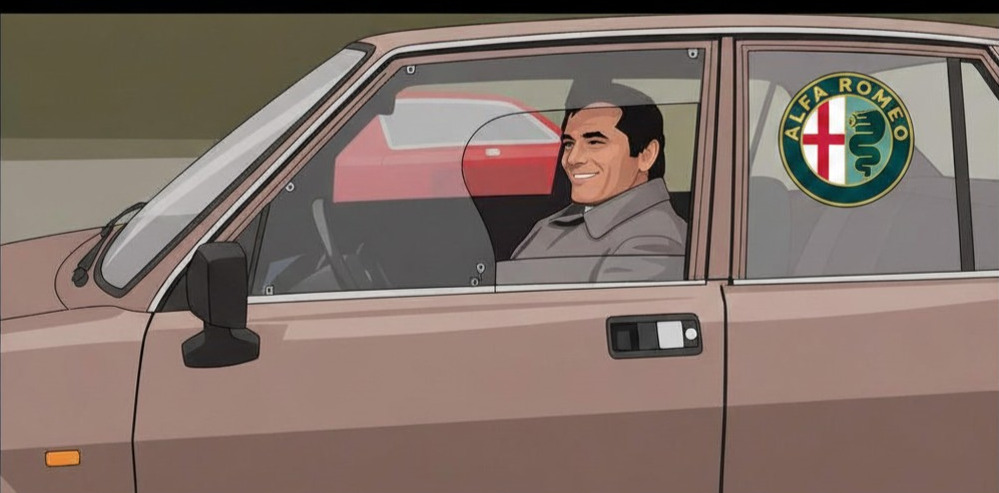
The dark forest brown Alfetta
The first Alfa I remember is an Alfetta in dark forest brown, a shade that would sound almost kitsch today but that in the Seventies and Eighties had its own autumnal dignity, almost earthy. The Alfetta was born in 1972 and represented one of the most daring technical leaps Alfa Romeo had ever made on a mass-production saloon. The House of the Biscione had chosen a transaxle layout, with the gearbox positioned on the rear axle alongside the differential, to achieve a weight distribution close to 50% on each axle. A racing-car solution applied to a bourgeois saloon.
The Style Center, directed by Giuseppe Scarnati, had designed a car with taut, almost angular lines, twin circular headlamps, and a central shield badge that had become the brand’s visual vocabulary. The Alfetta was not a showy car. It was rigorous, almost stubborn in its determination to be itself. And that stylistic consistency spoke to those like my father who looked for more than just a means of transport in a car.
With just under half a million units produced by 1984, the Alfetta had managed to win over an entire generation: private buyers, law enforcement, and professionals. It had become the car of the Carabinieri and the Guardia di Finanza. It had appeared in dozens of Italian films of the Seventies, becoming, in its own way, a pop icon almost despite itself.
The silver metallic 75 and the end of an era
When the Alfa 75 arrived, Dad had no hesitation. It was 1985, May 17, to be precise, and Alfa Romeo was presenting to Prime Minister Bettino Craxi a model bearing the number 75 to celebrate the brand’s seventy-fifth anniversary, founded in Milan in 1910. The 75 was technically the daughter of the Alfetta: same transaxle layout, same weight distribution, independent front suspension with torsion-bar springs, and the refined De Dion rear axle. Designer Ermanno Cressoni had turned the constraint of reusing the Alfetta’s door frame into a wedge-shaped, sharply modern body, making a mature architecture look new.
Dad’s example was silver metallic, and I still remember the quality of the interior, the well-finished fabrics, the front seats that held you well in corners without turning every journey into a fairground ride. Under the bonnet was a twin-cam four-cylinder, the engine Alfa fans knew by heart, refined over the decades until it became almost a sonic signature of the brand.
That 75 was, though we could not have known it then, the last Alfa Romeo built with pure rear-wheel drive before Fiat acquired the brand in 1986. It was the end of something. Today, the sportier versions, the Turbo Evoluzione and the V6 with the Busso 2.5-liter engine, are collector’s items commanding considerable sums on the classic car market, a sign of how deep an impression that generation of cars left.
The moment Dad switched to Lancia
Then came the Fiat era, and Dad started looking elsewhere. He never said so explicitly, but his move to Lancia, first with a Thema and then with a Zeta, was eloquent enough. The Thema was a car with character, built within the Fiat-Saab-Lancia-Alfa alliance, and the Zeta was a Peugeot-derived people-carrier that in the late Nineties had its practical reasons. How many house moves did I make with that car during my university years! But they were different choices; they were not Alfa. They were the pragmatic response of someone who had loved something he could no longer find in the catalog.
The Alfa models of the early Nineties, the 155 and then the 156, were capable cars, but the direct line to the technical tradition of rear-wheel-drive saloons had been broken. For someone who had driven an Alfetta or a 75, there was something unresolved in that transition.
The Mito and the Giulietta: a partial return
In his final years, Dad had looked at the Biscione again with renewed interest, though only as a spectator. The Mito, small and feisty, and above all the Giulietta, launched in 2010 as the successor to the 147, had won over at least some of the brand’s harshest critics. The Giulietta had sweeping lines, sharp engines, and an approach that tried to reclaim driving pleasure as a central value. It was not the 75, but it was once again an Alfa you could love without mental reservations.
Then he passed away, and with him went a certain way of experiencing the car.
The brand today: numbers, turning points, and a few doubts
The automotive market Dad would find today is profoundly different from the one he knew. In 2025, Alfa Romeo closed the year in Italy with 28,300 registrations, up 22.9% from the previous year, establishing itself as the premium brand that grew the most in the country. The main driver was the Junior, the compact B-SUV launched in 2024 that in 2025 alone accounted for 50% of the brand’s total sales. Worldwide, the brand reached 73,000 units sold during the year, with 60,000 orders for the Junior.
The numbers are more complex than they might appear at first glance. In the first five months of 2026, registrations showed signs of slowing across several markets. In Italy, the decline compared to the same period of 2025 is around 20%, with the Junior carrying the range on its own while the Giulia and Stelvio approach the end of their current lifecycle. In the United States, where the Giulia and Stelvio had found a loyal following after 2016, demand fell significantly due to the absence of new models. The next generations of Giulia and Stelvio are not expected before 2027-2028.
The picture is that of a brand that bought itself time with the Junior but now needs to refresh its range to avoid losing momentum. A script already familiar to anyone who has followed the Biscione’s fortunes over recent decades.
The Italian car market in 2026: the hybrid has won (for now)
To understand what Dad would drive today, you need to understand the market he would be navigating. The 2026 data paints a picture of a quiet but profound transformation. In May 2026, hybrid vehicles reached 47.1% of monthly registrations in Italy, split between mild hybrids at 31.1% and full hybrids at 16%. Fully electric cars stopped at 8.8% of the monthly share, while plug-in hybrids reached 10.2%. Pure petrol dropped to 20.4%, and diesel fell below 7%.
The picture shows a country that has chosen a hybrid as its transition solution. For every pure electric car sold, almost six hybrids are purchased, and the gap with the European average remains significant. In the European Union, electric vehicles account for around 20% of new registrations from the start of 2026, while in Italy, the share remains at 8.2%. The charging infrastructure, with over 76,000 public points distributed unevenly across the country, does nothing to close this gap.
Italy’s car parc is still one of the oldest in Europe, with an average age of 13 years and over 41 million cars in circulation. For every new car registered, almost four used ones change hands. A figure that says a great deal about a country where the car is still a durable good to be kept as long as possible, not an object to be renewed every three years.
What would Dad drive in 2026?
It is a question I keep asking myself, and it has no simple answer. My father appreciated cars that drove well, that had a perceptible mechanical soul, that did not try to hide their nature under layers of technology. He loved the sound of an engine the way you love the voice of an honest interlocutor. Two million kilometers do not accumulate by accident: they require an authentic relationship with the machine you are driving.
The Alfa today that comes closest to that profile is the Giulia, particularly in versions with the 200- or 280-horsepower turbocharged four-cylinder petrol engine, mounted on the rear-wheel-drive Giorgio platform. It is a car that purists continue to consider among the best in its segment for its driving dynamics, with a rear end that speaks the same language as the 75, updated by 40 years of technological progress. If he were looking for pure driving pleasure, without compromise, that would be his choice.
But Dad also had a practical side, and he would have looked at the Junior in its hybrid form with curious eyes. A compact, efficient car with a style that references the brand’s visual heritage without turning it into a parody. The electric version, with 156 hp and a WLTP range of 410 kilometers, would have fed his rational side. The irrational one would have kept circling back to the Giulia.
The point I made a few weeks ago, discussing how historic Italian brands survive market pressure, is that a brand’s identity is built over time but can deteriorate quickly. Alfa Romeo has gone through decades in which that identity was called into question. Yet it has retained a loyal core of enthusiasts who continue to see it as something different from the German or French competition. Something more irrational, in the best sense of the word.
The Biscione’s future between electrification and identity
The Alfa Romeo of the next decade will have to answer difficult questions. The European regulation aiming to eliminate emissions from new cars by 2035 is under political pressure from several member states, but the direction of travel is set. As I argued when discussing technological transformation and its impact on work, the industries that best survive moments of discontinuity are those that preserve what makes them recognizable as everything else changes.
For Alfa Romeo, this means finding a way to carry into the electric era the qualities that made the Alfetta and the 75 memorable: the weight balance, the steering response, the physical pleasure of driving. The Junior Veloce with 280 horsepower and all-wheel drive is a first step in that direction. The future Alfetta, a name Stellantis registered as a trademark in 2023 and which could return as a compact saloon from 2027-2028, will be the real test.
The underlying question is one the entire industry is grappling with. The most extreme Italian answer to that dilemma is the Ferrari Luce, the first fully electric Ferrari, unveiled in Rome in late May 2026 with 1,050 hp, four motors, five seats, and a design by Jony Ive that divided the automotive world in an almost tribally partisan way. The day after the reveal, Ferrari’s shares fell 8% and recovered almost entirely in the following days. Montezemolo said he hoped someone would remove the Prancing Horse from that car. CEO Benedetto Vigna replied that he continues to do what he decides, not what others tell him. A car at 550,000 euros, launching with orders already open. The market will decide.
Dad would not have driven a Ferrari Luce, but he would have looked at it for a long time. He probably would have said little, as he always did in the face of things that genuinely struck him. He would have liked it.
That license is in my wallet
I keep carrying it, always immaculate the way he would have wanted. It is not superstition, or at least not only. It is a way of keeping close to someone who spent two million kilometers driving cars he truly loved, and of remembering that the car, beyond market data and CO2 quotas, is still one of the objects through which people build their relationship with the world.
Dad would not have understood self-driving cars. He would have rolled his eyes at the enormous displays replacing physical buttons. He would probably have commented, with a half-smile, on the driver-assistance systems that correct your line without asking permission. But he would also have recognized, perhaps with some surprise, that certain cars today still know how to move you.
That rear-wheel-drive Giulia singing through a corner would have won him over. I am almost certain of it. This article, as well as to my dad, is dedicated to my friend Paul, who loves Alfa Romeos and has become irreplaceable in my life.
Related resources
- Alfa Romeo’s new hint at the Alfetta – ItalPassion
- Alfa Romeo Alfetta – Wikipedia
- Alfa Romeo 75: history and models – Motor1
- Alfa Romeo 75 – Stellantis Heritage
- Alfa Romeo: all models and full history – 4 Ruote
- In 2025, Alfa Romeo is Italy’s fastest-growing premium brand – Stellantis Media.
- Alfa Romeo Junior is no longer enough to save the brand – ItalPassion
- Alfa Romeo: new Giulia and Stelvio in 2028 – alVolante
- Italian car market May 2026: +7.6%, EVs at 8.8% share – HDmotori
- Hybrids reach 60.9% of car sales in Italy in 2026 – Quotidiano Motori
- Electric cars in Italy: +75% in the first 5 months of 2026 – Smartworld
- Italian car market: 2026 forecasts – Motor1
