
AI is coming for your washing machine repair too
There’s a common narrative around AI and the job market: white-collar, low-specialization cognitive work is on the chopping block. Think data entry, basic customer support, paralegal grunt work, junior copywriting. The argument goes that manual and artisan jobs are safer because they require physical presence, dexterity, and on-the-spot judgment that no chatbot can replicate.
I used to believe that, too. Then my washing machine broke.
The machine that stopped spinning
Our washing machine is 14 years old. One day, it just gave up mid-cycle, leaving a drum full of soaking laundry and flashing an error code. My first instinct was to replace it. It had a good run. My boyfriend disagreed.
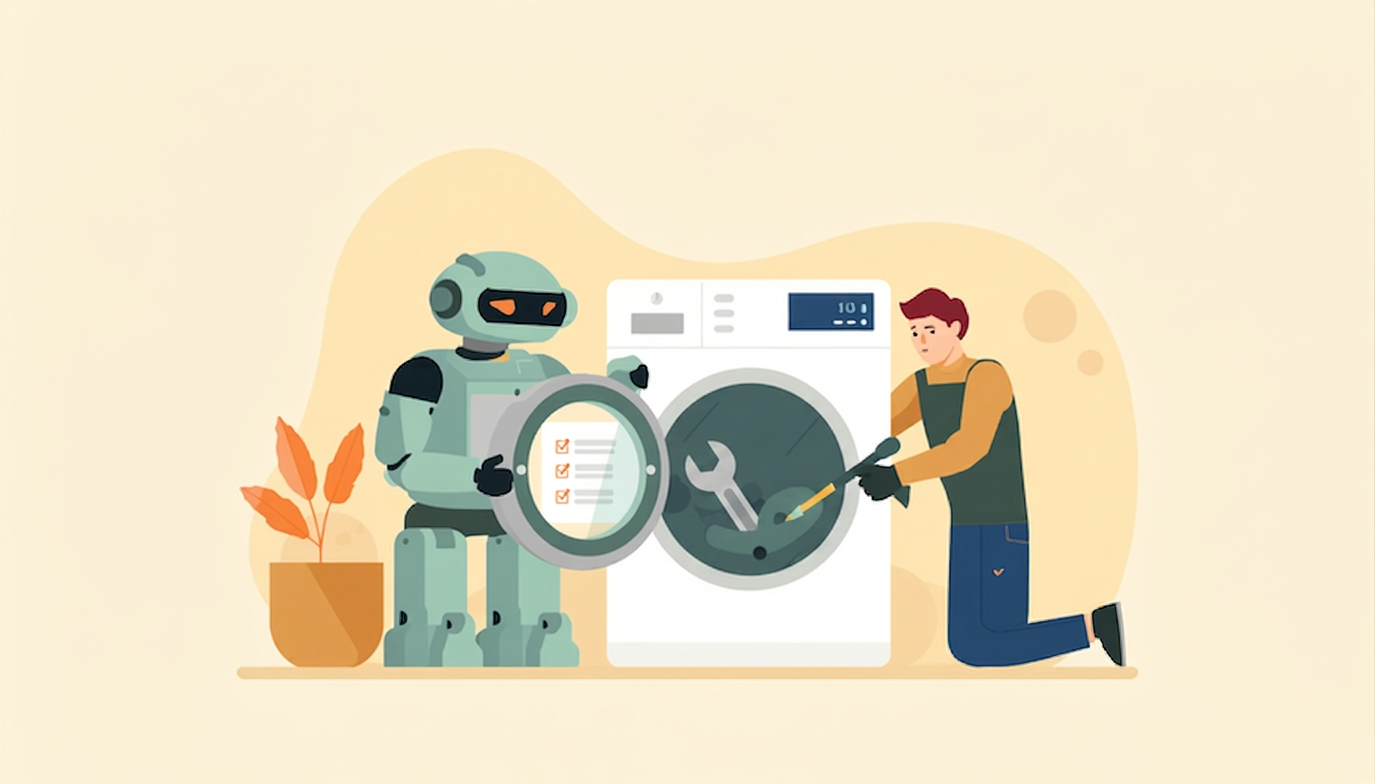
He opened ChatGPT and described the problem. What followed was surprisingly methodical. The bot put together a step-by-step diagnostic checklist, starting with the most likely culprits: electrical connections, wiring, and power supply. We ruled those out one by one. Then it moved on to individual components, providing specific instructions for testing each one.
After a fair bit of back-and-forth testing, ChatGPT pointed to a likely cause: worn-out carbon brushes on the motor. We had never heard of those. Apparently, washing machine motors have small carbon sticks that make contact with the rotor and wear down over time. After 14 years, ours were basically dust.
From diagnosis to spare parts
The bot didn’t stop at identifying the problem. It told us what to look for, what questions to ask at the spare parts store to check for compatibility, and roughly what to expect to pay. My boyfriend found them for 30 euros. A quick trip to a local shop, and we were back home, ready to operate.
ChatGPT then walked him through the disassembly process step by step: which panels to remove, in what order, what to watch out for, and how to keep track of screws and connectors. He’s handy, but this was genuinely new territory.
The twist (because of course there was one)
He did everything right. Reassembled the machine, turned it on… same error. Same flashing code. Same dead drum.
A lesser person would have called a technician at that point. Instead, he went back to ChatGPT and described what happened. The bot ran through two possibilities: either the replacement brushes weren’t fully compatible, or the left and right ones had been swapped. Brushes are directional, apparently. Who knew.
So he took the whole thing apart again, swapped the brushes, reassembled everything, and turned it on. The drum spun. The machine worked. It still works.
What this actually cost
A technician callout in our area starts at around 80 euros before they’ve even touched anything. Add labor, plus spare parts that would likely need to be ordered separately and marked up, and you’re easily looking at 300 euros or more. A new washing machine of equivalent size and capacity would have run us around 400 euros. We spent 30. And an afternoon.
I was fully ready to buy a new one. ChatGPT and a patient boyfriend saved us somewhere between 270 and 370 euros, and kept a perfectly functional appliance out of a landfill.
So what does this mean for skilled trades?
This is where I want to be careful, because I’m not saying AI is about to replace electricians, plumbers, or appliance repair technicians. Manual work still requires physical presence, real tools, and the kind of judgment that only comes from doing something hundreds of times. There are also plenty of situations where getting it wrong is dangerous, and no chatbot should be your safety net in those cases. As the Pope put it in a rather striking way, what AI cannot replace is judgment, and that is exactly what we should never delegate to a machine.
But what’s changed is the knowledge gap. Traditionally, the reason you called a technician wasn’t just because they could do the job. It was because you had no idea where even to start. That information asymmetry is what made skilled trades economically valuable, and it’s partly what AI is eroding.
The bot couldn’t disassemble my washing machine. But it knew what the error code likely meant, what to check, in what order, and what to buy. It compressed hours of forum-diving and guesswork into a structured process a non-expert could follow.
A note of caution before you go rogue with a screwdriver
None of this is a call to DIY everything. If something involves gas, high-voltage electricity, or structural integrity, please call a professional. AI can give you overconfident instructions on things it doesn’t fully understand, and there’s no substitute for someone who has done a job a thousand times and knows the edge cases. If you use AI regularly, you’ve probably already run into some of these frustrating quirks firsthand.
The sweet spot is narrower than the hype suggests: problems that are mechanical rather than dangerous, where the main barrier is knowing where to start, and where you have the patience to follow instructions carefully, backtrack when something doesn’t work, and recognize when you’re out of your depth.
My boyfriend had all three. Most people, given the right problem and a bit of time, could probably do so too.
The broader picture
What happened in our house that afternoon is a small version of something larger. AI isn’t just threatening spreadsheet jockeys and junior analysts. It’s starting to close the knowledge gap that has historically protected skilled manual work, not by doing the physical work itself, but by giving anyone with patience and a bit of dexterity access to the diagnostic reasoning that used to cost 80 euros before a single bolt was turned.
That’s a different kind of disruption than the one most people are talking about. And it’s already happening, one broken washing machine at a time. As I’ve written before, the real work starts where AI stops — and knowing where that line is makes all the difference.
Related sources
- Acemoglu, D. (2024). “Automation and the future of work: A review of the literature.” Journal of Economic Perspectives.
- Autor, D., Levy, F., & Murnane, R. J. (2003). “The skill content of recent technological change: An empirical exploration.” The Quarterly Journal of Economics, 118(4), 1279–1333.
- Brynjolfsson, E., & McAfee, A. (2014). The Second Machine Age: Work, Progress, and Prosperity in a Time of Brilliant Technologies. W. W. Norton & Company.
- Frey, C. B., & Osborne, M. A. (2017). “The future of employment: How susceptible are jobs to computerization?” Technological Forecasting and Social Change, 114, 254–280.
- Goldman Sachs. (2023). “The Potentially Large Effects of Artificial Intelligence on Economic Growth.” Global Economics Analyst report.
- OECD. (2023). OECD Employment Outlook 2023: Artificial Intelligence and the Labour Market. OECD Publishing.
- World Economic Forum. (2023). The Future of Jobs Report 2023. World Economic Forum.
