
Magnifica Humanitas: what the Pope said about AI, and why it matters
On May 25, 2026, Pope Leo XIV published his first encyclical, Magnifica Humanitas, and the choice of date was anything but accidental. The document landed on the 135th anniversary of Rerum Novarum, the landmark 1891 text in which Leo XIII grappled with the social upheaval brought on by industrial capitalism. The parallel is deliberate and telling. Just as Leo XIII looked at factories, poverty, and the erosion of human dignity in an age of mechanization, Leo XIV is looking at algorithms, data monopolies, and the slow transfer of human decision-making to machines. The message connecting them across more than a century is essentially the same: when transformative technology concentrates power in a few hands and weakens the social fabric, the Church has both the right and the duty to say so.
The encyclical runs to around 245 numbered paragraphs across five chapters, clocking in at roughly 38,000 words. It was presented with unusual ceremony in the new synodal hall at the Vatican, flanked by three cardinals, two theologians, and, in a detail that generated plenty of commentary, the co-founder of Anthropic, the AI company behind Claude. Whatever one makes of that staging, it was a deliberate signal: this document was written to be heard beyond the walls of the Church.
What Leo XIV actually argues
The encyclical opens with a premise that sets the tone for everything that follows: technology is never neutral. AI, Leo writes, takes on the characteristics of those who devise it, finance it, regulate it, and use it. That might sound obvious, but it runs counter to a dominant narrative in Silicon Valley and among some policymakers, who tend to frame AI as a blank tool whose moral value depends entirely on how it is applied. Leo XIV is saying something more uncomfortable: the systems themselves carry the fingerprints of the power structures that built them.
From there, the document moves into theologically grounded territory, written to speak to anyone paying attention. The Pope warns against what he calls an “armed” logic driving AI development, meaning the geopolitical and commercial competition that pushes states and corporations to develop AI faster than they can govern it. The word he uses to describe the necessary corrective is “disarmament,” and he is careful to clarify what he means: “To disarm does not mean rejecting technology, but preventing it from dominating humanity.”
The word “common good” appears in the text more often than the words “artificial intelligence,” “church,” or “religion.” That is a useful metric. The encyclical is structured around the principles of Catholic social doctrine, including the common good, the universal destination of goods, subsidiarity, solidarity, and social justice, but deployed here as a framework for thinking about something very new. Chapter three, which most commentators have identified as the core of the document, focuses on what happens when AI is used to surveil, profile, exclude, and decide in place of human beings. Chapter four turns to the specific dangers posed to truth, democracy, labor, education, and freedom. Chapter five addresses war and the transformation of conflict by digital technologies, calling for AI systems to remain subject to human judgment over life and death.
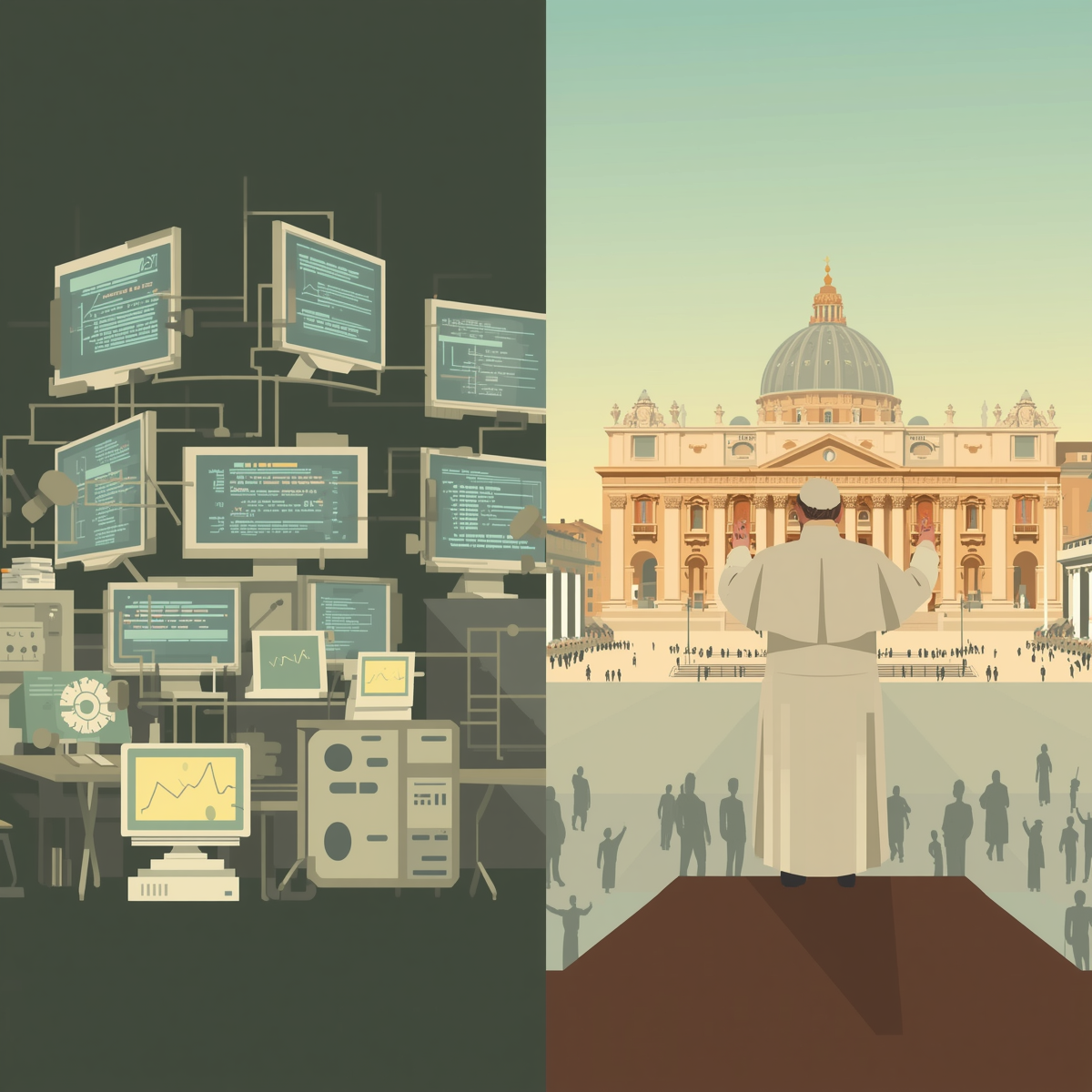
The most striking image in the encyclical is the opposition between Babel and Jerusalem. Leo XIV invokes the two cities as a choice facing humanity right now: we can build a system of concentrated, dehumanizing power that excludes most of the world from its benefits, or we can build something more like Nehemiah’s Jerusalem, rebuilt from within by a community committed to one another and to a shared future. It is an ancient image applied to a very contemporary problem, and it lands harder than a regulatory white paper ever could.
How the world reacted
The encyclical generated an enormous volume of commentary almost immediately, and the diversity of reactions was itself revealing. The New York Times called the document “disappointingly mild,” implying that Leo XIV had pulled his punches on institutional and economic reform. Forbes went in the opposite direction entirely, reading the encyclical in near-apocalyptic terms, leading with the Tower of Babel warning and the specter of “moral, social collapse.” The Guardian framed it sympathetically as “a humanity-first message the secular world can get behind,” emphasizing democratic accountability over theological concerns. Le Monde took a recognizably European communitarian line, presenting the Pope as someone who “does not simply proclaim that another world is possible, but calls on us to build that other world.”
Perhaps the most perceptive secular reading came from TechCrunch, which argued that “AI is the hook, the problems Leo focuses on are older and more pervasive.” That is probably the most honest summary of what the document is actually doing: using artificial intelligence as the occasion for a much older argument about labor, alienation, power, and the moral consequences of organizing society around efficiency rather than human dignity.
On the political side, Vice President JD Vance chose a commencement address at the US Air Force Academy to endorse Leo XIV’s concerns about autonomous weapons, stating that “humans and not machines must make decisions over life and death.” The endorsement was carefully framed: Vance took the piece he could agree with and bracketed the rest.
In UnHerd, Sohrab Ahmari read the encyclical as a defense of what he called “unfashionable universalism,” arguing that Leo XIV rejects both the flattening universalism of technocracy and the tribal fragmentation increasingly characteristic of democratic politics. Against both tendencies, he proposes a universal account of human dignity grounded in intrinsic moral worth rather than in productivity, identity, or consumption.
There was also an ironic subplot. Shortly after publication, several commentators raised the possibility that AI had been used to help write the very document warning against it. The Vatican did not comment directly, but the suspicion alone was enough to generate a minor media cycle that, under the circumstances, felt entirely appropriate.
Italy: politics and the Pope
In Italy, the encyclical landed in a context already charged with Vatican-related tension. Earlier this year, Donald Trump had publicly attacked Pope Leo XIV, even sharing an AI-generated image of himself depicted as a Christ-like figure, which put Giorgia Meloni’s government in an awkward position: she had been one of the closest European leaders to Trump, but the Pope commands a different kind of loyalty in Italian politics. The Meloni government moved to publicly back the Vatican following Trump’s provocations, without offering a detailed position on the encyclical’s contents.
The center-left, by contrast, moved quickly and strategically. Elly Schlein, leader of the Democratic Party, described Magnifica Humanitas as “a powerful message” and embraced Leo XIV’s warnings about technological power concentrating in a few hands, arguing that unregulated AI risks producing “new dependencies, exclusions, manipulation and inequalities.” Nicola Zingaretti, leading the PD’s delegation in the European Parliament, warned of a future governed by “digital oligarchies.” Sandro Ruotolo, the party’s information policy figure and an MEP, drew explicit links between Big Tech concentration and the deregulatory politics of the Trump era, calling for stronger European digital sovereignty. Senators Lorenzo Basso and Antonio Nicita, who had already introduced a bill on algorithm regulation, argued that the encyclical provided direct political support for stronger safeguards against algorithmic profiling, disinformation, and workplace surveillance.
The political calculus here is not hard to read. For years, Italian and European center-left parties have struggled to articulate a coherent language around AI that balances innovation, social protection, and democratic oversight without appearing either Luddite or naive. Leo XIV’s encyclical offers something they have been searching for: a moral vocabulary that connects labor, inequality, technological concentration, war, and democracy within a single framework, and that carries the weight of an institution with two thousand years of institutional credibility behind it. There is also, as analysts at Decode39 have pointed out, an electoral dimension: Catholic voters remain a decisive constituency in Italian politics, and an encyclical framing AI governance as a matter of human dignity is a useful bridge.
My take: judgment is the one thing you cannot automate
I have written elsewhere about my own struggles with AI, and reading Magnifica Humanitas felt, in many ways, like an unusually well-argued version of the unease I have been carrying around for a while. My view on AI is fairly simple: it is a powerful tool, and, like every powerful tool in history, it can be used to advance humanity and the general good, or to wage new forms of war against one another. That duality is not a reason to fear it, but it is a very good reason to think carefully about who controls it and for what purposes, which is more or less what Leo XIV is saying across 38,000 words.
What I observe in practice is that AI is rapidly replacing and enhancing capabilities that, until a few years ago, were exclusively human: writing, coding, image-making, legal research, medical diagnosis, and financial modeling. The list grows every month. Most of that is genuinely useful, and I have no interest in pretending otherwise. But there is one thing I do not believe AI can replace: judgment. The capacity to weigh incommensurable values, to sit with moral uncertainty, to understand that a technically optimal decision can still be a deeply wrong one, and to remain accountable for the consequences: these are not functions you can delegate to a model, however sophisticated. They are, in fact, the core of what political and civic leadership is supposed to mean.
That is why I find it troubling, not just philosophically but practically, when I see the conversation drift towards AI as a tool for governing decisions that directly affect people’s lives: who gets healthcare, who gets credit, who gets flagged by a border system, who gets parole. These decisions require judgment, and judgment requires accountability. A machine has neither. Anyone who argues otherwise is either confused about what AI actually does or is looking for a way to make consequential decisions without being answerable for them, which is a much more dangerous thing.
The broader point follows naturally from this: if judgment is the quality that matters most in an AI-saturated world, then the criteria we use to select political leaders become more important, not less. I would argue that we are not doing particularly well on that front right now. Leo XIV’s language about the “culture of power” resonates because it describes something visible and real: the drift towards leaders who are loud rather than thoughtful, fast rather than careful, and more interested in the performance of strength than in the quiet, difficult work of governing well.
So, a high five to Leo XIV from me. I hope Magnifica Humanitas is read as widely outside the Church as within it, and I hope it helps shift the terms of a conversation that has been dominated for too long by those who stand to profit most from the outcome. The goal of technology, like the goal of politics, should be to develop the world rather than to impoverish it. We still have a choice about which direction we go.
Related sources
- Leo XIV. (2026, May 15). Magnifica Humanitas: On Safeguarding the Human Person in the Time of Artificial Intelligence. Vatican. https://www.vatican.va/content/leo-xiv/en/encyclicals/documents/20260515-magnifica-humanitas.html
- Vatican News. (2026, May 25). “Pope Leo’s ‘Magnifica Humanitas’: AI must serve humanity, not concentrate power.” https://www.vaticannews.va/en/pope/news/2026-05/pope-leo-xiv-encyclical-magnifica-humanitas-ai.html
- National Catholic Reporter. (2026, May 25). “Pope Leo calls to ‘disarm’ AI in major document, warns of technological threats to humanity.” https://www.ncronline.org/vatican/vatican-news/pope-leo-calls-disarm-ai-major-document-warns-technologic-threats-humanity
- Time. (2026, May 25). “Pope Leo Uses First Major Papal Text to Warn About AI.” https://time.com/article/2026/05/25/pope-leo-encyclical-ai-magnifica-humanitas/
- Cusack, A. (2026, May 27). “Reactions to Magnifica Humanitas reveal anxieties of the AI age.” The Catholic Herald. https://thecatholicherald.com/article/reactions-to-magnifica-humanitas-reveal-anxieties-of-the-ai-age
- Decode39. (2026, May 25). “How Italy’s Democratic Party is using Pope Leo’s AI encyclical.” https://decode39.com/14963/how-italys-center-left-is-using-pope-leos-ai-encyclical/
- Ascension Press. (2026). “A Complete Guide to Pope Leo’s First Encyclical: Magnifica Humanitas.” https://ascensionpress.com/blogs/articles/a-complete-guide-to-pope-leo-s-encyclical-magnificent-humanitas
- OSV News. (2026, May 25). “Magnifica Humanitas: Pope Leo’s AI encyclical warns of temptation to build future excluding God.” https://www.osvnews.com/magnifica-humanitas-pope-leos-ai-encyclical-warns-of-temptation-to-build-future-excluding-god/
- PBS NewsHour. (2026). “Pope calls for robust regulation of AI in manifesto that ponders the future of humanity.” https://www.pbs.org/newshour/world/pope-calls-for-robust-regulation-of-ai-in-manifesto-that-ponders-the-future-of-humanity
- Bonifazi, C. (2025). “https://www.contentbenefit.com/5-struggles-when-using-ai/.”
