
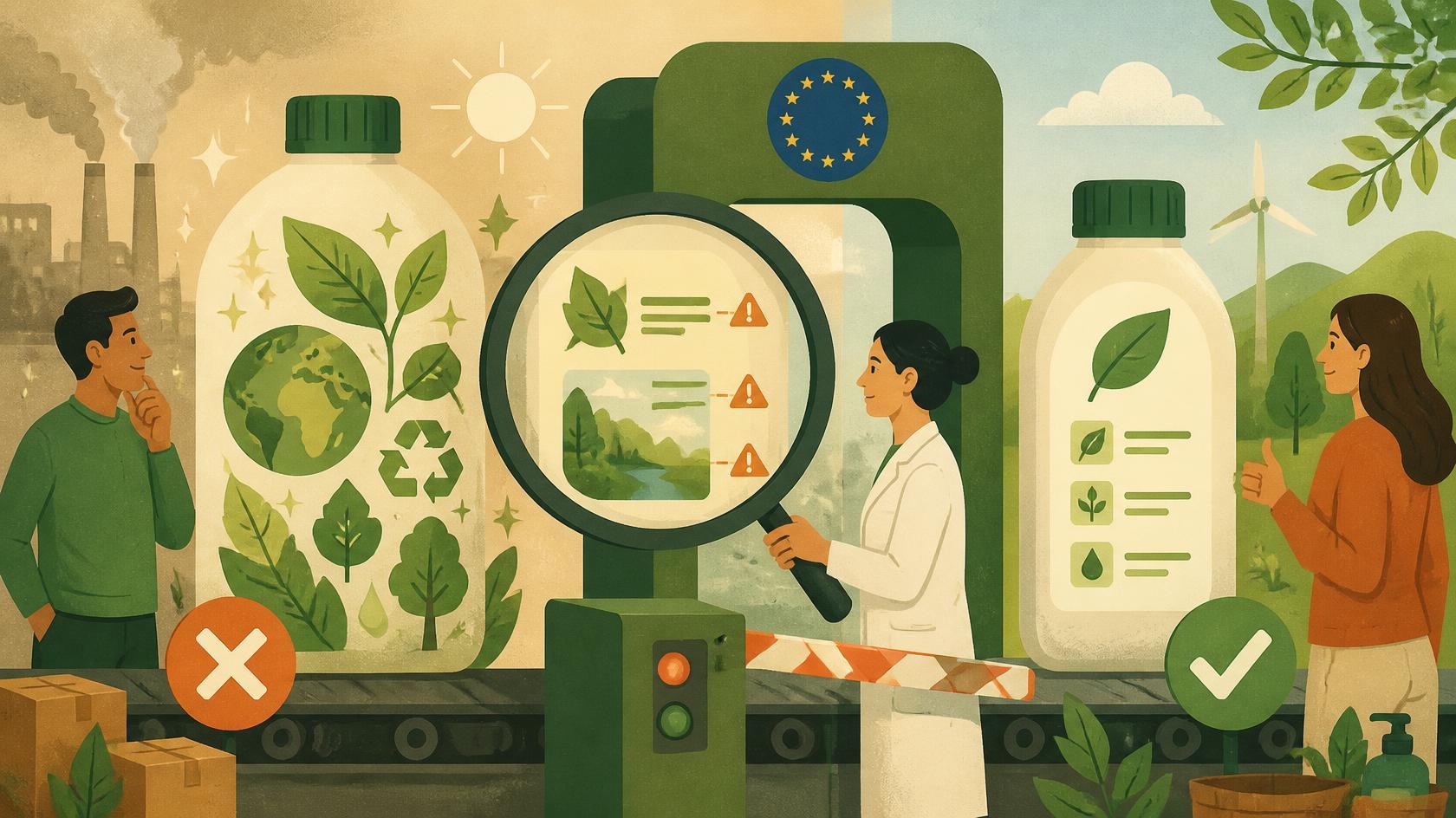
Greenwashing: what the new EU rules ban from September 27
As of September 27, 2026, greenwashing is no longer a gray area of marketing. In Italy, the rules of Legislative Decree 30 of February 20, 2026 now fully apply. The decree transposes EU Directive 2024/825 and adds a simple principle to the Consumer Code: every environmental promise must rest on concrete, verifiable evidence.
The decree defines greenwashing as commercial practices likely to mislead consumers about the environmental and sustainability features of a product. In practice, words such as “green,” “eco,” “environmentally friendly” or “nature friendly” can no longer stand alone on labels, websites and campaigns, unless the company proves excellent and relevant environmental performance.
Climate neutrality, labels and half-recycled products
Beyond vague adjectives, the law targets three widespread habits. The first concerns brands that claim a zero or reduced climate impact based solely on buying carbon credits: offsetting alone is no longer enough to back that promise. The second involves sustainability labels, which can’t be self-awarded and must rely on independent, third-party certification schemes. The third hits claims stretched to a whole product when they apply to a small part of it, like a bottle sold as recycled because its cap is.
Durability, repairability and warranty information must also be communicated transparently. Fittingly, the directive itself speaks of “empowering consumers for the green transition.”
Fines up to €10 million and the role of the antitrust authority
Enforcement falls to the Italian Competition Authority (AGCM), which can block campaigns, order companies to publish its rulings and impose fines from €5,000 up to €10 million. For violations with an EU-wide dimension, penalties can reach 4% of annual turnover.
The numbers explain such strictness. Back in 2020, a European Commission study found that 53.3% of the environmental claims examined were vague, misleading or unfounded, and 40% had no supporting evidence at all. In half of the cases it wasn’t even clear whether the promise covered the whole product or a single component.
Greenwashing cases sanctioned in Italy
The AGCM didn’t wait until September to act. Here are some of the best-known proceedings of recent years.
Eni and “green” diesel
Eni was fined €5 million over its campaign for Diesel+, marketed as a “green” fuel that helped take care of the environment. In 2021 the Lazio Regional Administrative Court rejected the company’s appeal, ruling that a motor diesel can’t be considered green. The most ironic detail: its “renewable” component contained a high share of palm oil, linked to deforestation. More on that shortly.
GLS and “zero-emission” deliveries
In January 2025, several companies of the GLS group received a combined €8 million fine over the Climate Protect project. Under scrutiny were statements such as “100% green energy in our facilities” and “zero-emission delivery vehicles,” along with some confusion between offsetting emissions and actually reducing them.
Shein and circular fashion
In August 2025 it was Shein’s turn: €1 million for the environmental claims published on its Italian website. The evoluSHEIN line was described as sustainable and fully recyclable, while “green” garments made up a tiny fraction of the catalog. Its emission-reduction pledges, judged generic, were also contradicted by a real rise in emissions between 2023 and 2024.
A fine isn’t always needed: with XEV YOYO and Microlino, two electric microcars, the authority’s moral suasion was enough to remove claims like “100% sustainable” and “zero emissions.”
Palm oil, the case I remember best
For me, though, the most telling example of greenwashing remains the wave of “palm oil free” products. Starting in 2014, after a press campaign, the Italian food industry raced to remove it. Until 2015 Mulino Bianco used it in about 90% of its products; then Barilla, which holds 43% of the Italian cookie market, replaced it mostly with sunflower oil. Coop removed it from over 200 store-brand products. Within a few years the “palm oil free” label appeared on almost every package, with a halo of virtue that went well beyond health.
Too bad the environmental problem simply moved elsewhere. According to a 2018 IUCN report, oil palm produces 35% of the world’s vegetable oil on less than 10% of the land devoted to oil crops, while alternatives need up to nine times as much land. Giving it up, the experts concluded, would likely displace biodiversity loss rather than halt it.
Coconut, chosen by many spreads, doesn’t fare better. A study published in Current Biology in 2020 estimated about 20 threatened species per million tons of coconut oil produced, compared with 3.8 for palm, 4.1 for olive and 1.3 for soy. The figures have been challenged, and the authors themselves clarified that they didn’t mean to paint coconut as worse than palm, yet the lesson holds: dropping an ingredient that has become unpopular doesn’t automatically make a product more sustainable.
Patagonia, the virtuous example
At the opposite end sits a brand quoted in every course on responsible communication. On Black Friday 2011, Patagonia bought a page in The New York Times to print “Don’t buy this jacket,” urging readers not to purchase what they didn’t need and to repair or resell used gear.
In September 2022, founder Yvon Chouinard went further: he transferred 98% of the company’s stock to the Holdfast Collective, a nonprofit that channels profits into fighting the climate crisis, and the remaining 2%, which carries voting rights, to the Patagonia Purpose Trust. A company valued at around $3 billion thus chose the planet as its only shareholder. Patagonia doesn’t claim to have zero impact, and perhaps that’s exactly why it sounds credible: it tells what it does and proves it with choices that cost money.
What changes for companies and consumers
For anyone working in communication, the new rules feel almost liberating. Instead of green superlatives slapped on packaging, brands now need data, certifications and clear boundaries: which part of the product, which stage of its life cycle, verified by whom. It’s the same path already seen with dark patterns turning into a legal risk: when an unfair practice starts to cost, language gets honest fast.
Shoppers, on the other hand, can still use a pinch of skepticism. Better alternatives do exist, from the cellulose fiber bottle to greener grocery choices, but they deserve a careful read. Not least because large corporations don’t easily give up their margins, as the lawsuits Big Food has filed against governments show.
The road to sustainability is still long and bumpy, but I’m committed to doing my part.
Related sources
- Greenwashing, scatta la stretta UE: cosa cambia per prodotti e aziende, Soldionline, September 26, 2026
- Directive (EU) 2024/825 on empowering consumers for the green transition, EUR-Lex
- Fast fashion e greenwashing: da settembre multe fino a 10 milioni per chi usa slogan “green” ingannevoli, greenMe, May 8, 2026
- Legislative Decree no. 30/2026 against greenwashing: objectives, obligations and sanctions for companies, Up2You, April 2026
- Greenwashing: le recenti decisioni dell’Agcm, Osborne Clarke, March 13, 2025
- Multa da 1 milione per Shein. L’Antitrust la accusa di greenwashing, Money.it, August 4, 2025
- Greenwashing: confermata multa di 5 milioni all’Eni, il diesel “green” è pubblicità ingannevole, greenMe, November 9, 2021
- No more ‘bee-friendly juice’ or ‘carbon neutral bananas’? Commission proposes ban on misleading environmental claims, FoodNavigator, March 24, 2023
- Olio di palma: biscotti e merendine “senza” hanno meno grassi saturi, Il Fatto Alimentare, March 29, 2019
- L’olio di palma è in via d’estinzione, Il Fatto Alimentare, June 12, 2017
- Saying “no” to palm oil would likely displace, not halt biodiversity loss, IUCN, June 26, 2018
- Coconut confusion reveals consumer conundrum, University of Exeter, July 6, 2020
- Does coconut oil really threaten more species than palm oil? No, it doesn’t, Mongabay, July 2020
- Profit for the planet: six months on from Patagonia’s radical restructuring, University of Manchester, April 17, 2023
