
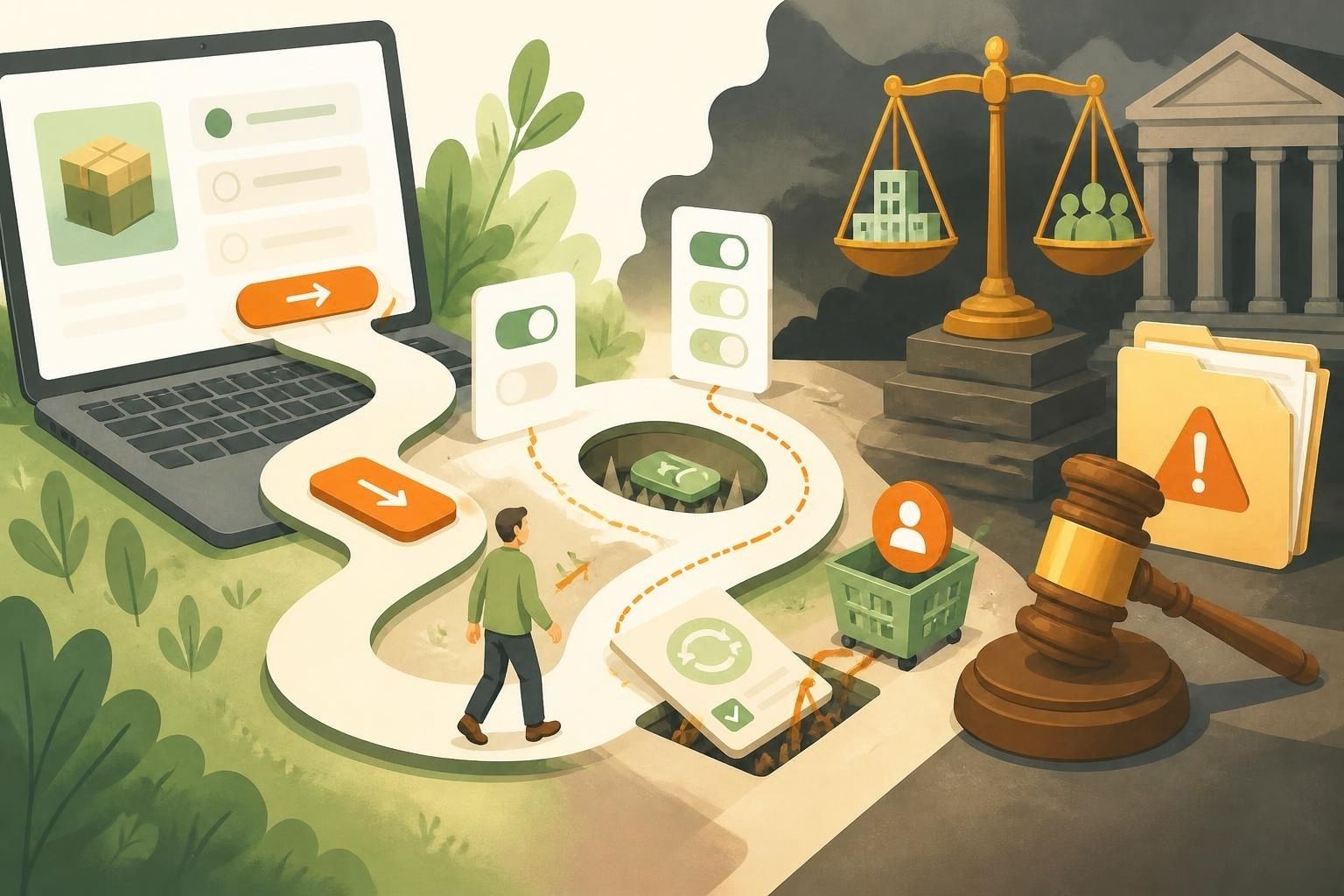
Dark patterns in sign-ups, cancellations and checkout: from bad practice to violation
Dark patterns are interfaces designed to push people into doing what they wouldn’t otherwise choose. For years they stayed conference material: people named them with outrage, quoted Harry Brignull’s catalog, then went back to optimizing conversions. In 2026 the picture is different. Authorities have started issuing fines, and European regulations mention these tricks explicitly. So anyone designing a subscription flow now works inside a legal perimeter, whether they chose it or not.
Amazon Music Unlimited activated from Echo by accident
I’ll start at home. More than once my niece, playing with the Echo, signed me up for Amazon Music Unlimited without realizing it. The detail that annoys me most is that I had disabled purchasing through Alexa: I thought I’d locked the door, yet the subscription went through anyway. The first time I blamed myself; by the second, I’d begun eyeing the voice assistant with some suspicion.
Beyond the few euros involved, I’m left feeling that the company counts on the distraction of whoever is using the device. In voice interfaces, consent shrinks to a word spoken on the fly, possibly by someone other than the account holder. That’s how an unfair practice erodes the reputation of a brand that, on everything else, has earned my trust.
The Amazon Prime case: $2.5 billion and a Homeric cancellation
In the United States, Amazon has already paid the bill. On September 25, 2025, the Federal Trade Commission closed its case over Prime enrollments with a $2.5 billion settlement: a $1 billion civil penalty, the largest ever obtained for violating an FTC rule, plus $1.5 billion in refunds for about 35 million consumers. The complaint, based on the Restore Online Shoppers’ Confidence Act (ROSCA), targeted confusing interfaces that enrolled people without their knowledge and an exit path built to discourage leaving: 4 pages, 6 clicks and 15 options. Amazon itself had internally compared it to the Iliad.
The obligations in the settlement amount to a design spec:
- a clear, conspicuous button to decline Prime, with no guilt-tripping wording like “No, I don’t want Free Shipping”;
- cost, date and frequency of charges, automatic renewal and how to cancel, all stated during enrollment;
- easy cancellation, through the same channel used to sign up;
- an independent supervisor, paid by Amazon, to oversee the distribution of refunds.
Amazon maintains it has always followed the law, but in the meantime it has had to redesign the flow.
In the US the click-to-cancel rule fell, enforcement didn’t
In July 2025 a federal appeals court struck down the FTC’s click-to-cancel rule on procedural grounds. The agency reopened comment in March 2026, while ROSCA-based enforcement continues, and several states, including California, Colorado, Minnesota and New York, have tightened their own auto-renewal laws. The general rule is gone, but the principle that quitting must be as simple as joining still stands.
In Europe: the DSA, the withdrawal button and the Digital Fairness Act
On the European side there are three tools.
The Digital Services Act. Article 25 bars online platforms from interfaces that deceive or manipulate users, or that impair their ability to decide freely. On December 5, 2025, the Commission issued its first non-compliance decision under the DSA: €120 million against X, partly for the deceptive design of the blue checkmark, which could be bought with no real identity verification.
The withdrawal button. Since June 19, 2026, Directive (EU) 2023/2673 has applied, adding Article 11a to the Consumer Rights Directive. Online sellers must offer, for the entire withdrawal period, a clearly visible function with an unambiguous label such as “withdraw from contract here”. A second confirmation step follows, then a receipt on a durable medium, such as an email, with date and time. No obstacles are allowed: no app to download (unless the contract was concluded there) and no fresh identification for users who are already logged in.
The Digital Fairness Act. The Commission has included it in its 2026 work program, with a proposal expected by the last quarter. It will address dark patterns, addictive design and personalization that exploits vulnerabilities. The fitness check that preceded it listed the difficulty of canceling or renewing digital subscriptions among the main problems.
In Italy the antitrust authority has already fined fake countdowns and hidden subscriptions
Italy’s Competition and Market Authority (AGCM) didn’t wait for Brussels. eDreams was hit with €9 million in fines. Six million concern the practices used to push customers toward Prime: fake deadlines and availability limits, misleadingly presented savings, the most expensive plan preselected and the full annual fee charged to people who didn’t qualify for the free trial. The other three million penalize the obstacles placed in front of withdrawal, including through customer service.
In June 2026 another penalty followed, €2 million against a home furnishings e-commerce site: a timer for “limited-time” discounts that renewed unchanged when they expired, a stock counter that fueled a sense of scarcity, and opaque strikethrough prices. The AGCM classified it under Article 23(1)(g) of the Italian Consumer Code, the list of practices deemed misleading in all circumstances. Sanctions can reach €10 million, or 4% of annual turnover for widespread infringements.
The ground these decisions cover is wide: back in 2022, a Commission study found at least one dark pattern on 97% of the most popular websites and apps in the EU.
What designers need to change in critical flows
Here’s a checklist, flow by flow, to bring to the next product review.
Sign-up. Declining must carry the same visual weight as accepting: same size, same contrast, same place in the hierarchy. Labels should describe the action (“Continue without subscribing”) rather than shame whoever opts out. It’s a job for UX writers as much as for designers.
Price and renewal. Cost, first charge date, frequency, automatic renewal and how to cancel must appear before payment details are requested, not in a footnote.
Free trials. Users need a heads-up before a trial turns paid, and the priciest plan should never be preselected. Anyone not eligible for the trial must know before confirming.
Cancellation. It must be possible through the same channel as sign-up: if subscribing takes one click, it can’t require a phone call. At most one retention offer, clearly skippable, and no maze of pages.
Withdrawal. A dedicated, easy-to-spot button is needed, reachable for guest purchases too, with the two-step confirmation the directive requires and an automatic receipt.
Urgency and scarcity. Timers and availability counters are allowed only if they match reality. A countdown that restarts from zero is exactly what the AGCM sanctioned.
Voice and shared accounts. Here I come back to my Echo. Every recurring charge started by voice should require explicit confirmation, such as a PIN or a notification in the account holder’s app. And settings chosen by whoever pays, like a purchase block, must apply to any spending, subscriptions included.
Metrics and documentation. Alongside conversion rates, it pays to track refunds, complaints and cancellations within the first thirty days, early indicators of coerced sign-ups. It’s also worth keeping records of design decisions and A/B tests: if challenged, showing an intent to be transparent matters.
On these topics, design and legal need to work together from the wireframe stage, not after launch. The principle is the same one I described when writing about the design of silence: a respectful interface lowers pressure instead of adding to it.
Trust and reputation are worth more than a subscription wrung out of someone
Anyone working on conversions knows how tempting that extra percentage point gained by hiding the “no” can be. Today, though, that point has a price measured in fines, refunds and redesigns imposed by a court. It also has a less visible one, which I know well: the trust of people who discover a charge they never wanted. After the third subscription my niece activated by mistake, I stopped seeing it as an oversight and started seeing it as a design choice. That’s the moment a brand loses credibility, well before any regulator steps in.
Those working on customization or AI companion apps would do well to take note: the Digital Fairness Act is aiming right there, and personalizing too much could become the next front.
Related sources
- FTC Secures Historic $2.5 Billion Settlement Against Amazon, Federal Trade Commission, September 25, 2025
- Amazon pays $2.5B settlement over deceptive Prime subscriptions, Malwarebytes, 2025
- FTC restarts negative option rulemaking after Eighth Circuit vacatur; enforcement under ROSCA continues, Gibson Dunn, 2026
- Regulation (EU) 2022/2065, Digital Services Act, EUR-Lex
- Commission fines X €120 million under the Digital Services Act, European Commission, December 5, 2025
- Directive (EU) 2023/2673, EUR-Lex
- EU consumer protection law update: new mandatory withdrawal button, Hogan Lovells, May 2026
- Digital Fairness Act, Legislative Train Schedule, European Parliament
- Italy: AGCM EUR 2M fine for e-commerce dark patterns, Baker McKenzie, June 2026
- Clienti ingannati: multa da 9 milioni per eDreams, Punto Informatico (in Italian)
