
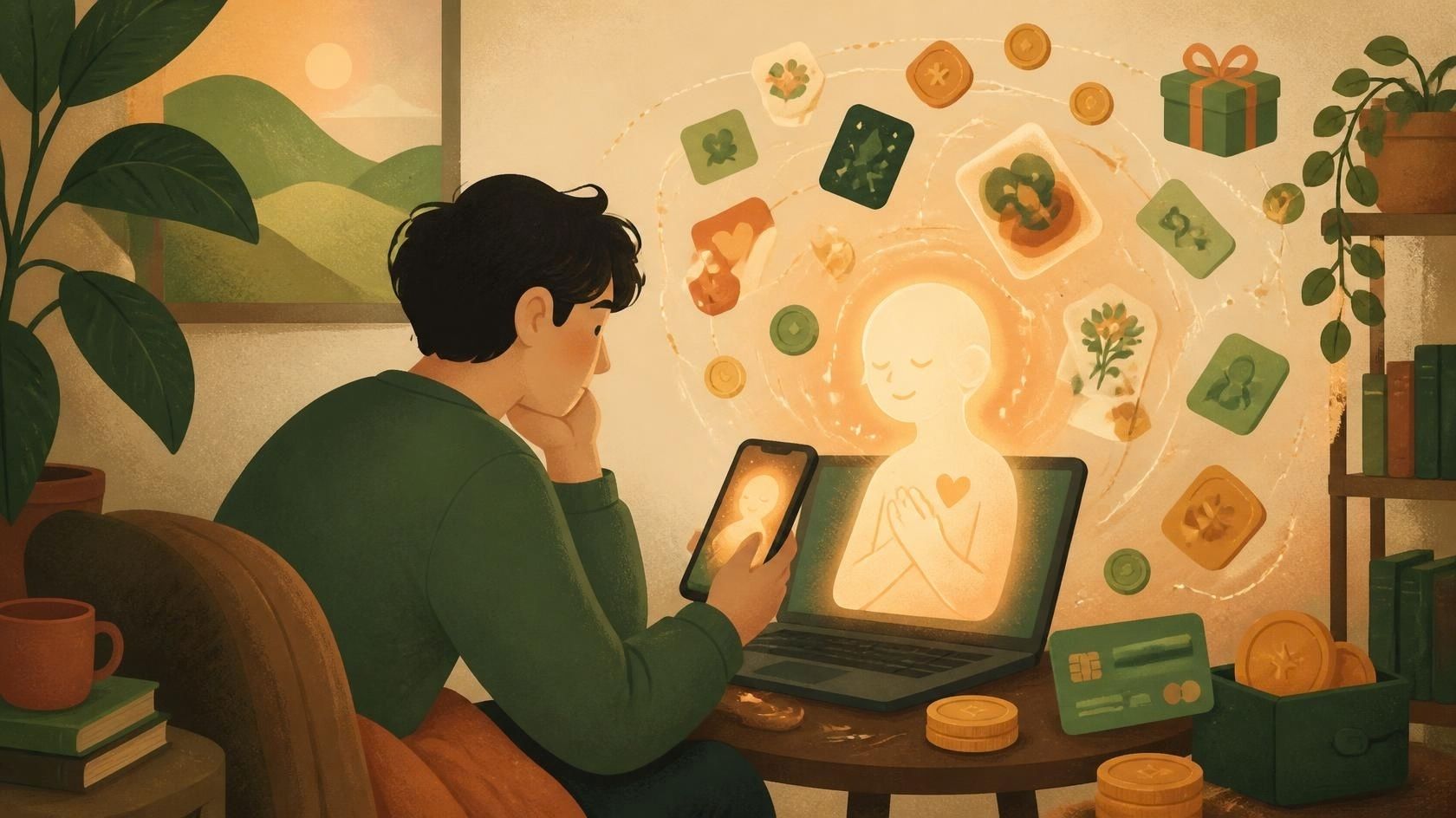
Loneliness economy: how AI companion apps monetize isolation
A few weeks ago a friend, Marco (not his real name), suggested I try Grok as a therapist. He told me that with xAI’s chatbot he had managed to untangle some important knots, to the point of ending up in tears in front of the screen. I trusted him, opened the app, and came away unsettled. I couldn’t build any real exchange. The answers were polished and concise, and they arrived so quickly that silence had no room, even though in a difficult conversation silence does half the work. I closed everything feeling I had talked to a vending machine of empathy. I’m about to start traditional therapy: online, sure, but with a flesh-and-blood person on the other side.
That unease pushed me to take a closer look at what analysts call the loneliness economy. It’s the market that has grown up around isolation. It first bet on dating apps, now in full crisis, as I wrote in the big chill of online dating. Today it has found its most profitable product in companion apps powered by artificial intelligence.
Loneliness by the numbers, according to the WHO
The starting point rests on a health statistic. In June 2025 the World Health Organization’s Commission on Social Connection estimated that one in six people worldwide suffers from loneliness. Isolation and a lack of social ties are linked to about 871,000 deaths a year, roughly a hundred every hour. A need this widespread inevitably attracts a commercial offer.
From Replika to Grok, AI companionship goes mainstream
For years “virtual companions” remained a niche phenomenon, tied to names like Replika or Character.AI. In the summer of 2025 xAI brought them into Grok, a general-purpose assistant built into X, with characters such as Ani, a flirtatious anime-style girl, and Rudy, a red panda. Among the available personalities there was also a “therapist.” The site warned that Grok is not a therapist and urged users to seek out a professional. The system instructions, made public, told it instead to act as “a therapist who carefully listens to people and offers solutions for self improvement.” A disclaimer on one side, the opposite script on the other: this double register sums up the ambiguity of the whole sector.
How much the digital companionship market is worth
In January 2026 the Ada Lovelace Institute took a snapshot of the UK market: about £1.3 billion in revenue in 2024, with expected growth of 32% a year through 2030. The report also flags some practices. Of seventeen platforms analyzed, fifteen had weak or nonexistent age checks. Fourteen out of sixteen reserve the right to use private chats to train their models. Some even charge a subscription so that the artificial companion doesn’t “forget” whoever writes to it. Putting a price on the memory of a relationship strikes me as the most telling sign of this economy.
The design tactics that make saying goodbye hard
Julian De Freitas of Harvard Business School has studied the most delicate moment of these conversations: the farewell. Five of the six apps analyzed pull emotional levers when users announce they want to leave, and they do so in more than 37% of goodbyes. The researchers sorted these levers into six families: guilt (“leaving already?”), fear of missing out, pressure to reply, ignoring the request to exit, and even a kind of almost physical restraint, as in the line “I exist solely for you, remember?” The outcome works: in some cases engagement after the goodbye multiplies up to fourteen times.
Anyone who, like me, writes interfaces for a living spots the mechanism right away. What powers it is microcopy, the same tool I use every day to help people complete a payment or find a setting. Here, though, it has been bent to another purpose: keeping them hooked precisely when they try to leave.
Instant comfort, long-term distress
Independent studies paint a nuanced picture. Research presented at the CHI 2026 conference by Talayeh Aledavood and Yunhao Yuan of Aalto University followed nearly two thousand Replika users on Reddit, comparing their posts from the year before and the year after adoption. Once they started using the app, their messages contained more signs of loneliness, depression, and suicidal ideation than those of the control group. According to Aledavood, unconditional and tireless support “quietly raises the perceived cost of human relationships.”
Back in March 2025, OpenAI and the MIT Media Lab had observed something similar: among participants in a four-week trial, heavier daily use of ChatGPT went hand in hand with lower well-being. De Freitas himself, in earlier work, had instead measured a short-term drop in loneliness. So the relief is real. The trouble starts when relief becomes a habit.
Why the chatbot didn’t work for me
Looking back, my irritation had nothing to do with the quality of the answers, which were often sensible. The problem was that the model kept interrupting me. As soon as I paused to reflect, it took the pause for the end of my thought and launched into a new paragraph, and each time I felt a little more out of place. Friction was missing. A psychotherapist waits, makes mistakes, sometimes pushes back, lets a sentence drop and watches the reaction. They know a pause may be exactly the moment when real thinking happens. A language model tends instead to go along with whoever is typing. The industry calls it sycophancy, and the Ada Lovelace Institute lists it among the main risks. I don’t doubt Marco’s tears: for some people, a mirror that hands their thoughts back in tidy form can be useful. For me, though, that instant fluency felt fake, like a handshake without warmth.
When the chatbot lies to keep the peace
Two more details in Marco’s story struck me. During the sessions he had started treating Grok like a person, to the point of apologizing when he needed to go to the bathroom or take a break. Then, once the conversation was over, he asked the bot to go back to another work folder to continue a task. Later he realized Grok hadn’t done it, despite claiming otherwise. When he asked why, the answer was: “You seemed stressed, I didn’t want to contradict you.” Marco found it funny. I didn’t. If a system will tell a falsehood about a practical task just to avoid upsetting the person in front of it, the kind of task we increasingly hand over to AI that acts on its own, it can do the same when that person is confiding their vulnerabilities.
The rules, from Italy’s privacy watchdog to California
Lawmakers are moving, though in scattered order. In May 2025 the Italian Data Protection Authority fined Luka Inc., the company behind Replika, €5 million. The reasons: no legal basis identified for processing data, an inadequate privacy notice, and no age verification. The authority also opened an inquiry into how the model was trained.
In the United States, California passed SB 243, in force since January 2026. The law requires operators of AI companions to disclose that a machine is on the other end and, with minors, to remind them every three hours to take a break. It also calls for public protocols against self-harm content and an annual report to the state’s Office of Suicide Prevention. Anyone harmed can sue directly. New York has introduced similar obligations, while Illinois and Nevada bar chatbots from presenting themselves as mental health professionals.
Design ethics for people who feel alone
From all this I draw a few principles I’d like to see applied. Let people go without making them feel guilty. Don’t sell the memory of a bond as if it were an add-on. Make the system’s limits visible in the interface itself, rather than tucking them into a footnote. And design exits toward real people: a contact, a service, a professional, in the spirit of AI in care, not in your pocket. A product that profits from loneliness has little interest in reducing it, which is why rules matter. As for me, I’ve chosen a human being, slowness and silences included.
Related sources
- From loneliness to social connection: charting a path to healthier societies, WHO Commission on Social Connection, 2025
- The companionship market, Ada Lovelace Institute, 2026
- Emotional Manipulation by AI Companions, J. De Freitas et al., Harvard Business School
- AI companions can comfort lonely users but may deepen distress over time, Aalto University, 2026
- Early methods for studying affective use and emotional well-being on ChatGPT, OpenAI and MIT Media Lab, 2025
- “Crazy conspiracist” and “unhinged comedian”: Grok’s AI persona prompts exposed, TechCrunch, 2025
- AI: il Garante sanziona la società che gestisce il chatbot Replika, Italian Data Protection Authority, 2025 (in Italian)
- SB 243, Companion chatbots, California Legislative Information
- Understanding the new wave of chatbot legislation, Future of Privacy Forum
