
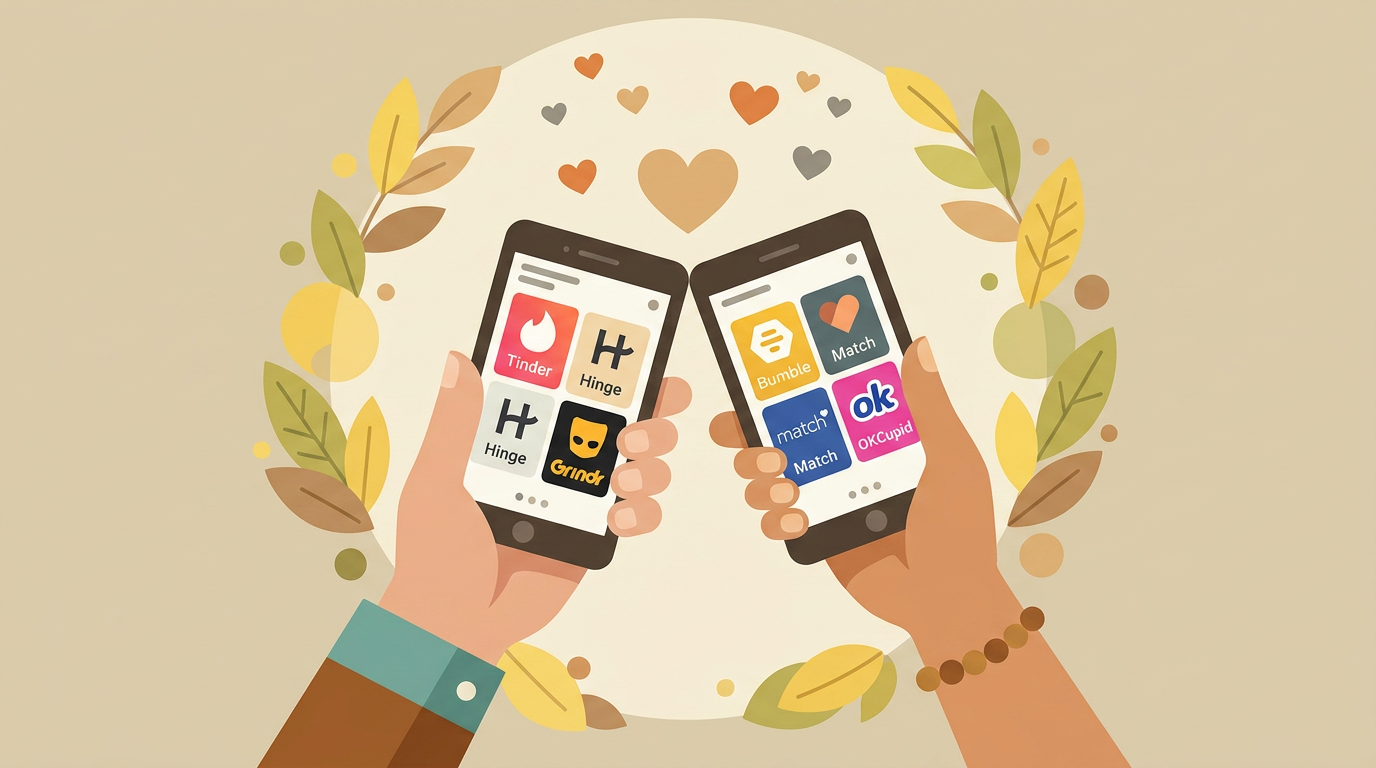
For a decade we were told that love was a matter of algorithms: one swipe to the right and destiny would handle the rest. Today that narrative is showing all its cracks. Matchmaking platforms keep bleeding users, subscribers and market capitalization, while younger generations look for a soulmate elsewhere: at dance classes, at live events and, with a certain dose of involuntary irony, on LinkedIn. The numbers deserve a closer look, because the story has many facets.
Tinder and Bumble between fleeing subscribers and stock collapses
The financial picture speaks clearly. Tinder closed the first quarter of 2026 with 8.6 million paying members, down 5% year over year and far from the peak of 10.7 million reached in 2022. Match Group, the parent company, has lost more than 80% of its value from the all-time high, while Bumble has surrendered about 95% since its Wall Street debut and announced a 30% staff reduction.
Still, declaring the sector dead would be premature. Hinge is growing 28% and aims at one billion dollars in revenue by 2027, and Match Group’s new CEO, Spencer Rascoff, claimed in the latest earnings call that “the turnaround is clearly underway”. What suffers, in short, is a specific model: the endless scroll of faces, designed to entertain rather than to spark real encounters.
What is happening in Italy
The phenomenon shows two sides there as well. According to Norton’s Consumer Cyber Safety Report, quoted by Sky TG24, 24% of Italians regularly frequent online matchmaking services, spending an average of six hours per week on them. The interesting part is who stays away: the San Valentino Observatory by Skuola.net, a survey of 2,500 young people aged 14 to 25, reveals that almost 9 out of 10 have never opened one of these applications and that only 3% of couples in that age bracket met through them. Roughly 4 out of 10 found their partner in a classroom, at school or university.
The reasons are easy to list: 72% of Gen Z doubts the authenticity of profiles and 62% struggles to find people with similar values. Then there is the wasted time, estimated at 123 hours a year for Italian users, the equivalent of five full days spent scrolling photos.
The generation that deserted the swipe
The most eloquent figure comes from the United States: an Axios poll among college students indicates that 79% ignores these tools altogether, while 58% of the youngest prefer meeting face to face. Burnout is well documented: according to Forbes Health, 78% of those who use such services have felt that sense of digital-date exhaustion at least once.
The testimonies collected by the American press capture the mood. Josh Mocklin, 21, a student at Fordham University, says that “every conversation on Raya or Hinge burns out and ends with the promise of a drink that never arrives”. Dating coach Rae Weiss sums up her generation’s feeling: swiping comes across as “transactional, laborious and artificial”. Hence the comeback of speed dating, singles events and hobby groups, a rediscovery of the analog world closely resembling the one described in Nonna maxxing and Gen Z.
LinkedIn, the place where nobody wanted to flirt
And here comes the paradox. While the platforms built to create relationships empty out, those designed for entirely different purposes fill up with suitors. On LinkedIn, flirting has become a measurable trend: a Zety survey of over one thousand American workers shows that 22% have sent or received messages with romantic intent, 12% have built a relationship that started on the professional network and 48% consider those profiles more trustworthy than the ones on matchmaking apps, because experiences, titles and mutual connections can be verified.
Google searches for “LinkedIn for dating” have grown eightfold in a year, reports Sherwood News, and a DatingNews.com poll indicates that more than half of respondents aged 20 to 40 went out with someone met on a professional network. The dark side is heavy: 91% of female users declare they have received unwanted advances at least once, and 74% of workers consider such proposals a violation of professional boundaries. I can confirm it firsthand: the occasional unsolicited approach reaches me too, although my profile has all the austerity of Miss Rottenmeier, and the same happens even on gaming apps, where in theory the conversation should stick to matches and scores. Curiously, the reverse path exists as well: according to Resume Builder, 34% of the members of romantic platforms exploit them for networking or job hunting, a strategy that says a lot about the market portrayed in The job hunter’s heartbreak.
From Strava to Duolingo, every digital square becomes a rendezvous
LinkedIn is only the tip of the iceberg. Over 40% of Gen Z and millennials consider social media essential to their sentimental life, according to YPulse, and creativity abounds: courtship blossoms on Strava, where sports clubs have tripled in a year and the “kudos” has become the new super like, but also on Letterboxd, Duolingo and even Yelp. A young developer interviewed by YPulse put it this way: love stories will be born “on every single app that exists, even on Uber Eats, it’s just bound to happen”. When each service ends up absorbing functions it was never meant for, we are back to the theme of To be all things to all apps.
A model to rethink
The lesson of this mass migration seems limpid to me: people keep looking for each other, yet they have lost faith in a system that turned desire into a paid catalog. They want context, shared interests, hints of authenticity: everything a 150-character bio cannot offer and that a professional profile, a playlist or a workout posted on social media convey far better. The companies in this industry have understood it and are chasing, between live events and promises of happy deletion. Perhaps the future of online romance will end up resembling good old word of mouth.
Related sources
- Is Gen Z killing the dating app?, Newsweek
- San Faustino, la festa dei single: quanti italiani usano le app di dating, Sky TG24
- Il crollo delle dating app: dal boom alla solitudine digitale, Investing.com Italia
- Tinder’s turnaround accelerates: Match Group Q1 2026 earnings, BigGo Finance
- LinkedIn romance report, Zety
- Why people are flirting on LinkedIn and job hunting on Tinder, Sherwood News
- Young people can make any app a dating app, even Duolingo, YPulse
- Running or Tinder? How Strava became Gen Z’s favorite dating app, Latination
- Gen Z is logging off dating apps and looking for love IRL, Columbia News Service
