
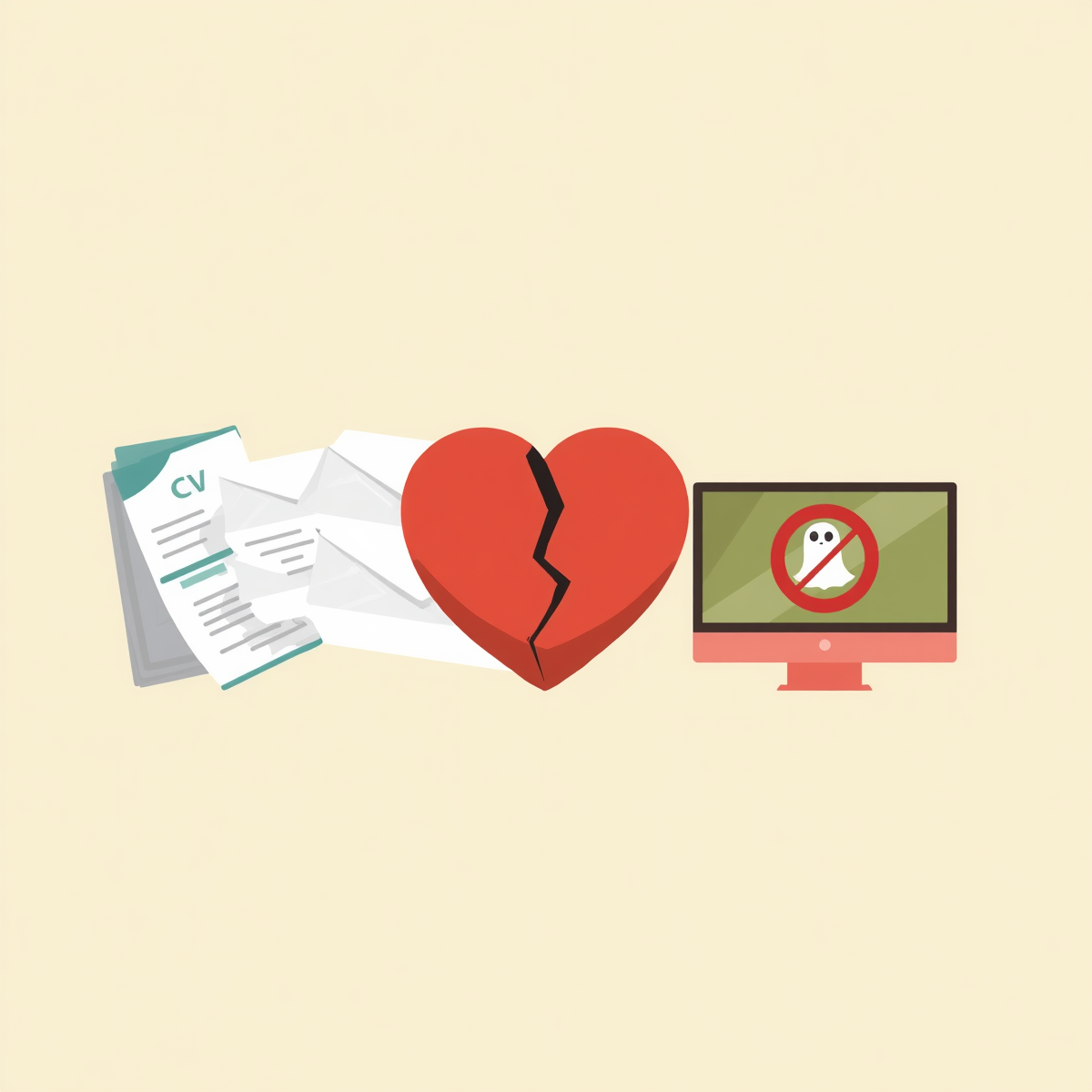
Your rejection email is a branding decision, act like it
Job hunting and dating are basically the same thing. You put together the best possible version of yourself, you do your research, you show up with nerves and a prepared set of talking points, you wait anxiously for a follow-up that sometimes never comes, and occasionally you get dumped via text, or in the professional equivalent, a WhatsApp notification from a recruiter, or a two-line form email sent at 11 pm.
The parallels are not just anecdotal. The term “ghosting” itself migrated from dating apps into HR circles precisely because the behavior is identical: a sudden, unexplained disappearance after what felt like a promising connection. Situationships, benching, love bombing, the slow fade. If you have been job hunting seriously in the last few years, you will recognize every single one of these patterns in your inbox. Medium contributor Monisha S put it well in a 2025 piece: the modern job search is not a transaction, it is an emotional experience with the vocabulary of modern romance, and all the bruising that comes with it.
The difference is that when a company does it, it also does it to its brand.
Ghosted after a few dates (or interviews)
Let’s start with the numbers, because they are staggering. According to a 2025 report by iHire, 53% of job seekers were ghosted by a potential employer in the past year, up from 38% in 2024, and the trend has continued to climb into 2026. More telling still: 61% of candidates have been ghosted after an actual interview, a nine-point jump since early 2024.
Think about what that means in dating terms. You met, you talked, you went on a second date, maybe a third. They seemed interested. And then: nothing. No explanation, no closure. Just silence, which your brain will helpfully fill with every possible worst-case interpretation of itself.
Research published in Personal Relationships (Wiley, 2025) found that ghosting produces longer-lasting emotional harm than explicit rejection precisely because of this ambiguity. Ghosted participants reported ongoing emotional attachment and lower self-esteem compared to those who received a clear “no.” A clear rejection, it turns out, is a kindness. The wound heals. The open question festers.
And research from Clemson University confirmed that this cuts both ways: ghosting job candidates haunts employers too, damaging their reputation in ways that are hard to walk back once the word spreads.
The breakup text (and why the wording matters)
So you did get a message. Progress. But here is the template that has been in rotation since roughly 2003:
“After careful consideration, we have decided to move forward with other candidates whose profiles more closely align with the requirements of the role. We encourage you to keep an eye on our careers page for future opportunities.”
In relationship terms, this is the “it’s not you, it’s me” of professional communication. Everyone has heard it, nobody believes it, and it offers absolutely nothing: no warmth, no specificity, no acknowledgment that the other person existed as an individual. I have received some version of this from a fintech company, a fashion retailer, a SaaS startup, and a nonprofit, four completely different industries, four identical emails.
The phrase “after careful consideration” is doing a lot of heavy lifting when, in many cases, a recruiter spends a median of 7.4 seconds on a resume (TheLadders eye-tracking study) and has made the call. Don’t perform a deliberation that didn’t happen. Candidates are not naive, and that language doesn’t protect you; it just makes you sound insincere.
The sugarcoated version is arguably worse. “While we were deeply impressed by your credentials and feel fortunate you would consider joining us…” Nobody believes this, and everyone can smell it. It is love-bombing with no follow-through: excessive flattery used to cushion a rejection that the rest of the email will deliver anyway. Performative warmth without substance is its own kind of dismissal.
The consequences for your brand
This is not a soft, feel-good issue. Poor candidate experience has measurable consequences.
A 2025 cross-industry meta-analysis of 150,000 job seekers found that 72% cite unclear timelines and post-interview silence as their top frustrations. And those frustrated candidates talk: 72% say they are likely to share a bad experience online or directly with someone in their network. 26% of people will avoid using a brand entirely if someone they trust has had a bad experience with it. 21% begin to mistrust a brand based solely on negative word of mouth.
Your candidates are also your potential customers, your future referrers, and your LinkedIn audience. The job market, like the dating pool, is smaller than it looks. People talk. Reviews on Glassdoor and LinkedIn posts about “my experience applying to X” are the professional equivalent of asking a friend: “Wait, you dated them, too?”
A rejected candidate who felt respected will still recommend your product. One who felt dismissed will remember, and share, how that dismissal felt. As Maya Angelou put it: “People will forget what you said, people will forget what you did, but people will never forget how you made them feel.”
Three real cases, a spectrum of approaches
I have been fully freelancing for a while now, and the volume of applications I have sent and rejections I have received has given me an unintentional field study in how companies handle this moment. Here are three that stand out.
Before we get into them, one thing worth noting: many companies now ask candidates to complete take-home assignments, record video introductions, or talk through role requirements on camera before a single human has reviewed their CV. These are not quick tasks. They require curation, creative thinking, and a real investment of time and energy, often hours of it. That significantly raises the stakes of every response. The higher the bar you set for entry, the more your silence or your form email costs you.
The fashion eCommerce brand had me go through multiple rounds. I later found out, by coincidence, that I was the strongest candidate and had made it to the final round. Their communication at the end? The standard template. Not a word acknowledging the process I had been through, the time I had invested, or the fact that it was a genuinely close call. That silence about what happened feels worse than the rejection itself, because it signals that the experience mattered more to me than it did to them. In dating, we call this being led on.
The fintech company had me complete a battery of tests, including mathematics, logic, and language, for a writing position. My language scores were above average. My logic scores were above average. My maths scores were not good, partly because I am dyscalculic, and the test was timed with no calculator allowed. Their feedback email reduced my entire performance to “below average for the position,” without acknowledging the dimensions where I had overdelivered, and without once asking whether I had any specific needs or access requirements. It was not just impersonal, it was exclusionary. Inclusivity in hiring does not stop at the job description; it extends to how you design and communicate assessments. In relationship terms, they only saw the one thing they didn’t like and used it to define the whole picture.
The third company, an AI-powered creative suite I still use daily, got it right, or at least much closer. Their subject lines alone told a story: “Okay, you’re in the mix” when my application was received. “It was not a match this time” for the rejection. The body copy was direct but warm, it did not pretend the decision was harder than it was, but it also did not leave me feeling like a number. I closed that email and thought, “I would still work with these people.” I would still recommend them. I still subscribe to their product. In dating, this is the rare, respectful breakup that leaves you thinking well of the other person even as you move on.
That last outcome is the point. A well-handled rejection is not just basic decency; it is a retention tool. Had that company disregarded me as the others did, I would have canceled my subscription. Competition is fierce, and customers, like candidates, remember how they were treated at the door.
Same rejection outcome in all three cases. Completely different lasting impressions.
Words are windows, or they’re walls
I have a motto I return to often in my work: words are windows, or they’re walls. Nowhere is this truer than in hiring communications. The language you choose at the end of a process, the moment when a person is most vulnerable to feeling dismissed, either opens a door to goodwill or slams one shut.
This is not a new idea in the world of UX and content design. I have written about how the micro-copy you choose in digital interfaces shapes trust, and how even error messages are a branding opportunity, a moment where frustration can either be validated and resolved, or compounded by a clumsy, generic system message. Rejection emails work the same way. They are, in the language of UX, a critical user touchpoint, and one that most companies are actively wasting.
If your product team would never ship an error message that says “an unexpected issue has occurred, please try again,” your HR team should not be shipping candidate communications that say “we have decided to move forward with other candidates.”
You do not need to write each one individually
The obvious objection here is scale. A company receiving 250 applications per open role, which is average for a corporate position, cannot have a copywriter craft a bespoke email for every candidate. Nobody is asking for that.
What is being asked for is intentionality. A handful of templates, written with a real voice and a real acknowledgment of what the candidate went through. A subject line that does not read like an automated system. A sentence that reflects the specific stage of the process the person reached, because someone who completed four rounds deserves a different message than someone who submitted a CV and never heard back.
In 2026, with the AI tools available to most hiring teams, there is genuinely no excuse for a one-template-fits-all approach. You can personalize at scale. You can train a tone. You can write three versions of a rejection email, one for early-stage, one for mid-process, and one for final-round, and still treat people like people.
And if you need help figuring out what that voice should sound like, or how to make these communications work harder for your brand, drop me a call.
Related sources
- iHire, 53% of Job Seekers Have Been Ghosted by a Potential Employer
- Fortune, The Number of Candidates Ghosted by Employers Just Reached a Three-Year High
- Wiley / Personal Relationships, Give Up the Ghost: Emotional and Behavioral Responses to Ambiguous Rejection (2025)
- Psychology Today, Ghosting vs. Rejection: Which Is Worse? (2025)
- Clemson University, Ghosting Job Candidates Can Haunt Employers
- Psychology Today, Ghosting in Recruitment: Did Your Dream Job Just Vanish?
- Medium, When Job Hunting Feels Like Modern Dating: Situationships, Benching, and Ghosting (2025)
- ClearanceJobs, Why Your Job Search Is Starting to Look a Lot Like Online Dating (2025)
- HR Dive, Job Seekers Are Swiping Right in Search of a New Job (2025)
- JobTwine, Candidate Experience Statistics 2025
- RecruitCRM, 20+ Candidate Experience Statistics That You Need
- NACE, How Execution and Authenticity Impact the Candidate Experience and Employer Brand
- TRC Talent Solutions, The Detrimental Impact of Poor Candidate Experience on a Company’s Brand
- ScienceDirect, Negative Word-of-Mouth and Applicant Attraction: The Role of Employer Brand Equity
- Vouch, 25 Employer Brand Statistics to Know in 2026
- Chiara Bonifazi, The Principles of UX Writing
- Chiara Bonifazi, Error messages are opportunities
