
Nonna maxxing: Gen Z has discovered what my friends and I already knew
There’s a new trend bouncing between Instagram and TikTok, started by Self, picked up by Vice and Newsweek, and finally landed in the Guardian: it’s called nonna maxxing, and the model to imitate comes, surprisingly, from our own home. Italian grandmothers, with all due respect to the Japanese and Nordic habits so much in vogue.
The term comes from to max out: the idea is that anyone can improve their life by adopting the habits of the seventy-somethings of our small towns. Generation Z, exhausted by the pressure to constantly optimize, produce, and turn every moment into content, has found an antidote in our grandmothers. And the subtitle of all these articles, unsurprisingly, is written in Italian: dolce far niente.
What do they do that’s so special?
Seen from abroad, Italian grandmothers appear to be keepers of long-life secrets. They walk every day, often crossing the whole town, because going on foot is for them a way of living before it is exercise, and Daniel Lieberman, professor of evolutionary biology at Harvard, confirms it: “walking helps you age well”. They accept their age without hiding it or longing for the old days, and research suggests that a serene attitude toward the passing years correlates with slower aging. They look after their grandchildren, a commitment that studies link to protection against cognitive decline. They eat seasonal products bought from their trusted vendor at the market. And above all they avoid isolation: the café, the friends, the church, the neighborhood, to the point that social media ironically compares them to a national security system.
There’s even a film that reads like a manifesto of the trend: Gioia mia by Margherita Spampinato, an award-winning gem this year, with Aurora Quattrocchi as Gela, the elderly Palermo aunt entrusted with a rebellious little nephew for the holidays.
Ogliastra, where grandmothers are super-agers
The phenomenon has solid, very Italian foundations. The Sardinian Blue Zone, one of five in the world, includes six villages in Ogliastra where the percentage of centenarians among people born between 1880 and 1900 was about five times higher than in the rest of Europe. A study by the University of Cagliari, published just days ago in the International Journal of Applied Positive Psychology, compared elders living in the Blue Zone with those of a nearby rural area: the former keep a recognized social role and a sense of purpose, cultivate curiosity and emotional resilience, and focus on activities they can still carry out with satisfaction, such as gardening, walks, and gatherings at community centers. An interesting detail: while worldwide women who reach one hundred far outnumber men, here the proportion is almost even. The credit, researchers say, goes to a community network that supports everyone.
Perdasdefogu, the Guinness village
Also in Sardinia, Perdasdefogu entered the Guinness World Records as the village with the highest concentration of centenarians on the planet. It was home to the Melis family, nine brothers and sisters recognized as the longest-living family in the world, with record combined ages. The Melis sisters, interviewed over the years, described days made of vegetable gardens, mass, chats with neighbors, and home-cooked meals. No secret formula: a daily routine shared with others.
Acciaroli, the centenarians under scientific scrutiny
Moving down to Cilento, in Acciaroli, a hamlet of Pollica, there are 30 centenarians per hundred thousand inhabitants, more than double the average. Women’s life expectancy reaches 92 years against the national 84. Since 2016 the CIAO project (Cilento Initiative on Aging Outcomes), run by Rome’s Sapienza University together with the University of California San Diego, has been following about 300 of the area’s oldest residents: they walk for kilometers up and down the village slopes, season everything with rosemary, and show a cognitive state comparable to that of much younger housemates. Here too, alongside genetics and the Mediterranean diet, researchers point to social bonds as the decisive factor.
Our own nonna maxxing is already underway
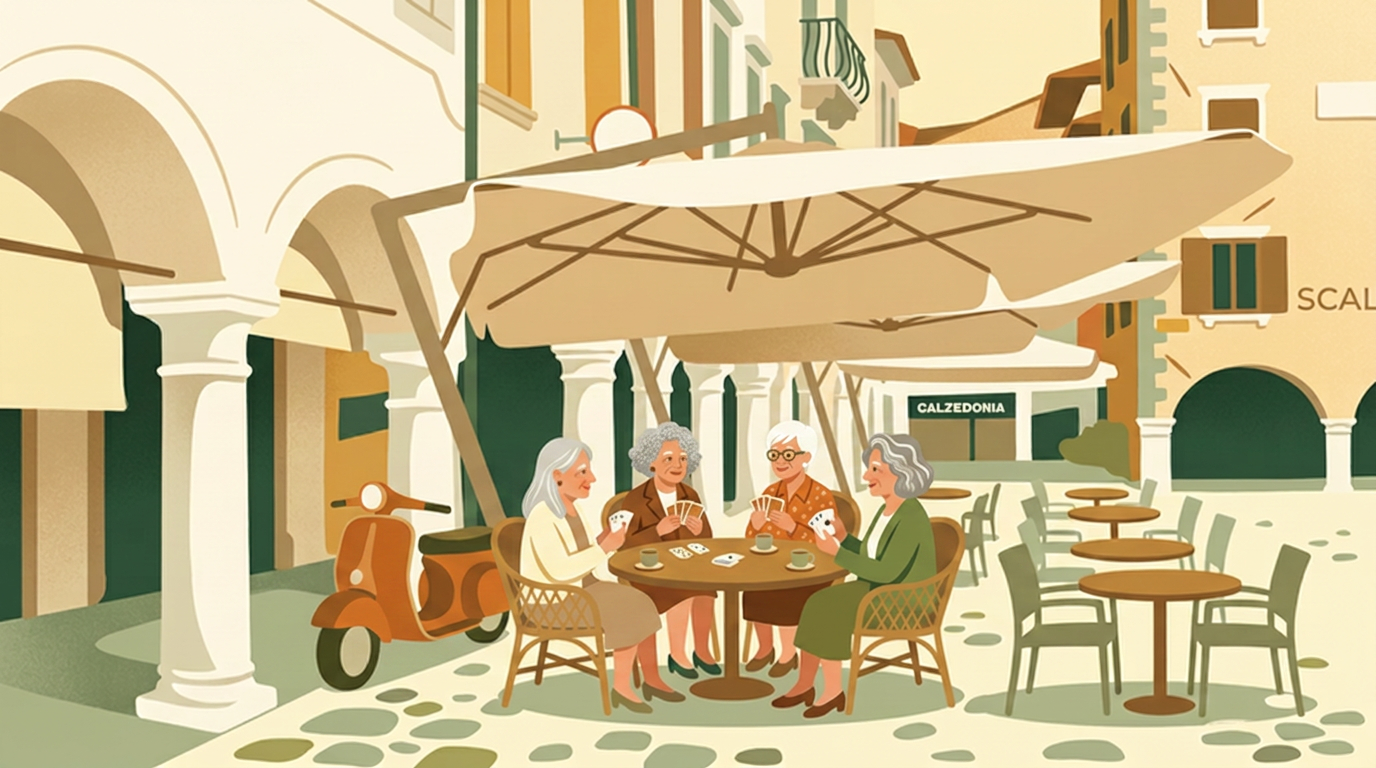
I have a confession: my friends and I have been planning our nonna maxxing for years, without knowing it had a name. We’ve already made precise plans for retirement: burraco card games, seaside lunches, a theater subscription. And we went beyond intentions: we bought homes close to one another (I wrote about how much housing matters, and how I chose mine in Milan, in this article on the housing crisis).
Because in the end, from Villagrande to Acciaroli, the common thread stays the same: the network. The friends to chat with, the trusted shops, the café table where you get to know the stranger sitting next to you instead of scrolling your phone. Studies confirm it: having a purpose in life preserves cognitive function and reduces the risk of depression and loneliness, because boredom is the only thing that truly makes you old.
Aging is scary, no point denying it. But not if you’re with the right people. Gen Z, watching our grandmothers, has understood something my friends and I are simply putting into practice ahead of time: the good life is built together, well before retirement.
Related sources
- ANSA, “Le nonne italiane ispirano la Gen Z nel mondo, è il ‘nonna maxxing’ trend”, July 11, 2026
- Euronews, “Blue zone secrets: How Sardinia’s elders stay sharp and happy in old age”, July 12, 2026
- Newsweek, “What is ‘nonna maxxing’? Meet Gen Z’s guilt-free answer to modern lifestyle”
- Forbes, “Gen Z is ‘nonna maxxing’ and cooking like their grandmothers again”
- La Nuova Sardegna, “Centenari sardi: Perdasdefogu da Guinness, la famiglia Melis resta la più longeva del mondo”
- Fondazione Veronesi, “Longevità: cosa rende speciali i centenari del Cilento?”
