
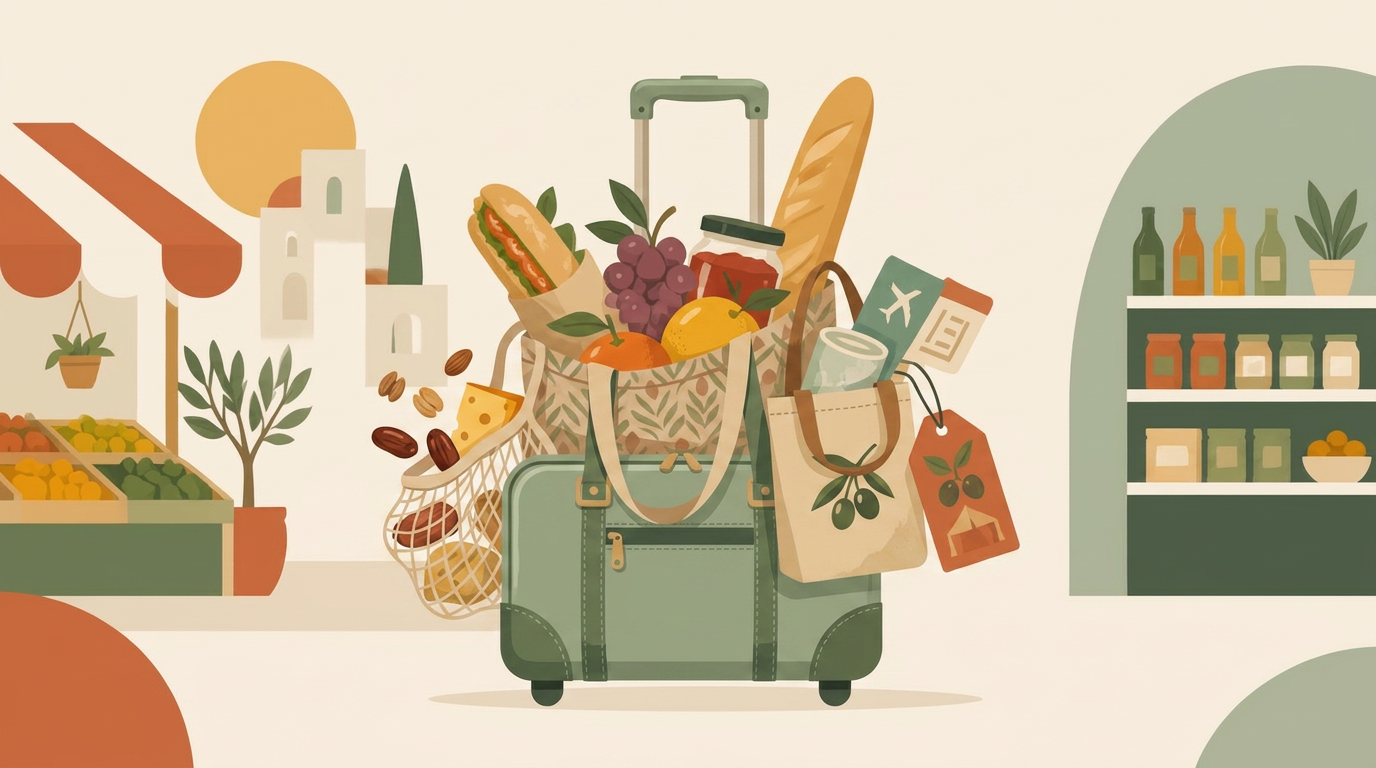
This summer, the way people travel tells a different story than usual. It isn’t just about monuments and itineraries packed with must-see stops anymore, but about lingering among supermarket shelves or the stalls of a neighborhood market. Corriere della Sera has named this “snackpacking”, a word that blends snack and backpacking and describes a holiday where everyday food, bought or tasted on the street, becomes the real compass of the trip.
What the numbers say about snackpacking among Millennials and Gen Z
The figures point to a clear shift in travelers’ behavior. According to recent research, 89% of Millennials and Gen Z consider food one of the main tools for getting to know a place, and for nine out of ten young people, taste is what actually drives the choice of destination. About six in ten tourists regularly buy local snacks while abroad, and over 75% say they are willing to change their itinerary just to reach a spot discovered on social media. It is no surprise that a whole hashtag has grown around 7-Eleven minimarkets, #711, turning a convenience store chain into a photogenic destination.
Supermarkets and minimarkets as new travel stops
The trend flips a hierarchy that once seemed settled. The monument used to come first, followed, maybe, by a local taste. Today neighborhood markets, corner bakeries, and even supermarket aisles have become a privileged vantage point on the daily habits of a population. It is a form of curiosity connected to the digitalization of tourism: social media has made visible places that once stayed off every guidebook, pushing tourist flows toward less central areas or smaller towns.
My own travel shopping list: farmers’ markets, short supply chains and neighborhood stalls
I will admit this trend resembles me, at least in part. When I travel, or simply when I shop at home, I prefer farmers’ markets, Campagna Amica stalls and short supply chain products: I like knowing where what ends up on my table comes from, and neighborhood markets remain my favorite place for that. Every so often I also step into small ethnic minimarkets nearby, but for practical reasons more than adventurous ones: they stay open late and on holidays, when everything else is closed. Then there is Lidl, where I go gladly, especially during those weeks dedicated to a single country’s products: I love browsing items I would not normally find elsewhere, though a doubt lingers that I cannot quite shake, namely whether those flavors really tell the story of a cuisine or are simply a well-packaged trap for tourists, relocated inside an ordinary store. I have to admit, with a bit of self-irony, that in both cases I nearly always end up buying what I already know, a habit that clashes a little with the adventurous spirit of snackpacking, but that probably says more than any statistic about how everyone’s curiosity actually works, made of small leaps and small comfort zones.
Between street food and tradition: the Italian trends to watch
In Italy, snackpacking intertwines with a broader movement, that of signature street food, which in recent years has stopped being just a cheap bite and become a form of storytelling about identity. Among the most mentioned Italian destinations are Lecce, with pasticciotto and rustico from historic pastry shops, Catania, where tavola calda is tasted at the kiosks of the Pescheria market, Verona, between cicchetti and pastissada de caval in local markets, Genoa, with focaccia and farinata in its narrow caruggi, Bologna, with mortadella and crescentine in the Quadrilatero district, plus Viterbo and Perugia, between porchetta, torta al testo and artisanal chocolate.
The gourmet sandwich follows the same direction: in Milan, in Tuscany and especially in the South, formats like PUOK in Naples reinterpret home recipes with selected ingredients and long fermentations. Gambero Rosso’s Street Food 2026 guide, which lists nearly 700 addresses, captures this double soul of the sector well: on one side, the “regional champions” preserving a legacy worth passing on, on the other, chefs with fine-dining backgrounds choosing lighter formats and international influences. It is a balance that echoes, in some ways, what is described in Nonna maxxing and Gen Z: the youngest generation looks to the past not out of nostalgia, but to find authenticity in a present full of alternatives.
What it means for the places welcoming these travelers
The figures carry real economic weight too. Italy’s food and wine tourism generated around 12.6 billion euros in 2024, 9% more than the previous year, while street food overall is expected to grow 5.5% annually through 2028. Globally, the culinary tourism market could approach 1.23 trillion dollars by the end of 2026. Behind these numbers lies a positive side effect for local areas: those seeking the “everyday heart” of a place, as Rosa Giglio of BWH Hotels put it, end up visiting outlying neighborhoods and smaller towns too, easing pressure on the usual postcard destinations.
A different way of getting to know a place
In the end, snackpacking looks like an updated version of an old idea: a place is best understood through the dishes people cook every day, not just through the displays set up for visitors. Whether it is a pasticciotto from Lecce or a familiar brand picked up at the ethnic minimarket down the street, the substance does not change: some holidays really do start from a shopping cart.
Related sources
- Turismo? Oggi passa (anche) dal supermercato: il fenomeno «snackpacking» che spopola tra Millennial e Gen Z, Corriere della Sera
- Snackpacking, perché i viaggiatori scelgono supermercati e mercati al posto dei monumenti, Food and Wine Italia
- Snackpacking, il trend dell’estate 2026: per 9 giovani su 10 il cibo guida la scelta della meta, GuidaViaggi
- Food, il trend dell’estate 2026 è lo Snackpacking, per 9 giovani su 10 assaggiare le specialità locali è il cuore del viaggio, Italian Food News
- Il panino gourmet conquista i viaggiatori: la nuova frontiera dello street food italiano, ViaggiNews
- I migliori street food d’Italia 2026, Gambero Rosso
