
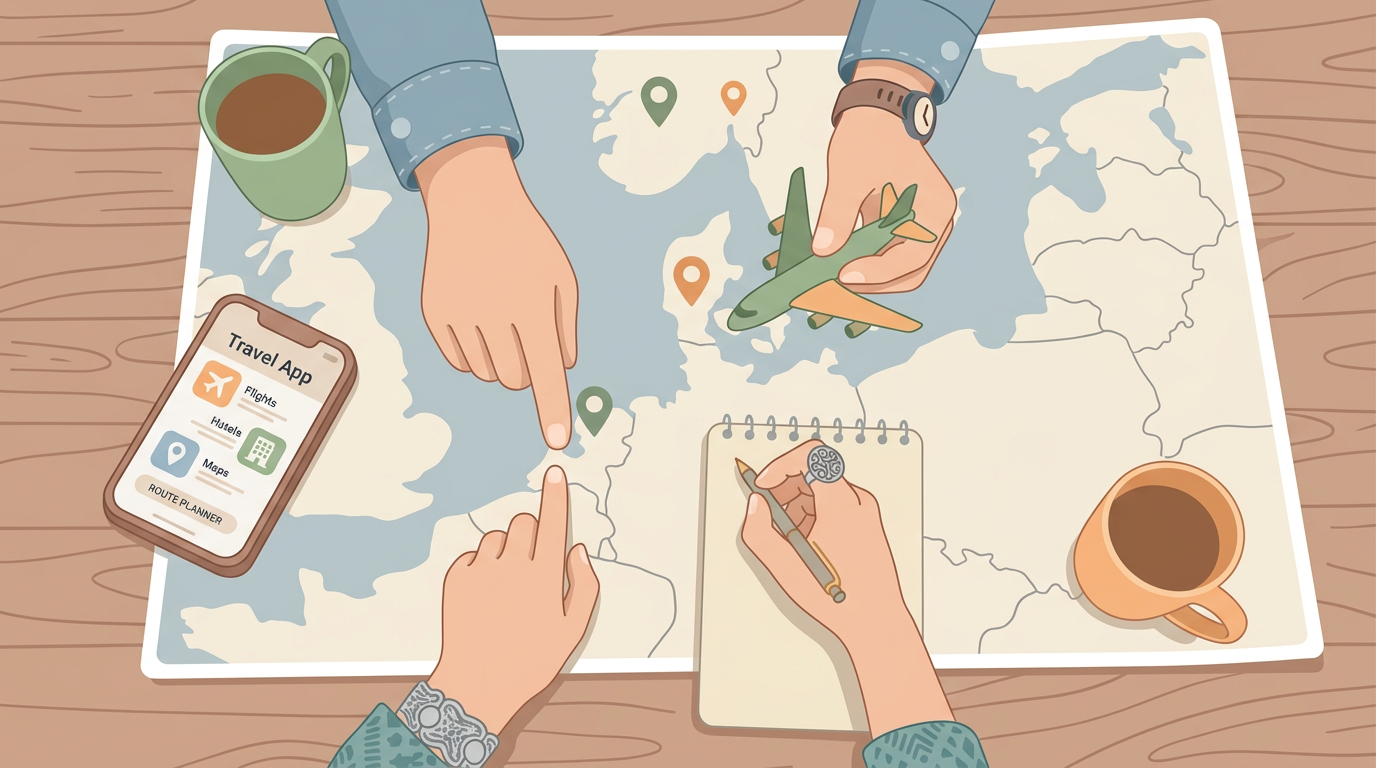
From the catalog in the shop window to the smartphone: how digital has transformed tourism
Anyone over thirty remembers it well: the holiday used to start at the window of a travel agency, among slightly faded posters of Sharm el-Sheik and glossy catalogs to leaf through on the counter. The agent was the keeper of an almost esoteric body of knowledge: fares, availability, flight combinations that we ordinary mortals could only imagine. Today, that ritual barely survives. We book from the sofa, compare a hundred hotels in ten minutes, and trust reviews from perfect strangers as if they were tips from friends. In between, there has been a revolution with few parallels in other industries for scale and speed.
When travel was bought through a shop window
Until the 1990s, tourism ran on total intermediation. Airfares lived within the GDS (global distribution systems) such as Amadeus and Sabre, accessible only to professional operators. The customer had no way of knowing whether the price was fair: trusting was the only option. Discounts were a privilege for insiders, reserved for those who knew the right person behind the desk or happened to walk in at the lucky moment of the paper’s “last-minute” offer taped to the window.
Then the internet arrived, and with it a handful of pioneers: Expedia and Booking.com were both born in 1996, and within a few years, they did something simple and sensational at once. They took that confidential information and put it in front of everyone’s eyes.
The democratization of the discount
This is the real historical watershed: transparency. OTAs, online travel agencies, turned price comparison from a profession into an everyday gesture. Booking built an endless hotel inventory, Airbnb opened up the private home market from 2008 onwards, and portals like eDreams, Skyscanner, or Kayak did the same with flights, aggregating airlines and fares into a single screen.
The eDreams case deserves a note: the group understood before others that subscription was the next frontier, and with its Prime program, which offered dedicated discounts in exchange for an annual fee, it passed 7.25 million members in spring 2025, quadrupling them in just a few years. Basically, the Netflix model applied to plane tickets. It is the same platform logic I have already covered when writing about food delivery: an app in the middle, two markets on either side, and commissions flowing through.
The numbers behind the revolution
A few figures help measure the scale of the phenomenon. In 2025, Booking Holdings, the parent company of Booking.com, handled 1.235 billion room nights and 186 billion dollars in gross bookings, with 65% of transactions completed on mobile. Airbnb, for its part, closed the last quarter of 2025 with booked value growing by 16%, its fastest pace in two years. We are talking about companies that move more value than entire national economies do, born of an idea as basic as it is powerful: closing the gap between those who leave and those who host.
And what about Italy?
Our country, which lives off tourism, has followed the same trajectory. According to the Travel Innovation Observatory of the Politecnico di Milano, in 2025, the Italian hospitality market is worth 38.2 billion euros, 57% of which goes through e-commerce; in transport, the online share climbs to 70% of a 27.6 billion total. Adding the two segments together, over 41 billion euros now flow through digital channels. Only 12% of Italians still book by physically walking into an agency, while a third say they use artificial intelligence to organize their trips. A shift in the way we search that I know well, because it is the same one shaking my own profession, as I described in From SEO to GEO.
Traditional agencies, however, have shown surprising resilience. Fiavet data show 7,100 active shops at the end of 2024, a slight recovery after 1,000 closures in 2022. The survivors have reinvented themselves: less ticketing, more specialized consultancy on honeymoons, cruises, and complex itineraries, where the human touch still beats the algorithm.
The flip side of the coin
It would be one-sided to tell only the bright part of the story. Platform commissions, which can reach 15-25% for hotels, have eroded the margins of many small businesses, making them dependent on an intermediary that once did not exist. And the boom in short-term rentals has helped empty historic centers of their residents, from Venice to Barcelona: an issue that intertwines with the housing crisis in big cities, where the tourist with a suitcase and the tenant looking for a flat compete over the same square meters. Democratized access, in short, has come at a cost, and the bill is often paid by the most photographed and Instagrammable places.
Weighing it all up: a happy few or everyone on board?
Having come this far, the question arises naturally: was the old world better, with travel a luxury for the privileged, or today’s world, where low-cost has put a weekend in Lisbon within a student’s reach? I have no doubts about the direction: an experience that broadens horizons should not depend on wealth, and those who long for the era of the chosen few usually stand on the more comfortable side of the barricade. The real issue is the how: yes to everyone traveling, but with rules protecting the people who actually live in those places and flows spread beyond the usual ten postcard destinations. Overcrowding stems from concentration even before sheer numbers, and the same technology that has filled Venice could help us promote a thousand villages still waiting to be discovered, in my native Abruzzo, for example.
My personal note: in praise of the staycation
And where do I stand in all this? I confess: I am a staycation kind of girl. I love reading about exotic destinations, but when I really need to switch off, I choose what I know. A few years ago, I bought a house by the sea in my hometown, and every time I open those windows, I understand why I did it: I relax more with what feels familiar. The bar where my coffee arrives without having to order it, the beach whose moods I can read, sunsets I never need to look up on a map. Paradoxically, even this choice goes through digital channels: the very platforms that bring the world within a click have taught me how much staying close is worth, at least to me. The revolution has given us the freedom to go anywhere; to me it has given the awareness of where I want to return.
