
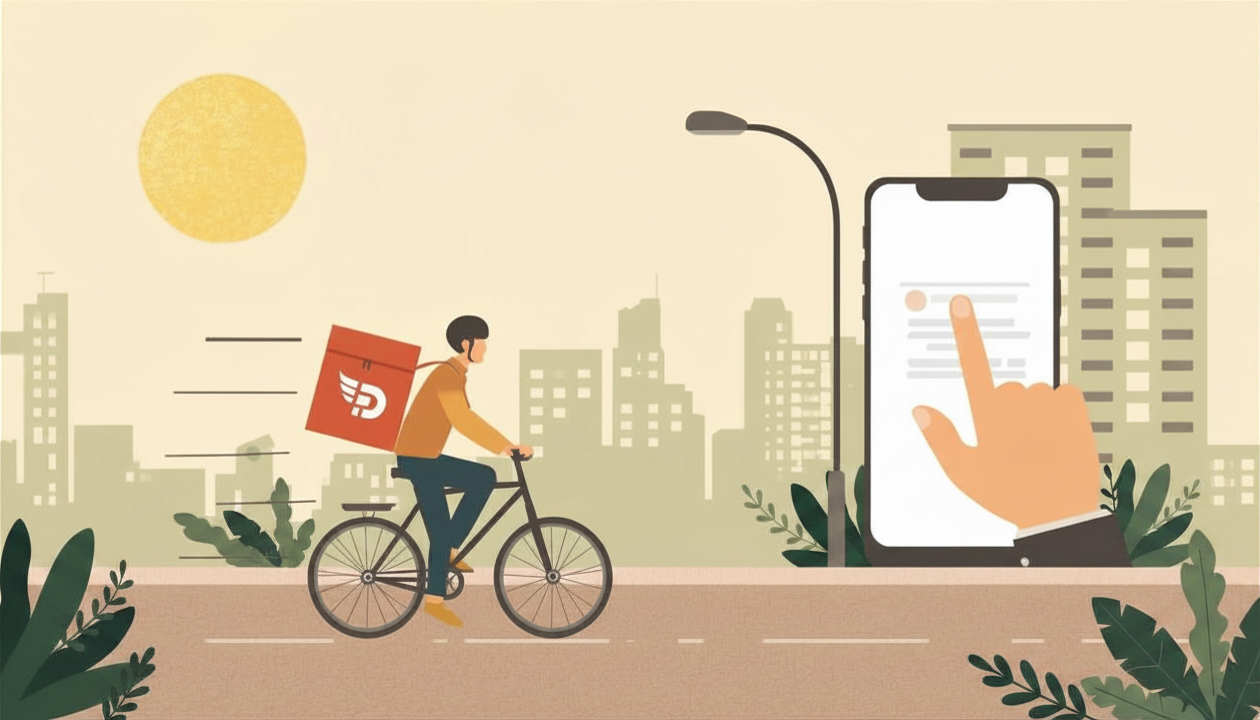
Food delivery and its dark side
Ordering a poke bowl at 1 pm on a random Tuesday has become an automatic gesture, like sending a voice message or paying with your smartphone. Behind that gesture, though, sits a chain that holds together billions of euros, algorithms deciding who works and how much they earn, and people pedaling under the July sun to bring us lunch. I wanted to line up the numbers, the investigations, and the regulatory news, along with a personal memory that has more to do with this industry than I would like.
A market worth billions
At a global level, estimates vary widely depending on the methodology, but the order of magnitude is clear: online food delivery was worth around 316 billion dollars in 2025, and projections indicate it will exceed 700 billion by 2034. In 2024, about 2.1 billion people worldwide used a meal delivery service, with Asia-Pacific accounting for almost 40% of the turnover.
In Italy, the online Food & Grocery segment is worth 5.1 billion euros in 2026, up 6% on the previous year, and delivery in the strict sense represents nearly half of that value, with 6.8 million users. Loyalty runs extremely high: more than seven purchases out of ten happen on platforms already used in the past. I had already written about eCommerce and its evolutions when covering live shopping, and the dynamic looks similar: convenience becomes habit, habit becomes market.
The players on the Italian field
The Italian table has progressively thinned out. Uber Eats left the country in mid 2023, and today the game is essentially played among three brands: Glovo, controlled by Germany’s Delivery Hero, Deliveroo, which came under the control of America’s DoorDash in 2025, and Just Eat, which ended up in the portfolio of the Dutch-South African group Prosus that same year. Just Eat deserves a separate note, because since 2021, it has chosen in Italy the path of hiring part of its couriers as employees, going against the grain of its rivals.
One detail says a lot about the health of the sector: revenue grows, profits much less so. Margins remain thin, and the race toward consolidation, as we will see, stems precisely from there.
The knot of riders’ employment status
Whoever delivers our sushi works, in most cases, as a freelancer. The collective agreement signed in 2020 by Assodelivery with the UGL union covers around 30,000 couriers and classifies them as independent workers paid per delivery, but it has been contested from day one: the courts of Bologna, Florence, and Palermo have deemed it unlawful or inapplicable, because the signing union lacked the requirement of broader representativeness. Meanwhile, several rulings, from Palermo to Turin, have recognized the subordinate nature of the relationship: if an algorithm decides shifts, compensation, and punishments, talking about autonomy sounds like a legal fiction.
Europe has sought to bring order with Directive 2024/2831 on platform work, to be transposed by December 2, 2026. Italy moved early with decree-law 62/2026, the so-called May Day decree: when the service is organized by an automated system, a presumption of subordinate employment kicks in, with a mandatory monthly pay statement from July 1, 2026, and app access through verified identity, including Italy’s SPID. On paper, this marks a turning point; in its concrete application, unions keep more than one doubt.
Gangmaster-level pay
The word caporalato, Italy’s term for illegal gangmastering, evokes tomato fields, and yet it entered Milan’s courtrooms precisely through delivery. In 2020, the Milan Prosecutor’s Office placed Uber Italy under judicial administration: prosecutors described riders paid 3 euros per drop regardless of the route, stolen tips, arbitrary deductions, and accounts blocked as punishment. The trial ended with a 3-year-8-month conviction for a manager of the intermediary companies and with 10,000 euros in compensation for each of 44 couriers, largely asylum seekers recruited precisely because they could be blackmailed.
Piece-rate remains the rule of the game: recent reports tell of fees as low as 1.90 euros per ride in slots without rain or bonuses. When earnings depend on the number of deliveries, every red light becomes a cost and every shortcut a temptation. I had shared some thoughts on the relationship between technology and employment in AI and the labor market: delivery is perhaps the most visible example of how an algorithm can manage people in flesh and blood.
Safety: underestimated numbers and real lives
INAIL records 1,337 accidents in two years and 7 official deaths among delivery cyclists, but news reports count at least 12 over the four-year span. According to the CGIL union, six riders out of ten fail to report their injuries, out of fear of losing their spot or unawareness of their protections. 60% of the injured are under 35, and foreign communities, from Pakistani to Bangladeshi, turn out to be the hardest hit.
The emblematic case remains Sebastian Galassi, a 26-year-old student who died in Florence in October 2022 during a delivery for Glovo, and was dismissed a few hours later by an automated email for failing to comply with terms and conditions. The company apologized, calling it a system error, and the privacy authority later imposed a 5 million euro fine on its Italian subsidiary for unlawfully processing the data of over 35,000 workers, geolocated even outside working hours.
The stop imposed by the heat
The summer of 2026 has added a fresh chapter. From July 7 to September 23, an ordinance by the City of Milan suspends or reduces delivery assignments between 12.30 pm and 4 pm on high-risk days, while in 16 regions, similar measures kick in whenever the Worklimate platform run by INAIL and CNR signals elevated thermal stress. Assodelivery has extended its own protections, with daily risk alerts and rest points offering water and shade.
The reaction of those directly affected, however, wrong-foots anyone expecting gratitude: without any safety net, an idle afternoon means an unpaid afternoon. The slogan of the Milan protests, “we either die of heat or die of hunger”, captures the paradox of a protection that, in the absence of compensation, turns into a pay cut. Hard to think of a better summary of the underlying problem: when a guaranteed wage is missing, even health protection becomes a luxury.
My selection process and the gourmet soft skill
With one of the giants of this industry, I have an open personal account, the kind you settle by laughing. More than ten years ago, a recruiter reached out to me on LinkedIn, a very short call, and threw me into a selection process that, I suspect, was only meant to pad the numbers. Then something went wrong with his plan: the interviews went beautifully, perhaps the best series of my life. Explicit compliments, firm handshakes, all the way to the final round with the General Manager, which also went great.
Two or three weeks of total silence followed. After I chased them up, the verdict came in: between another candidate and me, the difference came down to a soft skill: the gourmet. To this day, I still wonder about the meaning of that word used as a transversal competence, and I laugh about it with my friends over a kebab (home-delivered, irony included).
Where the industry is headed
The near future speaks the language of consolidation. DoorDash has taken over Deliveroo for 2.9 billion pounds, Prosus has bought Just Eat Takeaway for 4.3 billion dollars, and in May 2026, Uber submitted a roughly 10 billion euro offer for Delivery Hero, Glovo’s parent company. A handful of global players, ever-broader platforms, from meals to groceries to pharmacies, and a technological bet on automation, dark kitchens, and driverless deliveries.
For riders the scenario cuts both ways. On one side, the European directive and the Italian decree push toward real contracts and algorithmic transparency; on the other, bigger groups will hold more bargaining power and more tools to automate. Curiously, while twenty-somethings abandon mopeds (I wrote about it in 50 Special? Not any more, thanks), two wheels remain the working tool of those who deliver, often without having chosen them out of passion.
An ethical reflection, to wrap up
Every time we open the app, we are casting a vote. We can demand ten-minute deliveries at any temperature, or accept that a dignified service comes with different timelines and costs. Platforms optimize whatever we reward, and as long as we reward only speed and low prices, the weak link in the chain will remain the person pedaling. Leaving a real tip, ordering outside peak-heat hours, choosing operators that hire: small gestures, sure, but a multi-billion-dollar market moves this way, too. The true gourmet, perhaps, is exactly this: knowing what goes into what we put on the table, including the courier.
Related sources
- B2c eCommerce Observatory: Food & Grocery worth 5.1 billion in 2026 (WineNews)
- Food eCommerce used by 15 million Italians (Food Affairs)
- Online food delivery market size 2025 (Towards FnB)
- Riders: 1,337 accidents in two years and 7 official deaths (Il Fatto Quotidiano)
- Uber placed under judicial administration over rider exploitation (Fanpage)
- The ruling compensating 44 Uber Eats couriers (LifeGate)
- Riders, 1.90 euro fees and safety at risk (Leggo)
- Florence, student-rider Sebastian Galassi dies at 26 (ANMIL)
- Rider’s death, 5 million euro fine for Glovo (FirenzeToday)
- Record heat, a Milan ordinance protects riders (TGCom24)
- Riders, delivery stop between 12:30 and 4pm in 16 regions (TuttoLavoro24)
- Milan’s anti-heat ordinance and the riders’ protest (Il Fatto Quotidiano)
- Assodelivery extends heat protection measures for riders (ANSA)
- The European Parliament adopts the platform work directive (European Parliament)
- Riders: the new presumption of subordinate employment (La Legge per Tutti)
- Florence Tribunal and Palermo Court of Appeal: the UGL Rider agreement is inapplicable (Studio Legale Meiffret)
- How are Prosus and DoorDash reshaping food delivery? (Food Digital)
- Uber makes $11 billion bid to acquire Delivery Hero (PYMNTS)
