
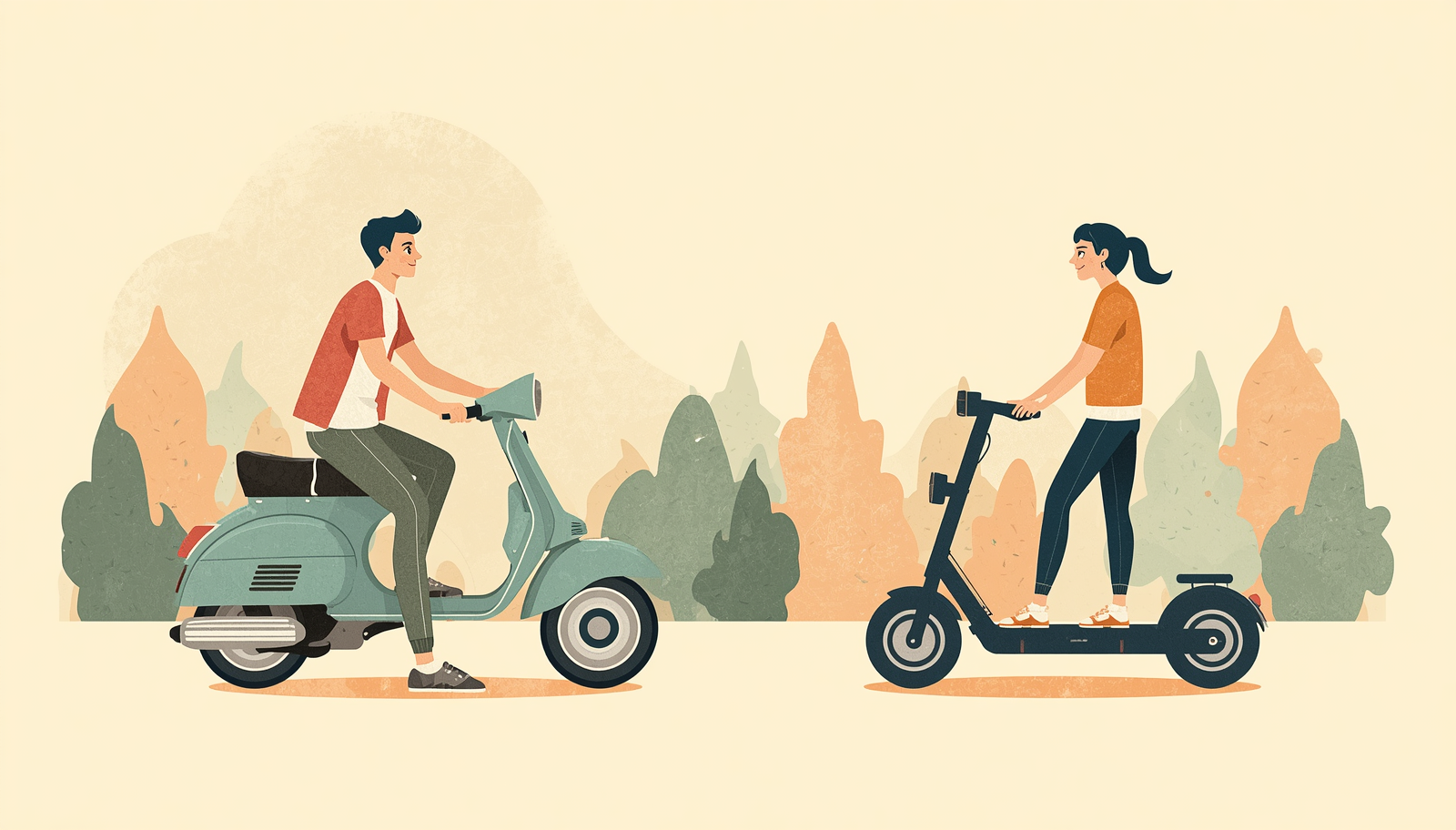
Gen Z and the moped: why today’s teenagers stopped dreaming about the cinquantino
My sister had a Piaggio Sì. I remember it vividly: sleek, with that clean silhouette that felt almost futuristic for the time, parked outside the house with the quiet air of a small conquest. For me, the younger one, it was an object of silent admiration. I used to daydream about the day I would finally get to ride it. Spoiler: I never did.
That scene, multiplied across millions of Italian families in the 1980s and 90s, said something very specific: the cinquantino was a rite of passage, a coveted object with a concrete social role. Turning fourteen and getting a moped were almost the same thing. Today, that connection has broken, and the numbers make it impossible to ignore.
From 311,000 to 12,000: a freefall
Italy’s all-time peak for moped sales was 1980, when 815,000 units were sold in a single year. A figure that today seems almost unimaginable. The decline started gradually, then picked up speed. In 2000, 311,836 mopeds were still being sold. The following year, 175,543: barely more than half. In 2009, sales fell below 100,000 units for the first time.
From that point on, the contraction became structural. In recent years, registrations settled at between 19,000 and 20,000 units, except in 2020, the lockdown year, when they dropped further still. In 2025, things got worse: in the first ten months of the year, around 12,000 mopeds were sold, a decline of more than 24% compared to the same period the previous year. The cinquantino segment lost nearly a third of its share in the overall two-wheeler market, down 31.93%.
All this while the market for larger-engine scooters held steady or even grew. In 2025, scooters confirmed their role as the real engine of demand, up 5.57% to over 197,000 registrations, making it clear that the problem is not with two wheels in general. It is specific to that category of vehicle that for decades had represented the first step toward teenage independence.
The Piaggio Sì and the Vespa: from mass dream to collector’s item
The Piaggio Sì was born in 1978 as an evolution of the Ciao. By the 1990s, it was one of the lightweight mopeds moving young people all across Italy, alongside the Fifty Malaguti and the timeless Vespa. It was more than a means of transport: it embodied the very idea of personal freedom for an entire generation. It remained in production until 2001, when teenagers definitively began to gravitate toward low-wheel-faired scooters.
The Vespa followed a different trajectory, reinventing itself from a beloved popular icon into an accessible global luxury brand. The first Vespa 50, produced from 1963, was marketed as “Young, modern and… no documents required” because, back then, fourteen-year-olds could ride it without a license, plates, or insurance. Since then, Piaggio has produced more than 3 million units of that model alone.
Today, the Vespa is a different creature altogether. By 2021, it had passed 19 million units produced since 1946, with nearly 2 million made in the last decade. It has become a global brand valued at over one billion euros according to brand consultancy Interbrand, described as “historic yet constantly evolving, deeply Italian and loved worldwide, premium and at the same time inclusive.” To celebrate its eightieth anniversary this year, the largest Vespa rally ever was held in Rome.
The Vespa, in short, survived the moped crisis by reinventing itself as a style object for adults. The original teenage dream, on the other hand, has faded.
Why young people no longer want a moped
The reasons behind the decline are several and interconnected. It would be reductive to blame it all on smartphones, even though that theory has been circulating for years and holds a kernel of truth.
The first factor is cost, which has become genuinely prohibitive. Taking the Piaggio Liberty 50, currently the best-selling moped in Italy, as a reference point, the purchase price is around 2,300 euros. On top of that come at least 400 to 500 euros for a certified helmet, jacket, and gloves, plus insurance: for a fourteen-year-old, the average cost of moped liability cover is 613 euros a year, with peaks exceeding 1,000 euros in Campania. Getting the AM license costs another 400 to 500 euros. The total easily exceeds 3,000 euros. A parent buying their child a top-of-the-range smartphone spends less, deals with far less bureaucracy, and faces no risk of a road accident.
The second factor is competition from lighter and easier alternatives. Until recently, the main alternative to the cinquantino was the electric scooter, which could be ridden without plates, insurance, or a helmet. The road code reform in November 2024 added these requirements, but e-scooters remain more convenient because no driving test is required. Then there are e-bikes, which fall under the lighter regulatory category of pedal-assist bicycles. In 2024, Italy registered 21,442 microcars, up more than 25% on the previous year.
The third factor is cultural, and perhaps the most interesting one. A fourteen-year-old of a generation ago dreamed of a moped because it let them be out with friends in the evening, stay out late, reach the town square quickly, and move around independently. A fourteen-year-old today asks for the latest iPhone for their birthday, because that is what they need to connect with their peers: chats, messages, and online games. Buying a moped used to open up a whole world. Today, the smartphone is the key.
How Gen Z gets around in Italy
Abandoning the moped does not mean young people are staying put. The mobility paradigm has reorganized itself around a different logic.
According to a 2023 McKinsey report, European Generation Z is the first to actively prefer flexible, multimodal options: public transport, bicycles, e-scooters, and car sharing are seen as cheaper, more sustainable, and more compatible with an urban lifestyle. In Italy, 71% of young people living in metropolitan areas say they do not need a private vehicle for their daily activities, and 65% say they regularly choose public transport or micromobility solutions.
Mobility is increasingly perceived as an on-demand service rather than a possession. The logic of ownership is giving way to the logic of access: using the vehicle you need, when you need it, without owning it. Driving license data for cars confirms this shift. If 95% of under-20s held a driving license in 2011, by 2021 that figure had fallen to 50%. And for cars, the number of vehicles registered to under-25s in Italy dropped by 43% between 2011 and 2021, falling from over 1 million to 590,000.
What is happening in the rest of Europe
This is not an exclusively Italian phenomenon, though the numbers here are particularly stark.
Across Western countries, more and more young people are choosing not to get a driving license, or are getting it later. In the United States, 43% of sixteen-year-olds had a driver’s license in 1997. By 2020, that figure had dropped to 25%. Across Europe, interest in cars among young people has been declining since the 1990s, driven by more accessible and affordable alternatives.
In Great Britain, the proportion of teenagers who can drive has nearly halved over the past twenty years, falling from 41% to 21%. In five European capitals, Berlin, Copenhagen, London, Paris, and Vienna, the number of car journeys made by workers has fallen significantly compared to the peak of the 1990s.
In Germany, ADAC data shows that driving licenses in the 18-to-20 age group fell by 15% between 2010 and 2020. In Switzerland, a University of Lausanne study found that in 2000, 70% of people in their twenties held a license; by 2015, that figure had fallen to 60%.
What has changed is not just the numbers but the meaning. Not driving is no longer experienced as a gap or a lack. For a growing number of young people in Europe, it is a deliberate choice and, increasingly, a statement of environmental awareness.
Beyond the moped: Gen Z consumption habits are shifting across the board
The disinterest in the cinquantino is part of a broader transformation in Generation Z’s consumption habits, one that cuts across multiple sectors and follows a few consistent threads.
The first is the primacy of experience over ownership. As I wrote in my piece on Ferrero’s seasonal ice creams, certain rituals work precisely because they are temporary experiences, anticipated and then released. Gen Z has internalized this logic at a broader level: what matters is not owning something, but accessing it at the right moment.
In entertainment, this plays out very clearly. According to the “Generations In Play: 2026 Audience Insights” report by Dentsu and IGN Entertainment, 59% of Gen Z users subscribe to a streaming service, watch a single title intensively, then cancel. Between December and January, 37% of Gen Z subscribers canceled at least one streaming service due to subscription fatigue, and another 29% said they planned to do so soon. This is not frugality for its own sake. It is a pragmatic approach to access: pay when you need it, leave when you are done.
Paradoxically, the same generation shows growing interest in cinema as a social experience. Data indicates that people aged 18 to 25 are 13% more likely than older generations to go to the cinema on a film’s opening weekend. The theatre returns as a social event, not as an isolated ritual.
The second-hand market is another area where this generation stands out. The Deloitte Global Gen Z & Millennial Survey 2024 finds that Italian young people’s two main concerns are the cost of living and climate change, and both directly shape their buying behavior: less impulsiveness, more intentionality. The Brandon Group Trend Report 2025 confirms that Gen Z is now the primary driver of the second-hand market, chosen for both economic and environmental reasons.
In 2023, around 60% of car-sharing users in Italy were aged between 20 and 39, confirming that subscription-based or occasional-use solutions are far more appealing to this generation than ownership.
One food-sector figure is worth adding because it captures how deep this cultural shift runs. According to a NielsenIQ survey from 2025, over the last five years, Italian Gen Z consumption has driven a boom in avocado purchases (+317%), ready-made vegetable meals (+120%), energy drinks (+119%), and portioned coffee (+100%). Different products, same underlying logic: convenience, individuality, and consuming exactly what you need when you need it.
Digital connection as the new form of freedom
There is a question that keeps coming up when the decline of the moped is discussed: have young people stopped wanting independence? The answer is that they are looking for it somewhere else.
The moped offered freedom because it allowed physical movement without depending on adults, a way to reach friends, and the ability to be present where things were happening. Today, part of that presence has shifted. Continuous, seamless digital connection has partly replaced the need to travel physically. Not entirely, not necessarily better, but sufficiently to make the moped feel less urgent.
According to the Pew Research Center, 98% of Generation Z use the internet regularly, averaging about 6 hours and 40 minutes online per day. And 92% spend more than three hours a day on their phones, mainly on social media and short-form video.
This does not mean Gen Z is passive or uninterested in physical experiences. Cinema data contradicts that, as do figures on youth travel, concerts, and festivals. This means mobility has lost its symbolic function as a rite of passage. Getting behind the wheel, or the handlebars, is no longer the gesture through which young people declare independence from their parents. That gesture now looks different, less visible but no less real.
As I explored in my piece on how many apps we actually use on our phones, digital life concentrates around a small number of genuinely useful tools. The ones that earn their place. For many young people today, a moped does not make that list.
A shift in paradigm that goes deeper than behavior
The move from ownership to access is not just about physical goods. It is about how identity and social status are built.
For entire generations, the things you owned were part of how you presented yourself to the world. The car, the moped, the house: they were signals of belonging and autonomy. Gen Z expresses identity through different channels: the content it creates and shares, the communities it belongs to, the causes it supports, and the consumption choices that align with its values. As I discuss in my piece on Web 3.0, crypto, and the future of payments, the value of what we own is increasingly measured not in physical terms but in experience and access.
The result is a generation that, at least in urban areas and places with adequate infrastructure, finds its freedom without necessarily passing through a set of handlebars. That is not an impoverishment. It is simply a different road.
Related sources
- ANCMA (Confindustria, National Association of Cycles, Motorcycles and Accessories), Market data 2025, ancma.it
- Moto.it, Mercato moto e scooter 2025: dati vendite, classifica modelli e analisi dei trend, January 2026
- Scooter Magazine, Mercato 2025: i dati finali, January 2026
- Il Post, I ragazzi non vogliono più i cinquantini, November 2025
- Dueruote, Perché nessuno vuole più i cinquantini?, November 2020
- Sportmediaset/Drive Up, Finita l’era dei cinquantini per i giovani: il mercato si è ridotto del 96%, November 2025
- Il Sole 24 Ore, Vespa, ottant’anni e non sentirli, April 2026
- Il Post, Giriamo in Vespa da ottant’anni, April 2026
- Bikeitalia.it, Che orrore, i giovani d’oggi non vogliono più guidare, June 2025
- Repower Sustainable Mobility, Acquisto auto: il mercato e il fattore Gen Z, February 2025
- NSS Magazine, La Gen-Z contro la patente: il nuovo fenomeno, October 2024
- Il Bo Live (University of Padua), I giovani non vogliono più comprare un’auto
- Dentsu and IGN Entertainment, Generations In Play: 2026 Audience Insights Report, 2026
- Deloitte, Global Gen Z & Millennial Survey 2024, deloitte.com
- Brandon Group, I principali trend di consumo della Gen Z nel 2025, July 2025
- NielsenIQ, Survey on Gen Z food consumption in Italy, 2025
- McKinsey & Company, The Future of Mobility, 2023
- Virgilio Motori, Piaggio Sì, la storia del motorino evoluzione del Ciao, September 2024
- Linkiesta, Altre priorità: la Generazione Z senza patente e il rischio di scordarsi della provincia, February 2023
