
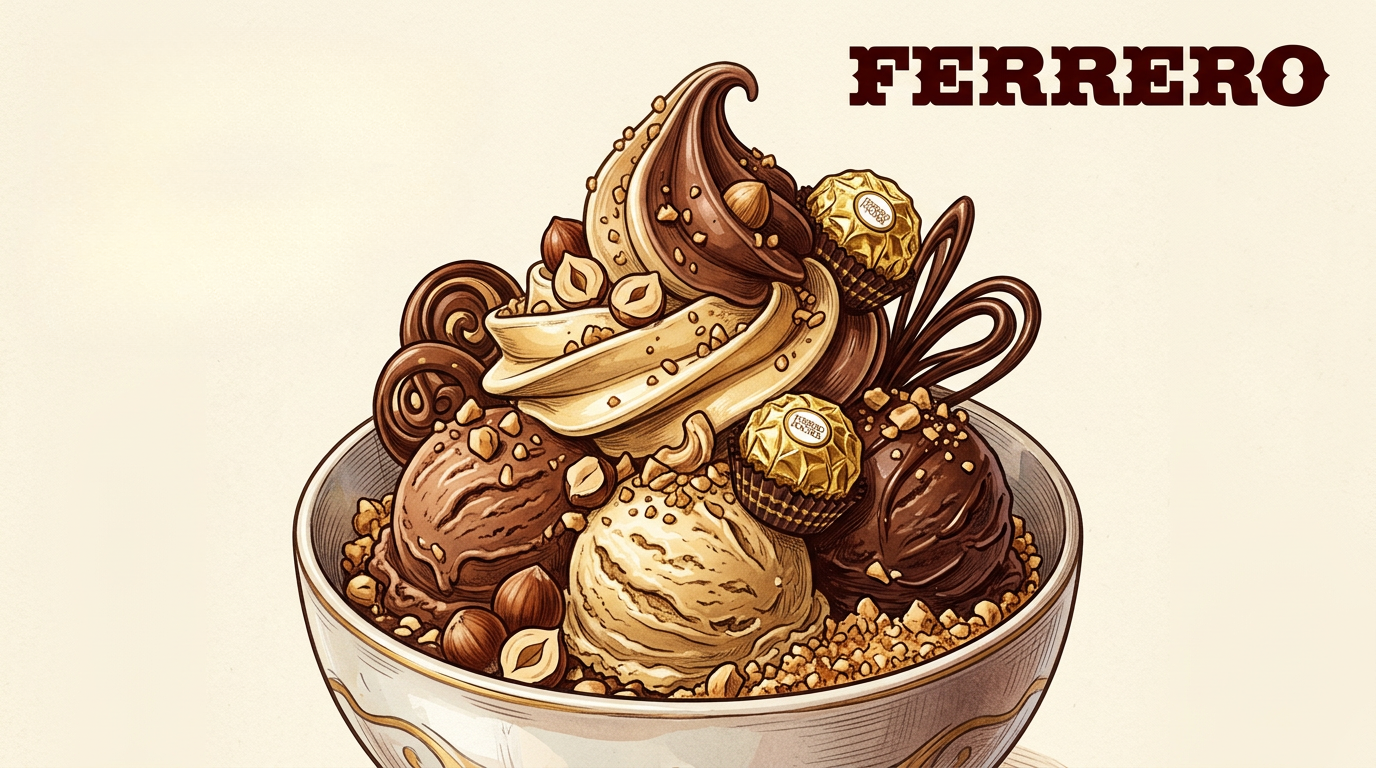
Ferrero diversifies for seasonality
Every year, between April and May, something fairly rare happens in the consumer goods world: a multibillion-euro company voluntarily removes its flagship products from shelves. Ferrero Rocher disappears. Pocket Coffee, too. Mon Chéri as well. Nobody is particularly surprised anymore because, after decades of transparent communication on this point, Italian consumers have learned to expect it and, in some ways, appreciate it.
What might look like a revenue sacrifice is actually one of the most consistent brand strategies in the European food industry. Ferrero understood before most others that the perceived quality of a product depends partly on the experience of the first bite, and that a Rocher softened by July heat is no longer a Rocher. So the company chose absence over a poor version of itself.
Why heat is the real enemy of chocolate
The critical threshold is well known in the industry: above 18 degrees Celsius, chocolate begins to lose structure, and between 22 and 25 degrees, fat separates, producing a whitish surface coating, technically called fat bloom, which is harmless but visually off-putting. Ferrero Rocher, Pocket Coffee, and Mon Chéri are products with delicate fillings, thin shells, and a precision of construction that makes them particularly vulnerable to temperature fluctuations in the Italian distribution chain, where a truck without active refrigeration, a poorly climate-controlled warehouse, or a shelf exposed to direct sunlight can ruin weeks of production.
Ferrero’s answer to this problem is simple in logic and demanding in execution: full withdrawal from spring through early autumn, and a return in October with communication that has, over the years, become something like an anticipated seasonal event. The Pocket Coffee website still has a dedicated FAQ page titled “withdrawal and return” that lays it all out with disarming clarity.
Raffaello holds on, and that is no accident
Not every Ferrero product goes on holiday. Raffaello, the white chocolate with wafer and coconut, stays available year-round because its formulation, free of dark chocolate, handles summer temperatures better. Ferrero has turned this technical detail into a commercial advantage: Raffaello becomes the summer gift product for anyone who still wants to bring something Ferrero to a beach aperitivo or a July dinner.
The answer to the summer gap: ice cream
Seasonality required a constitutional solution, and Ferrero found it in packaged ice cream. Over the past four years, the company’s ice cream division has recorded 42.3% growth, compared with 7.4% for the overall market, a gap that tells a story of successful positioning rather than simple luck. The Italian packaged ice cream market is worth more than €1.5 billion in 2024, and Ferrero now offers 27 active products across sticks, cones, popsicles, and tubs.
To produce this range at scale, Ferrero acquired Ice Cream Factory Comaker, a Spanish company based in Alzira, Valencia, in 2019. An industrial move that gave the company the necessary production capacity without building from scratch, and allowed it to keep ice cream production in Spain while maintaining the core of its chocolate business in Italy.
The coordinated European launch of Rocher and Raffaello ice cream sticks
The first chapter of the ice cream strategy was the simultaneous launch of Ferrero Rocher and Raffaello ice cream sticks across five European countries: Italy, France, Germany, Austria, and Spain. Not a market test, but a direct entry at continental scale into a segment, the ice cream stick, that accounts for 18% of the European ice cream market. The positioning was clearly premium, with pricing consistent with the image of the original products and packaging, which recalled the pralines’ aesthetic.
The choice to start with these two ice cream brands reflects a cautious brand-extension logic: you begin with what consumers already know and trust, reducing the need to explain the product. The Ferrero Rocher ice cream stick needed no introduction.
Estathè Ice: the Italian exception that became a talking point
The story is different for Estathè Ice, the tea-flavored popsicles in peach and lemon. This product remained an Italian exclusive, and the reason is fairly clear: Estathè is a brand with an entirely Italian history, launched by Ferrero in the 1970s and established as the go-to iced tea for generations of consumers in this country. Exporting it to Germany or France without that history behind it would have required brand awareness work that made no commercial sense.
The logic of the Estathè popsicle mirrors, in miniature, the seasonal withdrawal of chocolates: the tetra pak drink also suffers in high temperatures during distribution and storage, and transforming it into a popsicle meant bringing the same brand into a format built for the heat rather than fighting it. On TikTok, Estathè Ice tasting videos circulate regularly every summer, often from people discovering it for the first time and reacting with the curious surprise of someone finding an obvious idea that somehow did not exist before. The popsicle format gave new life to an already loved brand, reaching a younger audience that perhaps no longer buys iced tea in cartons.
Advertising, from Ambrogio to today
Talking about Ferrero without at least a mention of the communications machine behind all this would be incomplete. Ferrero invests around €800 million per year globally in communications, with an estimated €150 to €200 million allocated to Italy alone, one of the highest proportions in Europe relative to the size of the local market.
Ferrero’s advertising tradition spans decades. The 1990s ads featuring Ambrogio, the elegantly dressed butler carrying a tray of Ferrero Rocher and delivering the line “ho un leggero languorino” (“I have a slight pang of hunger”), became part of Italian popular culture well beyond their commercial function, to the point where they are still cited today as examples of effective advertising storytelling. I wrote about this in my piece on how ads used to be short films and the lasting myths older campaigns could build.
For ice cream, the register shifts. The 2022 ad for Ferrero Rocher ice cream used “Blinding Lights” by The Weeknd as its soundtrack, set against a relaxed, everyday scene of a young man on the sofa enjoying a stick in summer, miles away from Ambrogio’s tuxedo elegance. The implicit message was exactly right: Rocher ice cream is for every day; chocolate is for occasions. Two distinct positionings for the same brand.
For the launch of Nutella Ice Cream in June 2024, Ferrero chose an immersive experience in Piazza Municipio in Naples, with tastings and activations over two days, followed by a television campaign managed by the in-house agency Pubbliregia. An integrated communication effort that worked: on social media, the launch generated thousands of organic pieces of content from consumers going to supermarkets to find it, often discovering empty shelves in the first few weeks.
Gran Soleil: the product Ferrero could not quite make people love enough
In 2006, Ferrero launched Gran Soleil, a single-serving lemon sorbet (later in other flavors as well) sold in supermarkets and designed to be frozen a few hours before eating. The idea was interesting: a practical, packaged sorbet with the Ferrero name on it, to serve as a post-meal dessert or summer snack.
For a few years, it worked. Then, in 2014, the product was quietly withdrawn. The official reasons were vague, but the underlying problem was structural: Gran Soleil did not quite know what it wanted to be. Too similar to a granita to be an elegant dessert, too complicated in its storage instructions to be as convenient as an ice cream stick, too expensive for its size. The positioning confusion, combined with the difficulty of finding it in stores (it was displayed at room temperature but needed to be frozen at home), slowly eroded its appeal.
What is interesting, though, is what happened after the withdrawal. Gran Soleil became a classic object of Italian collective nostalgia, one of those things people describe as “impossible to understand why it no longer exists.” A Change.org petition asking Ferrero to bring it back still exists. Il Fatto Alimentare has written about it multiple times. In the comments of certain Italian food posts on Facebook, the name Gran Soleil appears with a frequency disproportionate to that of a product that has been off the market for more than ten years.
The takeaway is twofold: Ferrero can get a product wrong like anyone else, but even its commercial mistakes manage to build affection. Not many companies can say the same about their flops.
Nutella Ice Cream: my favorite, and not only mine
The ice cream that generated the most noise among all of Ferrero’s frozen launches was, without a doubt, Nutella Ice Cream, released in June 2024 in a 230-gram tub. The formula is the right one: a layer of hazelnut ice cream with Nutella ribbons running through it, a structure that balances the ice cream’s creaminess with the hazelnut spread’s density, allowing you to recognize the original flavors immediately without overpowering them.
I will admit this one is my personal favorite. And apparently I am not alone: the launch triggered what could fairly be described as supermarket raids, with shelves cleared in the first few weeks and waves of social content from people searching for it or tasting it for the first time. The price of around €4.99 for the 230-gram tub struck many as high-end but consistent with Nutella’s premium positioning.
Nutella Ice Cream was named Product of the Year 2025, alongside the Nutella Croissant, confirming a clear pattern: expanding the Nutella brand into categories beyond the spreadable cream works, and works well, because the trust consumers place in the name transfers without friction onto new formats. The same logic that made the Biscuits a runaway success in 2019.
The product is available in nine European countries, including France, Germany, Austria, and Spain, as well as Italy, confirming that this time Ferrero had no intention of staying within the domestic market alone.
The Ferrero myth does not fade
There is something special in the relationship between Ferrero and Italian consumers that goes beyond product quality or the consistency of communications. It is an affection that forms early, in childhood, with the Kinder egg and the Baci di dama, and that then sediments over the years through the Rocher on elegant buffet tables, the Mon Chéri on rainy afternoons, Nutella as a mental category before it is even a product.
Ferrero has built this brand capital on decades of consistent behavior: never compromising on quality, never dropping the premium positioning, communicating with continuity, and when a product risks falling short of expectations, removing it rather than letting it deteriorate on shelves. Even the Gran Soleil, which was a commercial failure, left the overall reputation intact and actually added a note of humanity to a company that might otherwise seem impervious to mistakes.
The summer ice cream strategy fits into this logic precisely: Ferrero does not disappear in summer; it transforms. The chocolate Rocher makes way for the ice cream stick. The Estathè in its carton becomes a popsicle. The Nutella in its jar becomes a tub. The format changes, the promise stays.
This brand is one you can trust, and in a food market where consumer trust is an increasingly fragile and increasingly contested variable, that is the real asset Ferrero protects. Far more carefully than it protects chocolate from summer heat.
Related sources
- Ferrero: for us, quality comes first (summer withdrawal of Rocher, Pocket Coffee, Mon Chéri)
- Pocket Coffee: withdrawal and return FAQ
- Nutella transforms and becomes ice cream, too, according to the Ferrero press release
- Nutella Ice Cream and the social media mania, Food Affairs
- Ferrero ice creams: premium novelties for the 2025 season, HorecaNews
- Estathé Ice: the iced tea becomes a popsicle, Il Fatto Alimentare
- Gran Soleil, the Ferrero sorbet that disappeared from shelves, Il Fatto Alimentare
- Whatever happened to Gran Soleil? From boom to flop in 8 years, Il Giornale d’Italia
- Ferrero’s biggest flop, Metodo Merenda
- Change.org petition: Ferrero, bring Gran Soleil back to market
- Nutella becomes a tub ice cream, €435m segment, Unindustria
