
Secondhand in Italy: my relationship with used goods, from Kijiji to Vinted
Italy’s secondhand market is now worth 27.2 billion euros, according to the Second Hand Economy Observatory run by Ipsos Doxa for Subito, and in 2025 more than six Italians in ten bought or sold something used. I belong to that majority, but my relationship with it is one of love and hate. To explain why, I have to go back to the days when growing classifieds was my job.
Five years at Kijiji, between job listings and rooms for rent
I worked for five years at Kijiji, the free classifieds site eBay launched in 2005 in six countries, Italy included (the name means “village” in Swahili). Of all the categories, the two I believe truly served people were Jobs and Rooms for rent. There, a listing wasn’t an object to unload but a piece of life: a job, a bed in a new city.
When I went on maternity leave, there was a clear plan on the table: turn Kijiji into a vertical devoted solely to jobs, and leave eBay Annunci the role of horizontal platform, the place where you sell everything. When I came back, I found the picture turned upside down. The eBay Annunci brand had been eclipsed, and Kijiji alone covered every category, from electronics to strollers.
In my view, that was a strategic mistake. A generalist brand without a clear calling struggles to stand out, and meanwhile Subito kept growing. In 2021 eBay sold its entire classifieds division to Adevinta, which already owned Subito, and in 2022 Kijiji.it shut down, sending its users over to its old rival. A shipwreck foretold, washing ashore at the competitor’s door.
Why selling used items in person has always made me uncomfortable
As a consumer, I’ve always had a conflicted relationship with secondhand. Not out of snobbery: I simply find it hard to deal with people for commercial purposes, especially face to face. Tight haggling over a few cents, people pleading for an item until they get it for free, missed appointments: all of it has always grated on my nerves. At that point, I’d rather give things to whoever I say.
Those exhausting negotiations have a scientific explanation, too. In 1990 Daniel Kahneman, Jack Knetsch and Richard Thaler described the endowment effect: people who own something tend to value it far more than those who would like to buy it. In their mug experiments, owners asked for more than twice what prospective buyers were willing to pay. Seller and buyer start from two different prices already set in their heads, which makes haggling all but inevitable.
Vinted and the no-meetup model
Vinted set out to innovate on exactly this front: removing in-person exchanges, guaranteeing payment and generating automatic feedback. It was the right answer to everything I couldn’t stand on Kijiji or eBay Annunci, and the numbers prove it right. In 2025 the Lithuanian platform passed 1.1 billion euros in revenue (+38%), with 10.8 billion in transaction volume, even though net profit fell to 62 million because of investments in logistics and new markets.
The buyer pays for this model, though. Buyer Protection costs a flat 0.70 euros plus 5% of the item price, with shipping on top. In 2022 Italy’s antitrust authority fined Vinted 1.5 million euros over this very fee, charging that it had failed to show consumers their costs clearly from the first contact. I touched on this when writing about dark patterns turning into a legal risk.
Vinted’s non-binding offers
Then there’s a mechanism I find especially annoying. On Vinted, users can propose a lower price, but the offer isn’t binding the way it is on eBay, where an offer the seller accepts commits the buyer to complete the purchase. So you accept, wait for the payment, and watch the other person vanish into thin air. Maybe they changed their mind, maybe they found a better deal elsewhere, but to me, anyone who makes an offer should stand by it. Otherwise we’re back, in digital form, to the missed appointment.
eBay returns to consumer to consumer, its original calling
Meanwhile eBay, after its long “new in stock” phase, when it looked more and more like an online distribution chain, is refocusing on consumer to consumer, its historic core, and leaving Amazon a near-unassailable lead in new goods. Since September 1, 2026, private sellers on eBay.it no longer pay final value fees, while buyers pay a protection fee: 0.10 euros per item plus a tiered percentage starting at 7% on the first 20 euros. The scheme mirrors Vinted’s almost to the letter.
When Vinted doesn’t pay off: low-priced items
Still, Vinted isn’t the winner that takes it all. For cheap items it becomes a poor deal, and then some, because shipping has a cost and the game isn’t worth the candle. On a 4-euro T-shirt, Buyer Protection adds 0.90 euros and the courier a few more: the buyer ends up paying almost double, so they either bargain down or give up.
I’d call it a closet-clearing tool with limited returns, except for items that are truly hard to find, which was eBay’s original mission anyway. The data backs up my impression: according to the Observatory, 59% of people who buy secondhand say it improves their household’s well-being, but among sellers the share drops to 26%.
I’m experimenting myself, selling a few things there and gladly chatting with buyers, as I described in Infinite scroll, last stop. Yet the more parcels I pack and pickup points I hunt down, the more I think giving those things away would have been better. Without even having to leave the house.
The “I’ll give it to you if you come and get it” Facebook groups
In the Facebook groups called “Te lo regalo se vieni a prenderlo” (“I’ll give it to you if you come and get it”), found in cities all over Italy, well-equipped armies show up within hours, ready to dismantle half a home and load it into their cars. The network was born in Switzerland in 2011, the idea of Ticino-based trainer Salvatore Benvenuto, who was struck by how many working objects ended up in the trash. Today in Italy it counts more than a hundred pages and groups, organized by province, city and neighborhood, with over a million subscribers overall; the Milan group alone has more than 80,000 users.
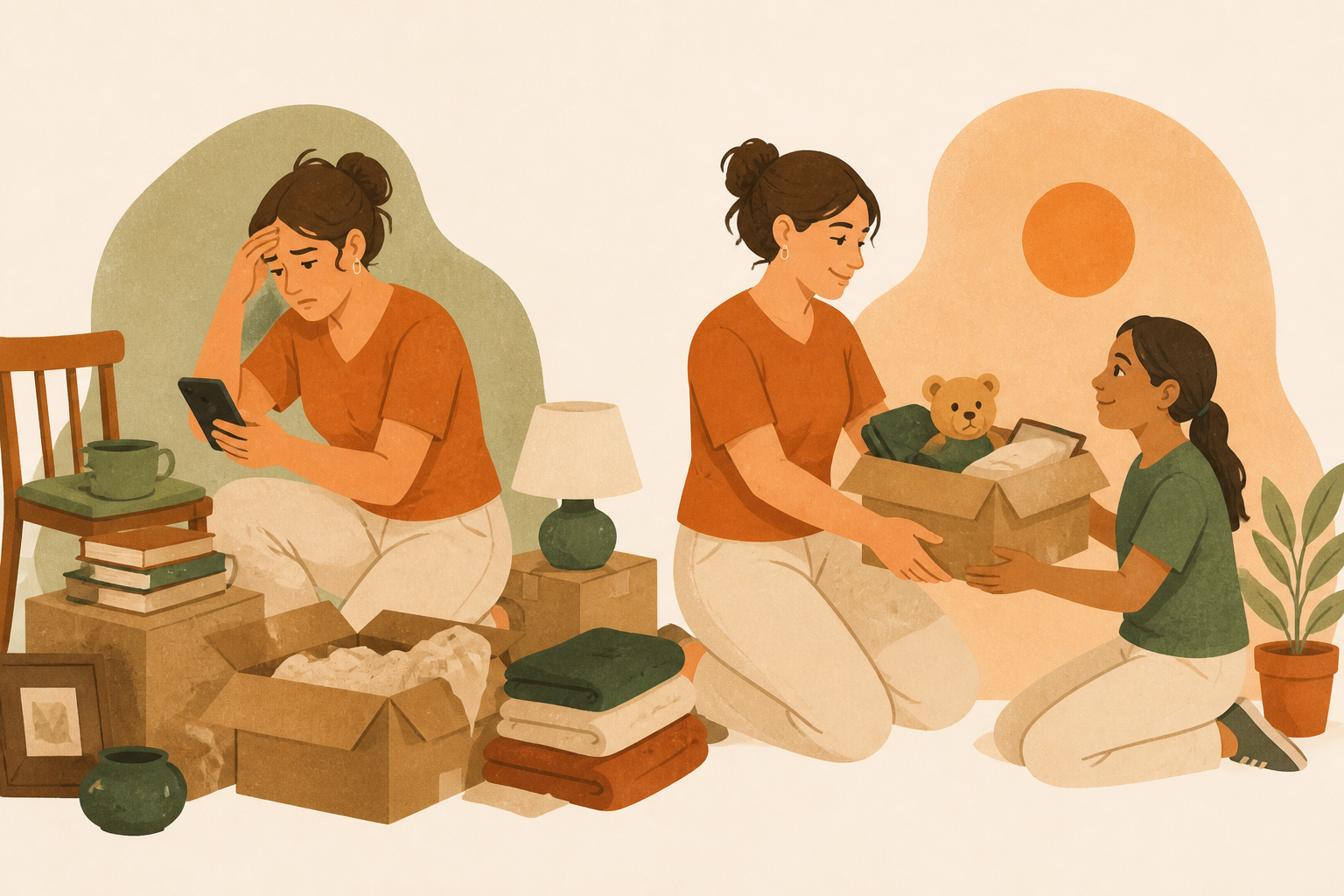
The rules are simple and, for someone like me, reassuring: only private individuals take part, the giver decides, and whoever arrives first doesn’t necessarily win, while anyone who fails to show up for a pickup gets reported and often removed. These groups saved me when I had to empty my parents’ apartment before selling it, and they’ve also helped me get rid of furniture, clothes and toys I no longer needed.
Giving makes us happy: what the research says
That giving feels good is more than a hunch. In 2008 Elizabeth Dunn, Lara Aknin and Michael Norton published a study in Science showing that people who spend money on others report higher happiness than those who spend it on themselves, for the same amount. Giving away an object isn’t the same as spending, of course, but the mechanism is similar: the satisfaction of knowing that something of ours is useful to someone else.
Then there’s the environmental side, which applies to selling and giving alike. According to ThredUp’s 2026 Resale Report, secondhand apparel is worth 393 billion dollars worldwide, about 10% of total clothing spend, and grows twice as fast as fashion overall. Every garment that changes hands is one less garment to produce, and I’ve already shared my doubts about brands’ green promises in Greenwashing, the party’s over.
Subito, Marketplace and my final verdict on secondhand
Subito and Facebook Marketplace, I admit, don’t feel like a fit for me: they replicate the bargaining dynamics I’ve always struggled to handle. I prefer the groups.
Having tried more or less every platform, my impression hasn’t changed. When time is short and the items are ordinary, with little commercial value, giving them away is the better choice. It’s faster, because there’s no haggling; painless, because all it takes is waiting for someone to come and collect; and generous, because it does some good. Vinted and eBay remain great for the rare piece, the one somebody has been hunting for years. For everything else, my closet has found a shorter route.
Related sources
- Cresce il mercato dell’usato nel 2025: compravendite per 27,2 miliardi di euro (Quotidiano.net, Second Hand Economy Observatory by Ipsos Doxa for Subito)
- Vinted reaches 1.1 billion euros in revenue for 2025 (FashionUnited)
- Vinted: guida per acquistare e vendere in sicurezza (Altroconsumo)
- Cos’è questa storia delle commissioni di Vinted? (Rolling Stone Italia)
- eBay goes fee-free for private sellers in France & Italy (Value Added Resource)
- Anche in Italia eBay lancia Kijiji (01net, 2005)
- Kijiji chiude, acquistato da Subito (TuttoTech, 2022)
- Adevinta completes acquisition of eBay Classifieds Group (Adevinta)
- Un milione di italiani regalano oggetti su Facebook (Businessonline)
- “Te lo regalo se vieni a prenderlo”, la seconda vita degli oggetti (Tio.ch)
- Experimental Tests of the Endowment Effect and the Coase Theorem (Kahneman, Knetsch, Thaler, Journal of Political Economy, 1990)
- Spending Money on Others Promotes Happiness (Dunn, Aknin, Norton, Science, 2008)
- ThredUp’s 14th Annual Resale Report (ThredUp/GlobalData, 2026)
