
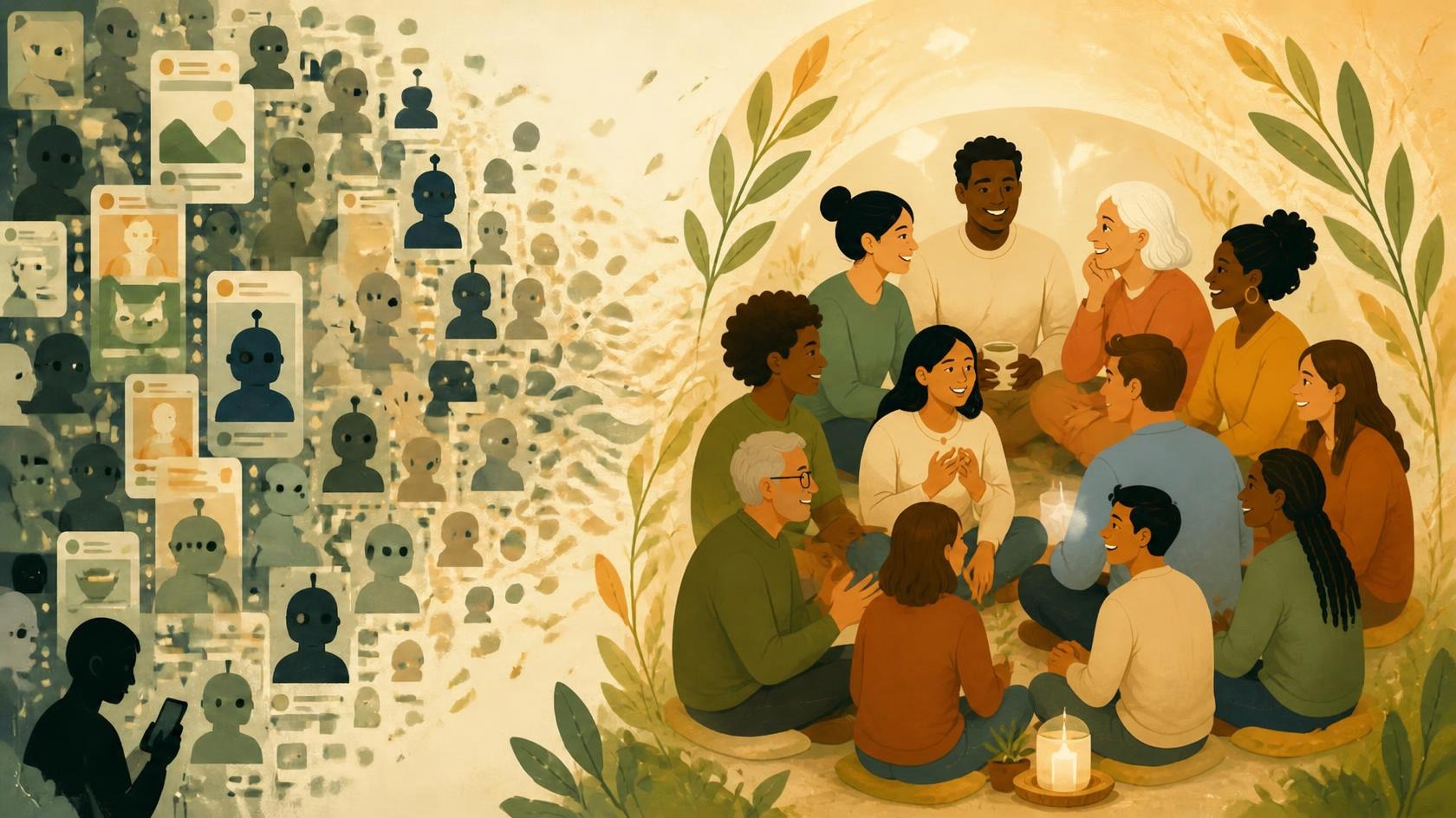
Infinite scroll on the way out: creators move to private communities
The decline of infinite scroll is a forecast that has been making the rounds more and more often among people who work in social media and the creator economy. The reason, in my view, lies in the algorithms. Platforms are optimizing them less and less to show content to followers and communities, and more and more for a vast, undifferentiated audience where bots, AI agents and machines move alongside people. In a stream like that, a creator’s voice risks getting lost among millions of synthetic posts and automated views.
Bots and AI agents have overtaken human traffic
The numbers give a sense of scale. According to Imperva’s (Thales) 2025 Bad Bot Report, bots already generated 51% of web traffic in 2024, the first time in a decade, and malicious bots alone accounted for 37%. This year Cloudflare, which sits in front of more than 20% of the web, recorded automated traffic overtaking human traffic. At the end of September, CEO Matthew Prince told The Verge that within five years machines could generate a thousand times more traffic than people, while human traffic stays roughly flat.
On social media the effect is twofold: there is more AI-generated content, and more automated accounts watching, commenting on and resharing it. Views and likes, the metrics the feed runs on, are becoming an ever less reliable sign that a human is present.
Instagram admits the feed is dead
Adam Mosseri, head of Instagram, said it openly in the reflection he published at the end of 2025. According to Mosseri, the feed of polished photos is dead: people stopped sharing personal moments there years ago, and today photos and videos travel mostly through direct messages, full of blurry shots and unflattering candids. In the same piece he predicts that AI-created content will soon outnumber content captured with a camera and that authenticity will become a scarce resource. His prescription: label AI, but above all verify real content at the source and surface credibility signals about who is posting.
It strikes me that the person shifting the center of gravity from the feed to conversations runs one of the most scrollable apps in the world. I touched on this in Posting zero, social like TV: we went from users to spectators, and anyone who still wants to express themselves does it elsewhere.
The European Union also puts infinite scroll on trial
Regulation is speeding up the feed’s decline too. In February 2026 the European Commission preliminarily found that TikTok breaches the Digital Services Act through its addictive design: infinite scroll, autoplay, push notifications and a highly personalized recommender system. For Brussels, screen-time tools and parental controls aren’t enough, and the very architecture of the service would have to change, starting with that stream of content that never runs dry. The topic is close to The design of silence, where I described product teams redesigning badges and notifications to ease cognitive load.
Broadcast channels and private communities: the new spaces of trust
If the feed turns into a square crowded with machines, creators look for more intimate spaces. Instagram introduced broadcast channels in 2023, and TikTok has started testing a similar tool called bulletin boards. With these channels, brands and creators send updates and behind-the-scenes content straight to whoever chooses to subscribe. Alongside them, newsletters, closed groups, Telegram and WhatsApp channels and Discord servers keep growing: places with a smaller audience but more attention, where people interact up close and confirm to each other that they’re not bots.
For anyone in communications, the perspective flips. Reach matters less and relationships matter far more: a few hundred attentive readers are worth more than thousands of views whose origin nobody knows.
On TikTok and Vinted, I’ve already chosen close circles
I’ve made this move myself, almost without noticing. On TikTok I subscribed to my favorite creators’ private channels, where I find a more personal tone, far from the noise of the feed. On Vinted, meanwhile, I chat with the people who buy my items and give those exchanges a genuinely friendly, relational value that goes beyond sizes and shipping.
As I wrote in Loneliness, AI cashes in, I can’t have a real interaction with a machine: everything feels too synthetic and too fast. These digital living rooms work because on the other side there’s someone who answers in their own time, with their own imperfections and their own voice.
Related sources
- Bots now account for over half of all internet traffic, TechRadar (Imperva Bad Bot Report 2025)
- Cloudflare’s Prince tells The Verge bots could be 1,000x human traffic, The Next Web
- Adam Mosseri suggests highlighting ‘real media’ rather than AI content on social media, BetaNews
- European Commission says TikTok’s addictive design breaches DSA, Society for Computers & Law
- TikTok is testing its own version of Instagram’s ‘broadcast channels’, TechCrunch
