Posting zero: why we stopped posting on social media
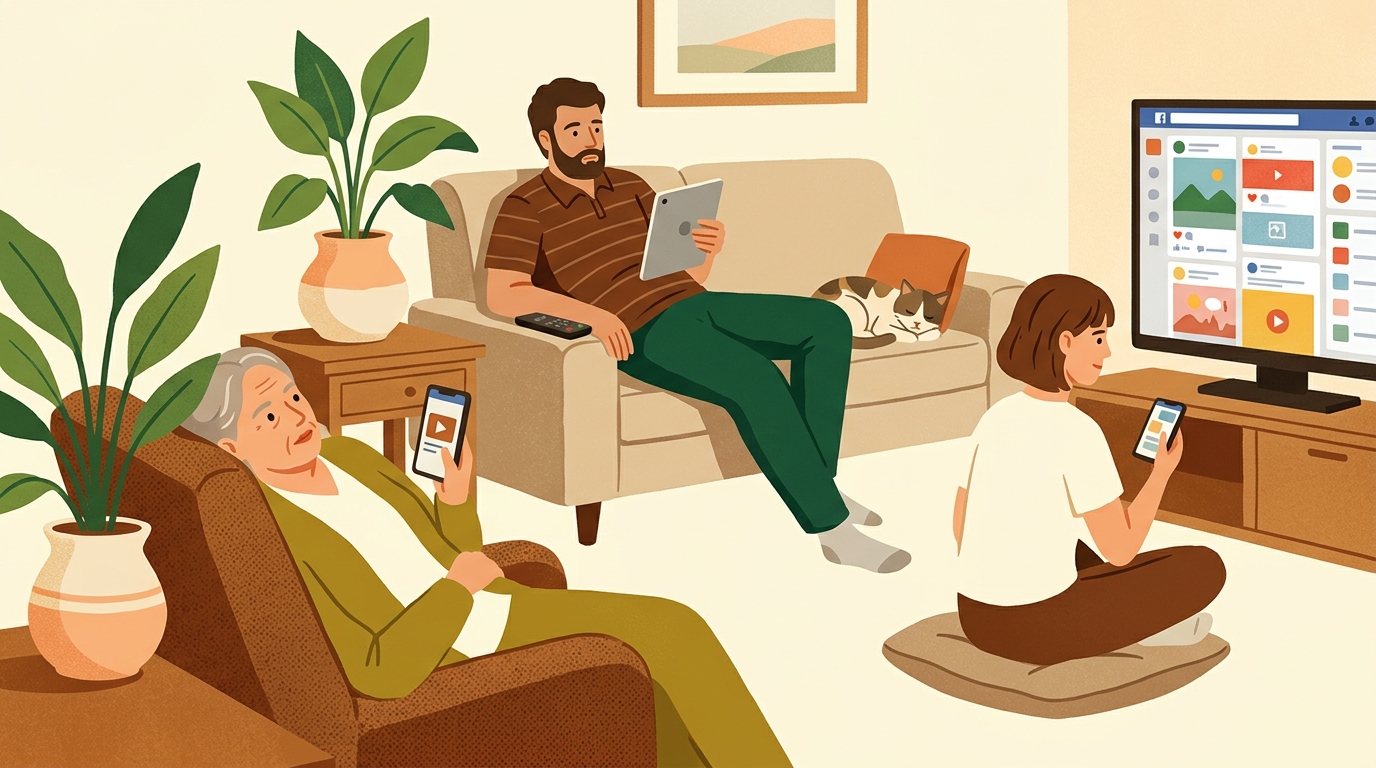
I open Instagram, scroll, watch, close it. Then I move to Facebook and repeat the ritual. Somewhere in between, not a single piece of content comes from me. I remember one of my last “organic” posts very well, meaning personal ones with no professional agenda: it goes back years and its star is a refrigerator. I’ll come back to it later, because it explains a lot. In the meantime, I discover I’m part of a much wider phenomenon. This trend even has a name, posting zero, coined in November 2025 by Kyle Chayka in his New Yorker column. It describes the point where ordinary people stop sharing their lives online while still hanging around the platforms. We have become an audience, sitting in front of a feed that looks more and more like a TV schedule.
The numbers behind the decline: fewer friends in the feed, less time online
The clearest signal comes, paradoxically, from a courtroom. In the ruling on the antitrust case the FTC brought against Meta, Judge James Boasberg put it in black and white: Americans spend only 17% of their time on Facebook viewing content from friends. On Instagram the share drops to 7%. The rest is material pushed by the algorithm: creators, celebrities, viral videos, ads.
Overall time is shrinking too. A Financial Times analysis of GWI data (250,000 adults in more than 50 countries) places peak usage in 2022. By the end of 2024 the daily average had fallen to 2 hours and 20 minutes, roughly 10% less, with the sharpest drop among teenagers and people in their twenties. The detail that struck me most concerns motivation. Since 2014, the share of people who say they use social platforms to stay in touch with friends, express themselves or meet new people has fallen by more than a quarter. What keeps growing instead is opening the app on reflex to fill idle moments.
The picture in Italy is similar. According to Audicom-Audiweb data analyzed by Vincenzo Cosenza, between the first nine months of 2024 and the same period of 2025, X lost 27.6% of its users and Facebook about one million people. Meanwhile TikTok, the platform closest to television in how it is consumed, saw time spent grow by 27%.
Then there is an admission from the inside. Adam Mosseri, head of Instagram, wrote on Threads that people share less to their feeds, more to stories and even more in private messages. In short, personal life has changed address and moved backstage.
Fear of judgment, even from friends
Back to the refrigerator, which marks my farewell to carefree sharing. Years ago, before leaving for a weekend, I took a photo of the open fridge to show off the stock of supplies set aside for my partner and my son, ahead of their PlayStation and TV series marathons while I was away. I just wanted to be a little ironic. The comments, written by contacts I knew rather than by strangers, focused on something else entirely: where the appliance stood, the furniture next to it, the clear plastic cover on the wooden table. Nobody got the joke, everybody noticed the décor. It killed my urge to joke around and, as it turns out, my urge to post as well.
Research confirms that this kind of self-censorship is extremely common. Back in 2013, a study by Sauvik Das and Adam Kramer, covering 3.9 million Facebook users over 17 days, found that 71% had written something and then decided at the last moment not to publish it. Posts were discarded more often than comments, and people with a more varied audience to manage tended to filter more.
Alice Marwick and danah boyd (who writes her own name entirely in lowercase) christened this mechanism context collapse. On social media your coworker, your aunt, an old high school classmate and the neighbor next door all read the same message, and each of them interprets it by their own standards. So a photo meant to make a few people smile turns into an exhibit open to everyone’s scrutiny.
An algorithm that turned social media into a TV schedule
The second cause is technical, but its cultural effects run deep. For years the feed mostly showed what the people we knew were sharing. Then, under pressure from TikTok, Meta shifted its center of gravity toward recommended content: reels from strangers, news, gossip, stars. Zuckerberg himself, testifying at the trial, acknowledged that the friendship dimension has lost its central role.
The result is an experience very close to network TV: a continuous stream chosen by others, in which the viewer plays no active part. If my vacation photo ends up squeezed between a soccer player’s video and a report on a government crisis, the motivation to share it fades. Without the feeling of speaking to a community, posting becomes a drop in the ocean.
Personal data: the awareness that holds us back
Third factor: today we know far more about what happens to whatever we put online. In 2018 the Cambridge Analytica scandal showed how data from tens of millions of profiles could end up in third parties’ hands. More recently, Meta announced that starting in late May 2025 it would use European users’ public content to train its AI models unless they explicitly objected. Italy’s data protection authority, the Garante, published detailed instructions on how to exercise that right.
The distrust is measurable. According to the Pew Research Center, 77% of Americans have little or no trust in social media leaders to admit mistakes in handling data. Among people familiar with AI, 81% fear that the information collected will be used in ways people would not be comfortable with. Every photo of the kids, every tagged location, every opinion becomes material that could be reused, and staying silent looks like the safest choice.
Performance anxiety over likes and story views
Then the metrics come into play, measuring every gesture. A freshly published piece of content is weighed immediately: how many hearts, how many comments, who watched the story and, above all, who didn’t. Instagram itself began testing hidden like counts in 2019 precisely to ease social pressure, and since 2021 it has let everyone hide them. If a platform felt the need to step in, the psychological weight of those numbers is obvious.
And so a spontaneous gesture turns into a small exam. People calculate the right time, pick the filter, anticipate the reactions. Many prefer to avoid the risk of a disappointing response altogether, or fall back on their close friends list, where judgment feels less threatening.
Fatigue from overexposure and overstimulation
The last cause is perhaps the easiest to recognize: we are tired. A meta-analysis published in 2023 in Computers in Human Behavior, covering 64 studies and more than 28,000 participants, identifies information overload, social overload and feature overload among the main drivers of social media fatigue. That exhaustion directly affects the intention to cut back on the platforms or leave them altogether.
I have already written about this in the context of personalization fatigue: when everything is designed to capture attention, attention runs out. Watching takes less energy than producing, and so we slide into the role of spectators, a bit like sitting on the sofa in the evening with the remote in hand. For anyone looking for a different balance, I gathered a few ideas in Less screen, more presence.
What changes in practice for people, brands and platforms
Posting zero has concrete consequences that go beyond nostalgia for the old feeds.
For people, social life migrates to group chats, direct messages and close friends lists. The flip side is that the visible part of social media stays in the hands of those who post for a living. The imbalance isn’t new: the so-called 1% rule has long described online communities where a tiny minority produces almost everything, and according to Pew, back in 2021, 49% of US adults on Twitter posted fewer than five tweets a month. Today, though, the gap is wider, and the feed risks becoming an ever glossier shop window, less and less representative of real life.
For brands, the decline in spontaneous sharing means less user-generated content, less visible word of mouth and organic reach that keeps shrinking. It makes sense to invest in owned channels such as newsletters, blogs and private communities, and to focus on dialogue rather than display. Whoever manages to get forwarded in a chat, with the classic “look at this” sent to a friend, holds the most valuable lever.
For platforms, finally, the gap left by ordinary users is being filled by professional creators, ads and, more and more often, AI-generated content. It’s a dynamic I also observed when writing about how AI cashes in on loneliness: when real relationships pull back, someone finds a way to occupy the space left empty.
From protagonists to audience: where the conversation has moved
In posting zero I also see a healthy side, a kind of digital hygiene: choosing more consciously what to tell, to whom and where. I, for one, now share something about myself mostly here on the blog, where I set the context and nobody comments on the plastic cover on the table. Still, something has been lost: that slightly ramshackle town square, made of blurry photos and jokes between acquaintances, that made social media a lived-in place rather than just a channel to watch.
Related sources
- Kyle Chayka, Infinite Scroll column, The New Yorker, November 2025
- Memorandum Opinion, FTC v. Meta Platforms, U.S. District Court for the District of Columbia, 2025
- Have we passed peak social media?, John Burn-Murdoch, Financial Times, 2025
- Gli italiani utilizzano sempre meno i social, crolla X e resiste TikTok (in Italian), Geopop, December 2025
- People are sharing to feeds less, but to stories more, Adam Mosseri, Threads
- Self-Censorship on Facebook, Sauvik Das and Adam Kramer, ICWSM 2013
- I tweet honestly, I tweet passionately: Twitter users, context collapse, and the imagined audience, Alice Marwick and danah boyd, New Media & Society, 2011
- Spinning off Instagram, the decline of ‘friending’ and other takeaways from Mark Zuckerberg at the FTC monopoly trial, CNN, April 2025
- Da fine maggio Meta addestrerà i suoi sistemi utilizzando i dati personali degli utenti che non si saranno opposti (in Italian), Garante per la protezione dei dati personali, 2025
- How Americans View Data Privacy, Pew Research Center, 2023
- Instagram, Facebook Will Now Let You Hide Public Like Counts, Variety, 2021
- A meta-analysis of social media fatigue: Drivers and a major consequence, Ou, Zheng, Kim and Chen, Computers in Human Behavior, 2023
- 5 facts about Twitter lurkers, Pew Research Center, 2022
