
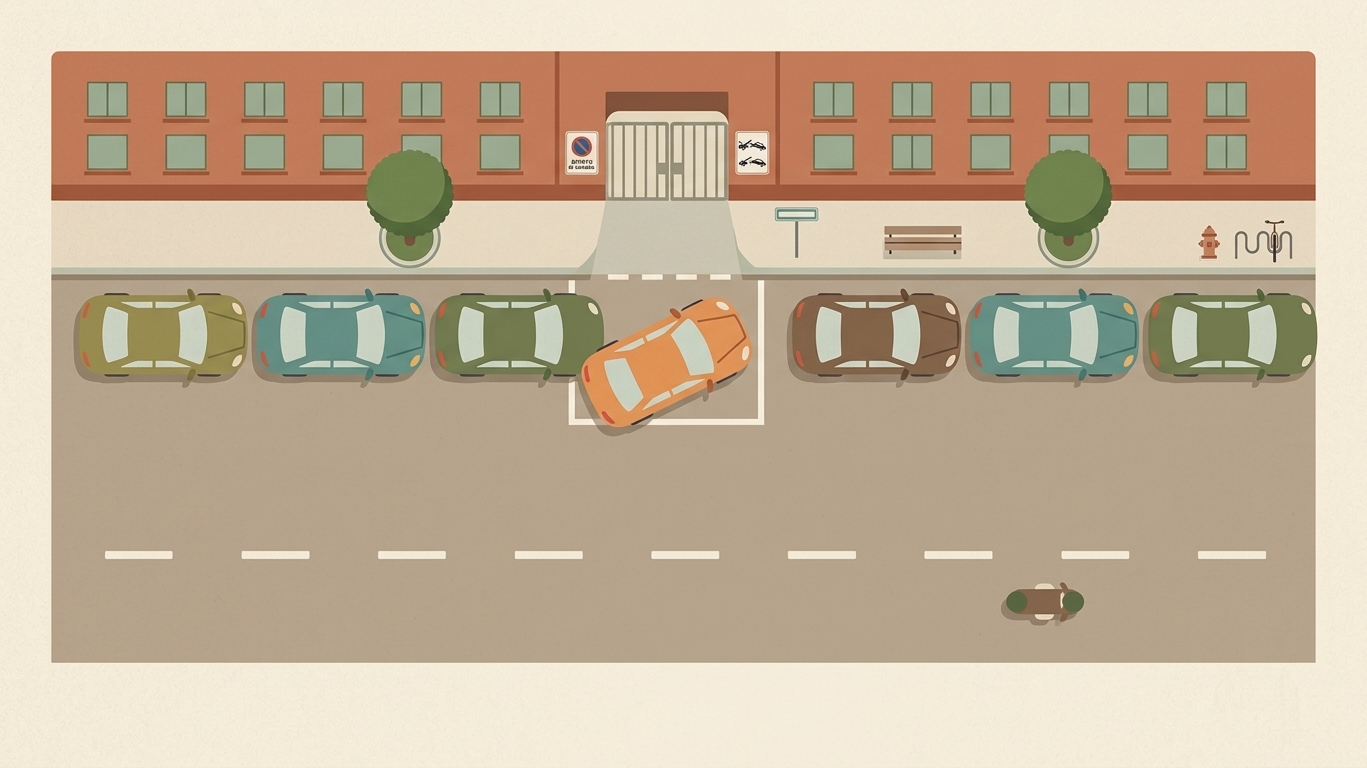
A sleepless night over a blocked driveway
Over the years plenty of cars have settled in front of my garage. On some windscreens I left a note asking the driver to please observe the “Passo Carrabile” sign, which sits there in plain view and even in capitals. Several of them cleared off in a hurry, as though the warning had materialised overnight. Then came the white Fiesta, parked crooked in the worst possible way, which I found in position in the morning and again in the afternoon. That is when I lost my temper and rang the local police.
In my head I was teaching a lesson to some cocky young lad. The owner turned out to be an elderly gentleman, faintly comical, with the battered air of a person carrying other troubles around. He could have been my father. The rules were on my side, my conscience filed a request for further investigation, and I spent the night turning over in bed.
Out of that insomnia came a question that reaches into my profession too: how widespread is common sense? The feeling, more nagging by the month, is that only its name is common. Counterintuitive choices get made without anyone weighing the effects on the decider or on the people nearby. And then there are those of us who weigh everything once the phone call has already gone out.
Whiting and Watts measured how much good judgement is actually shared
In 2024 Mark Whiting and Duncan Watts published research in PNAS that puts collective wisdom to the test. They asked 2,046 participants to rate 4,407 claims about geography, mathematics, culture and philosophy, with two questions attached to each: do you hold this to be true, and do you believe others hold it to be true?
The findings dismantle the phrase itself. Very few statements come out as shared at group level, and the overlap collapses as soon as the audience widens or more claims join the pile: the more heads involved, the less survives. Age, schooling and political leaning explain almost nothing about an individual score, while the ability to read what other people think explains quite a lot. Whoever reads other minds well carries judgement aligned with the average. Everybody else has their own, and calls it universal.
Manzoni had already separated good judgement from received opinion
The insight is two centuries old. In chapter XXXII of The Betrothed, with Milan hunting for plague spreaders, Alessandro Manzoni writes that “there was good sense; but it was kept hidden, for fear of common sense”. Individual judgement existed, shared opinion silenced it. The American study, with its numbers, does little more than quantify that gap: judgement is private, the presumption of its universality is public.
In meetings, common sense turns up when research is missing
Here the matter enters the workplace. On digital projects the phrase “it is clear, it is just common sense” shows up punctually halfway through a discussion, right before a decision nobody has verified. It is a cheap move: it closes the debate, it looks democratic, and it spares anyone from admitting that testing with real people never happened or never got funded. Then release day arrives and the label changes, becoming “users failed to understand”.
I have written before about the unneeded Trenitalia redesign and about SEO myths worth debunking: in both cases the shortcut has the same shape, an internal conviction promoted to a law of nature. The discipline of UX writing exists precisely to swap those convictions for stated, checkable criteria.
False consensus makes the merely familiar look self-evident
The mechanism has a name and a respectable seniority. In 1977 Lee Ross, David Greene and Pamela House described false consensus: people overestimate how many others share their choices, and read anyone who chooses differently as an odd type with some extreme trait. The Nielsen Norman Group applies the principle to project teams: the interface gets tried on oneself and on the colleagues sitting nearby, conclusions get drawn from a sample of six heads who speak the same jargon, and the struggles of whoever uses the thing end up filed under incompetence.
I keep a piece of evidence in my own archive, from the time I wrote about the PayPal signup button in Italy: a limpid word in one language turns opaque in another, and no amount of in-house judgement can anticipate it. The same holds for accessibility by default, where whatever looks legible to the designer proves illegible to a person whose sight differs from theirs.
Consequences for other people register only once they have a face
Back to the driveway, because my sleepless hours have an explanation in the literature. Deborah Small and George Loewenstein have shown that an identifiable person moves the willingness to act far more than a statistical category, and that analytical reasoning dampens compassion towards someone with a name and a face.
Until the phone call I had a repeated infringement in front of me, which is to say an abstraction. Straight afterwards I had an old man with a curved back and a shapeless T-shirt in front of me, which is to say a person. The facts held still, the emotional weight did not. Digital products run the same pattern at scale: as long as the talk is about “users” the choices slide by smoothly, and the moment a single person sits stuck on a form the same choice becomes indefensible.
There is a less comfortable piece to add, the one Emily Pronin, Daniel Lin and Lee Ross named the blind spot: cognitive distortions are wonderfully visible in others and barely detectable in oneself. The gentleman parked wherever suited him, certain he was bothering nobody. I telephoned certain I was defending a rule, rather than inflicting a fine on somebody who will probably feel it in the monthly budget.
The Groningen figures show that tolerated breaches multiply
What finally let me sleep is the last piece. In 2008 Kees Keizer, Siegwart Lindenberg and Linda Steg ran six field experiments in Groningen, published in Science. Where walls were covered in graffiti, the share of people dropping flyers on the ground climbed from 33 to 69 per cent. Faced with a fence, unauthorised shortcuts rose from 27 to 82, and theft of an envelope with five euros inside doubled, from 13 to 27.
A visible, tolerated transgression authorises the ones that follow, including breaches of an entirely different kind. Habitual parking across a driveway works as a signpost: this is allowed. It is also Carlo M. Cipolla’s third law, the one about the person who inflicts harm on others without securing any gain in return. Applied to an eighty-year-old hunting for a space in a city that has none, though, the formula loses its cheer.
On projects I replace assumed self-evidence with small pieces of proof
The profession offers a way out more practical than brooding in the dark. When somebody invokes shared judgement, one question remains useful: self-evident to whom, and measured how. Then modest gestures suffice. Rewriting the claim as a testable hypothesis, putting it in front of five people from outside the team, checking it in every language the product lives in, keeping a record of the call and the reason behind it. None of this demands a laboratory budget, and all of it shifts the weight from conviction to evidence.
For the rest I have fewer instruments. My entrance is clear for now, the car has not reappeared, the remorse has faded without vanishing. Common sense, when it arrives, resembles a private idea wearing the air of a universal verdict. Treating it as exactly that, in work and outside it, looks like the only prudence available.
Related sources
- A framework for quantifying individual and collective common sense, Mark E. Whiting and Duncan J. Watts, PNAS, 2024
- I promessi sposi, chapter XXXII, Alessandro Manzoni, 1840
- The false consensus effect: An egocentric bias in social perception and attribution processes, Lee Ross, David Greene and Pamela House, Journal of Experimental Social Psychology, 1977
- You Are Not the User: The False-Consensus Effect, Nielsen Norman Group
- Sympathy and callousness: The impact of deliberative thought on donations to identifiable and statistical victims, Deborah A. Small, George Loewenstein and Paul Slovic, Organizational Behavior and Human Decision Processes, 2007
- The Bias Blind Spot: Perceptions of Bias in Self Versus Others, Emily Pronin, Daniel Y. Lin and Lee Ross, Personality and Social Psychology Bulletin, 2002
- The Spreading of Disorder, Kees Keizer, Siegwart Lindenberg and Linda Steg, Science, 2008
- Le leggi fondamentali della stupidità umana, Carlo M. Cipolla, il Mulino
- Everything Is Obvious: Once You Know the Answer, Duncan J. Watts, Crown, 2011
