
How two words changed a conversion metric, and what it taught me about localization.
When I joined PayPal, the localized site for Italy hadn’t been launched yet. When it finally did, I was the Linguist lead and was sent to San Jose, PayPal’s headquarters, to be trained for the role. It was January 2005, and I had no idea that a single button would teach me one of the most valuable lessons of my career.
A Copy-Paste That Didn’t Quite Fit
At first, the Italian site was a faithful reproduction of the US one, only translated. On the surface, it looked perfectly fine. But the thing is, the Italian market in 2005 was a profoundly different landscape. Market maturity, digital literacy, and trust in online payments were all comparable to what PayPal had been building on in the United States for years.
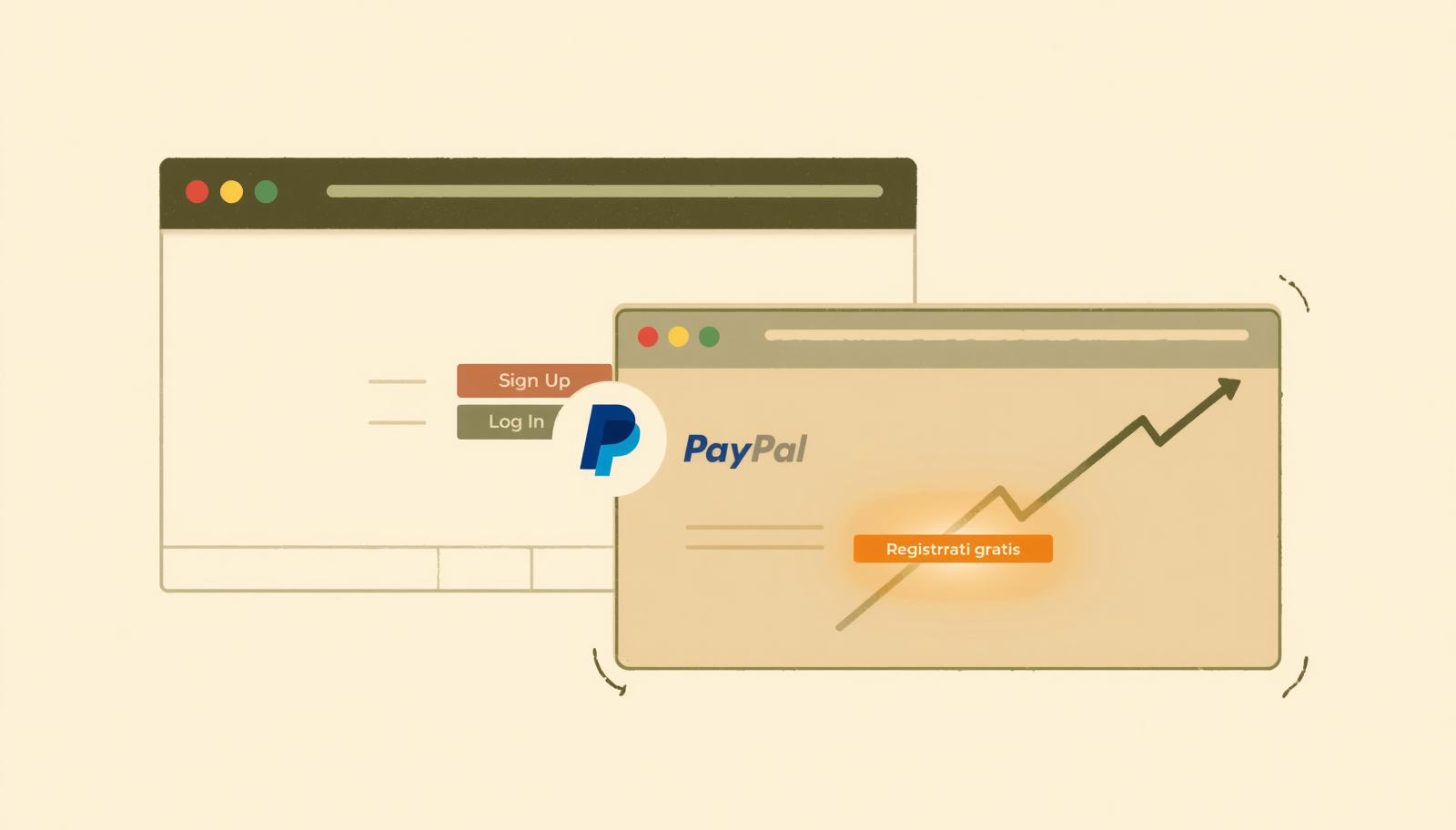
One issue stood out immediately. The Log In button was far more prominent than the Sign Up button. For a mature US audience already familiar with the platform, that made perfect sense; most visitors were returning users. But for Italians, who were just beginning to discover PayPal, this was counterintuitive. The priority should have been to start their journey, not to welcome them back to a place they’d never been.
And then there was the Sign Up button itself. It was slick, sure. Clean and minimal. But for Italian end users approaching an unfamiliar online financial service, it was intimidating as well. “Sign Up” alone said nothing about what they were getting into, or more importantly, what it would cost them.
The Localization Hack
At the time, editing content on the site was remarkably difficult. There was no clean separation between the code and the textual layer, so any change was a battle with engineering constraints. But I saw an opportunity that didn’t require restructuring the front end. I decided to apply what I think of as a “localization hack.”
Instead of translating “Sign Up” literally, I translated it just a tad differently:
Registrati gratis
Sign up for free.
Still two words. Still short enough for a CTA button. But those two words introduced a concept that was enormously relevant for the Italian audience: you don’t have to pay for this. Not to join, not to use it as a buyer. Free.
It may sound like a small thing. But in a market where people were wary of hidden fees and unfamiliar with online payment platforms, “gratis” was the reassurance they needed to take the first step.
The Results
Sign-ups for Italy jumped by 13% in the first week and continued to climb.
No redesign. No A/B testing infrastructure. No product overhaul. Just a deeper understanding of who was on the other side of that screen and what they needed to hear.
Why This Matters
This story isn’t really about a button. It’s about the difference between translation and localization, between reproducing content and adapting it for a market. A word-for-word translation serves the source language. True localization serves the user.
When you launch a product in a new market, you’re not just crossing a language barrier. You’re crossing a cultural, economic, and psychological one. The competitive scenario is different. The level of digital maturity is different. Your users’ anxieties and expectations differ. And your content, down to the smallest CTA, needs to reflect that.
This kind of adaptation isn’t a one-time effort, either. It needs to evolve as the market evolves, as competitors enter the space, and as user expectations shift. For a broader look at how localization has transformed over the past two decades, from fax machines to AI, read my article on the evolution of the discipline.
The Long Game
Fast forward to 2024: PayPal was named the number-one most reputable brand in Italy according to The RepTrak Company’s 2024 Italy Reputation Ranking, surpassing iconic names like Ferrari, Ferrero, and Giorgio Armani. A fintech company, born in Silicon Valley, sitting at the very top of Italy’s reputation chart, above some of the most storied Italian brands in the world.
That doesn’t happen by accident. It happens through years of customer-centric decisions, large and small. It happens when teams on the ground are empowered to adapt, not just translate. It happens when a linguist in San Jose is trusted to change two words on a button because they understand what the market needs.
I’m proud to have been part of that revolution, even if my contribution was just two words long.
Related Sources
On PayPal’s reputation in Italy: The RepTrak Company, “2024 Italy Reputation Ranking,” presented at Assolombarda, Milan, May 2024. Coverage via DailyOnline. RepTrak measures over 250 companies across 20+ sectors in Italy monthly. The 2024 Global RepTrak methodology is available at reptrak.com.
On CTA copy and conversion impact: KISSmetrics, “CTA Button Best Practices: What the Data Says About Buttons That Convert,” February 2026. Available at kissmetrics.io. Research shows that a single word change in button copy can shift conversion rates by 10–30%.
Sender.net, “50+ Call to Action Statistics to Boost Your Conversions in 2026,” March 2026. Available at sender.net.
On content localization strategy: Phrase, “Content Localization: What It Is, and How to Create a Strategy.” Available at phrase.com. A comprehensive overview of how localization goes beyond translation to adapt tone, visuals, and cultural references for each target market.
Redokun, “Content Localization: What Is It and How to Get It Right.” Available at redokun.com. Includes practical case studies from Adobe and Samsung on adapting content for local audiences.
On PayPal adoption in Italy: Statista Consumer Insights, “PayPal Usage for Online Payments or at POS in Italy, 2018–2024,” July 2024. Available at statista.com.
