
How kerbside collection works in Pescara
Portanuova is the Pescara neighbourhood where I grew up and where I still keep a house. The calendar issued by Ambiente SpA splits the area into a northern and a southern half. Food waste goes out three times a week in a brown bin. Everything else travels in sacks left on the pavement: plastic and cans on one day, paper on another, dry residue on a third, each fraction with a single weekly slot. Bags must appear between 9pm and midnight, and glass goes to bell containers opened with a magnetic card. Rigid receptacles, in my part of the district, amount to exactly one, the brown one. The rest is plastic film.
Why a sack on the pavement cannot cope with the weather
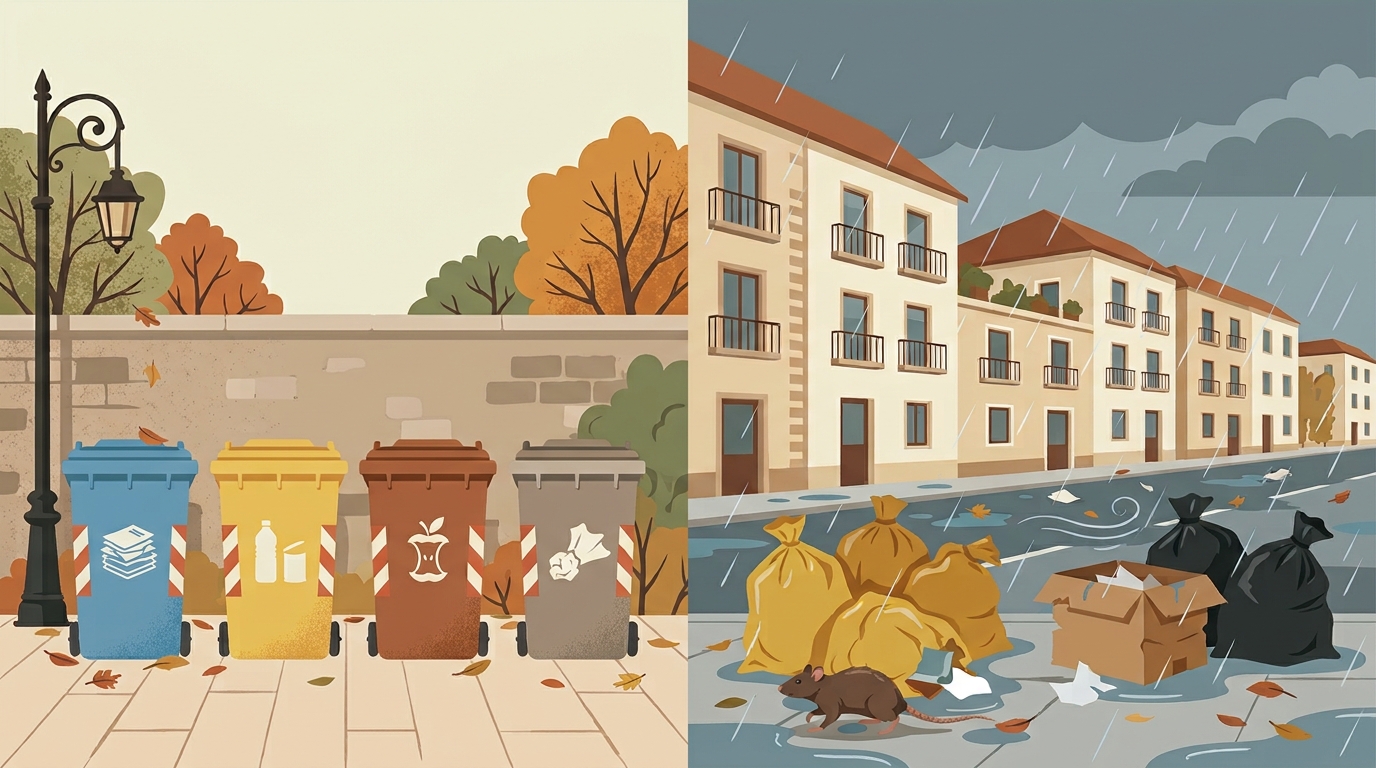
Anyone living on the Adriatic coast knows how much the wind matters here, since it blows hard and with a certain regularity. One evening of libeccio is enough to send the yellow sacks rolling down the road, splitting them open against lamp posts and leaving a trail of flattened bottles as far as the junction. Rain does worse: paper disintegrates, the bag rots, the contents end up on the tarmac and stay there. The final picture resembles the very thing the scheme was meant to abolish, with one difference. Before, the mess sat closed inside a container, and now it lies scattered across the carriageway.
It seems fair to ask whether the old street skips really were the absolute evil. They looked ugly, granted, and they invited fly-tipping. Yet they held most refuse inside, and someone coming home at eleven at night after a shift did not have to organise the week around plastic day.
The flat that turns into a storage room
A single weekly round per fraction means the packaging from an appliance, the trays from a family lunch and the soft-drink bottles from dinner with friends sit indoors for seven days. Add an unexpected trip, a departure or a lapse of memory, and the tally climbs to fourteen. In a second home, visited at intervals, the arithmetic turns surreal: arrive, produce waste, leave before the right morning comes round, and the sack waits for the next visit.
The side effect shows up in my buying habits. Ever since every object carries the question “and where does this end up afterwards”, I have stopped picking up things I once bought without a second thought. In theory that counts as an environmental gain. In practice it grows out of annoyance rather than conviction, and virtuous behaviour built on daily hassle rarely lasts. I had already written about the mounting weight of packaging when coffee pods were reclassified and when shrink-wrapped water multipacks began to disappear.
Missed rounds, heaps and rats: what residents report
Discontent in Pescara does not come from a handful of chronic grumblers. The association Insieme per Pescara has called the scheme “a total failure”, pointing at pavements held hostage by litter and at smells outside schools and shops, and it convened a public meeting in June. Domenico Pettinari’s movement speaks of an emergency for urban decorum and estimates that operators handle roughly 800 collection points a day against a ceiling of 400, with a motion voted down by the majority. The Five Star Movement and the consumer group ACU have run a petition against extending the scheme to the centre, citing among their reasons a rise in the waste levy.
Local reporting fills in the rest: streets where containers vanished before the new bins had been handed out, queues at the distribution points in piazza dei Grue, sightings of rodents between via Tavo and via Giardino and around the Conservatory. On the outskirts, skipped rounds happen often, and each one leaves a sack that nobody will come back for until the following week.
What the research actually says about the kerbside model
Honesty is due here, even where the evidence fails to back up the irritation of the person writing. A white paper by ARS Ambiente and IFEL for DNA Ambiente, published in GSA Igiene Urbana at the end of 2025, cross-referenced ISPRA’s waste register with the CONAI database: the kerbside method comes out on average more efficient than card-controlled containers, with a gap in operating cost per percentage point of separate collection ranging between 25 and 30%. Paired with weight-based billing it passes 83% capture. The approach works, then, and more than five thousand Italian municipalities have adopted it.
The catch sits elsewhere. Those figures measure the share of material intercepted, while saying nothing about how liveable a street feels. Pescara, stuck at 48.1% in 2023 against a regional average of 64.6%, shows that adopting the scheme guarantees nothing on its own. Over twenty points separate Teramo at 72% from the Adriatic capital, with the same principle applied in different ways.
Pesaro is dismantling kerbside collection and still sits at 73%
The most instructive case lies in the Marche region. Pesaro, which already reached 73%, has decided to retire its door-to-door service by 2030 and replace it with card-operated smart islands: the initial 23 clusters will grow to 42, covering thousands of households, with no announced rise in charges. Mayor Biancani lists urban decorum, quality of the material captured, real-time traceability and freedom of timing for residents.
Pescara shows an unintentional consistency of its own, and it starts in Portanuova. In the car park between viale Pepe and lungomare Colombo, since May 2024, a smart island has been running: it opens with the Eco-card already issued to households on the kerbside scheme, takes mixed packaging, paper and dry residue, and stays available seven days a week, around the clock. For the pedestrian heart of the city the council has planned six installations of the same kind, alongside the underground bell containers in piazza Sacro Cuore.
The paradox lies in the proportions. A single facility serves an entire neighbourhood, accepts neither food waste nor glass, and reaching it means walking there with the sacks in hand. Multiplying it, with a station every few hundred metres, would give Portanuova what Pesaro has mapped out for its whole territory.
The Milan model and its courtyard bins
In Milan, where I live, separate collection hovers around 63% and the city ranks among the top three in Europe above a million inhabitants. The mechanism is plain: every apartment block keeps its own wheeled containers in the courtyard, residents drop things off whenever it suits them, and on the agreed morning somebody wheels them out. In my case that somebody is the stairwell cleaning firm, which we pay for the task. Performance stays high because the arrangement absorbs the small accidents of daily life instead of punishing them.
Underground bins, vacuum pipes and scales that charge by the gram
Beyond the national borders, solutions abound. A March 2025 report by ACR+ compared Antwerp, Porto, Rotterdam, Florence, Hamburg and Barcelona on their use of sunken containers and equipped drop-off areas, weighing up organisation, performance, cleanliness and savings. Stockholm and Barcelona run pneumatic ducts that suck refuse underground and clear the public realm entirely. Seoul, with RFID units that weigh food scraps and bill each deposit by the gram, has built one of the most effective food chains anywhere, to the point of rewarding households that cut their output with convertible points.
Ljubljana deserves a footnote, being the first European capital to declare itself zero waste with 61% separate collection and 121 kilos of residual waste per inhabitant against a continental average of 285. It got there precisely through household collection, backed by drop-off points in its denser nodes. The lesson, then, concerns choosing the instrument that fits each urban fabric, rather than condemning a method outright.
Sorting stays a duty, the system remains a choice
Separating waste is a civic responsibility I have no doubts about, and regular readers know how much environmental questions and Abruzzo affairs matter to me. What convinces me far less is the operational translation picked for my area: flimsy sacks in a windy city, one round a week for three fractions out of five, no give at all for people on shifts, people who travel, people looking after a relative.
Alternatives exist, they deliver, and one has been running a few minutes from my house at the far end of viale Pepe. What is needed is a versatile solution, easy to use, that spares the pavement from becoming a depot and the flat from becoming a branch office of the landfill.
Related sources
- La raccolta Porta a Porta a Pescara Centro e Portanuova, Ambiente SpA
- Utenze domestiche e non: definito il calendario per la differenziata in centro e a Porta Nuova, IlPescara
- Raccolta dei rifiuti porta a porta, Ambiente spa estende il servizio in centro, Comune di Pescara
- Rifiuti, Insieme per Pescara: il porta a porta e un fallimento totale, Rete8
- Rifiuti a Pescara, Pettinari chiede la revisione del porta a porta, Notizie d’Abruzzo
- Rifiuti: raccolta firme contro il porta a porta nel centro di Pescara, Cityrumors Abruzzo
- Tolti i cassonetti in alcune zone di Porta Nuova ma molti non hanno ritirato i mastelli, e protesta, IlPescara
- Le diverse velocita della raccolta differenziata in Abruzzo, Openpolis
- Raccolta differenziata porta a porta: la scienza ne sancisce il successo, Materia Rinnovabile
- Pesaro, addio porta a porta: isole ecologiche informatizzate in tutta la citta nel 2030, CentroPagina
- Eco-Isola Informatizzata a Pescara Portanuova, Ambiente SpA
- Pescara, inaugurata l’Eco Isola Informatizzata in via Pepe, Rete8
- Beneath the Surface: Insights from six cities changing their waste collection, ACR+
- The story of Ljubljana, first Zero Waste capital in Europe, Zero Waste Europe
- Why Seoul is paying residents to throw away less food, The Korea Herald
- Milano capitale del riciclo: i dati sui rifiuti, MiTomorrow
