
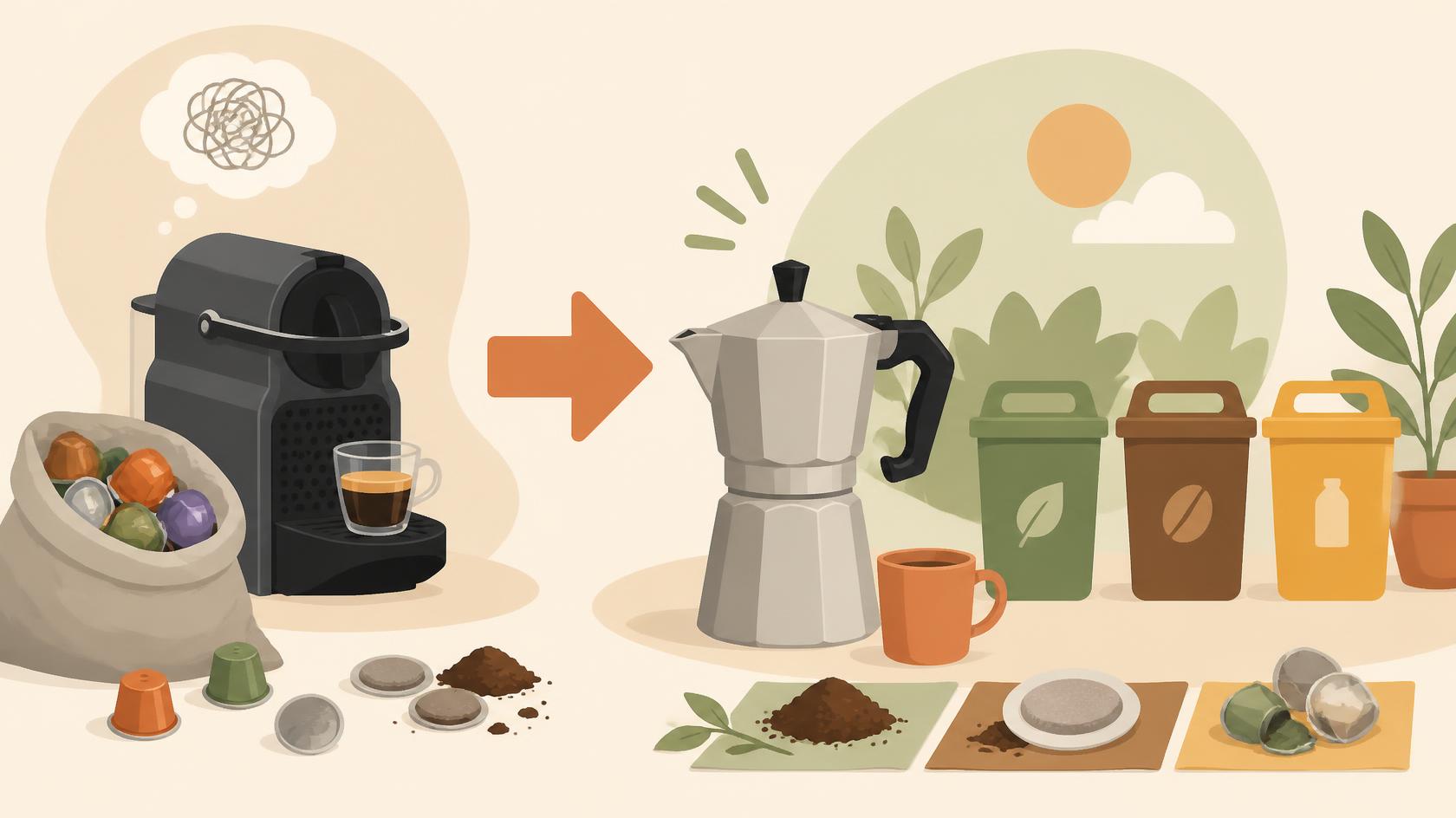
The Nespresso machine got retired a few years ago. The capsules felt like an environmental compromise that was getting harder to justify: so much aluminium or plastic for a few grams of coffee, with an uncertain fate in the wrong bin. These days coffee gets brewed rarely around here, and when it does, the moka pot wins: fewer wrappers, fewer doubts about what goes where. Just as the subject seemed closed, a piece of news lands that concerns everyone who still relies on capsules: starting tomorrow, 12 August, pods and capsules officially become packaging across the European Union.
EU regulation 2025/40 reclassifies coffee pods and capsules
The change comes from the Packaging and Packaging Waste Regulation, EU regulation 2025/40, which takes effect in Italy on 12 August 2026. For the first time, pods and capsules are formally recognised as packaging, even when they still contain coffee grounds at the moment of disposal. It sounds like a minor clarification, but it isn’t: until now, classification varied from one municipality to another, leaving people caught between the manufacturer’s instructions and their local recycling rules.
Emptying the capsule before throwing it away is no longer required
The most tangible consequence touches a habit repeated in countless kitchens every morning: emptying the coffee grounds out of the capsule before tossing it. Under the new rule, that step disappears, because the container itself counts as packaging regardless of what’s left inside. A small simplification, and, in practice, a considerably less messy one too.
Where aluminium, plastic, and compostable pods end up now
The exact procedure still depends on the material and, to some extent, on where someone lives. Aluminium or plastic capsules follow the manufacturer’s guidance combined with local collection rules, ending up with packaging, metals, or general waste depending on the case. Certified compostable pods go into food waste, where that service exists. Separable components, when present, get sorted on their own. There isn’t a single rule across the whole country yet, but the legal foundation is now shared: something similar already happened with bottled water, where producers were pushed to rethink packaging and multipacks.
Who actually has to change something
Most of the burden falls on manufacturers, who now need to design more recyclable or compostable capsules and label them clearly. Harmonised environmental labels, meant to carry the same information everywhere in Europe, are expected to roll out gradually over the coming months. CONAI, Italy’s packaging consortium, coordinates collection and recovery flows, while municipalities remain responsible for how the system runs locally, arguably the hardest part to align, given how uneven Italian collection systems already are. The Comitato Italiano del Caffè, representing the industry, has described the shift as one companies are “leading as pioneers” rather than merely enduring, pointing to eco-design investments and collection trials already underway. The same rules are reshaping packaging choices for drinks well beyond the coffee aisle, from bottles to cans.
How widespread are capsules in Italy compared to the rest of the world
Looking at the numbers, Italy remains something of an outlier compared to markets where capsules dominate almost unchallenged. According to the “Italians and Coffee” study by AstraRicerche for the Comitato Italiano del Caffè, 59.5% of Italians used pods or capsules in 2025, down from 65% recorded in the 2021-2023 period, while the moka pot climbed back to 55.2% and automatic machines stalled at 34.4%. That balance is hard to find elsewhere: globally, the single-serve coffee market was worth roughly $34.66 billion in 2026 and is expected to reach $46.91 billion by 2031, with Europe alone accounting for 36.21% of global consumption and Asia-Pacific growing faster than any other region. In Italy, then, the capsule still coexists with the moka pot rather than replacing it outright, a different picture from many Anglo-American markets, where single-serve machine ecosystems have taken over in an almost definitive way.
The moka pot stays the choice here, though capsule loyalists are understandable
This regulation won’t send anyone back to Nespresso, at least not in this house. The moka pot still feels easier to manage, and drinking coffee only occasionally makes the whole question less pressing. Still, it’s easy to understand people who aren’t ready to give up the convenience of capsules and who, until now, felt a bit guilty every time they threw one away without really knowing where it belonged. A clear legal baseline, even one that doesn’t solve everything, helps consumers make more informed choices and stops producers from hiding behind vague labelling. What remains to be seen is whether Italy’s recycling system, often inconsistent from one municipality to the next, can actually keep pace with a rule designed to be the same everywhere.
Related sources
- Capsule e cialde di plastica o di alluminio, dal 12 agosto vietato buttarle nell’indifferenziata
- Raccolta differenziata capsule e cialde di caffè: cosa cambia dal 12 agosto
- Le capsule di caffè diventano imballaggi: cosa cambia con la nuova norma europea
- Cialde e capsule del caffè diventano ufficialmente imballaggi: cosa cambia
- Espresso most popular coffee, moka pot catches up with pods
- Coffee Pods and Capsules Market Report
