
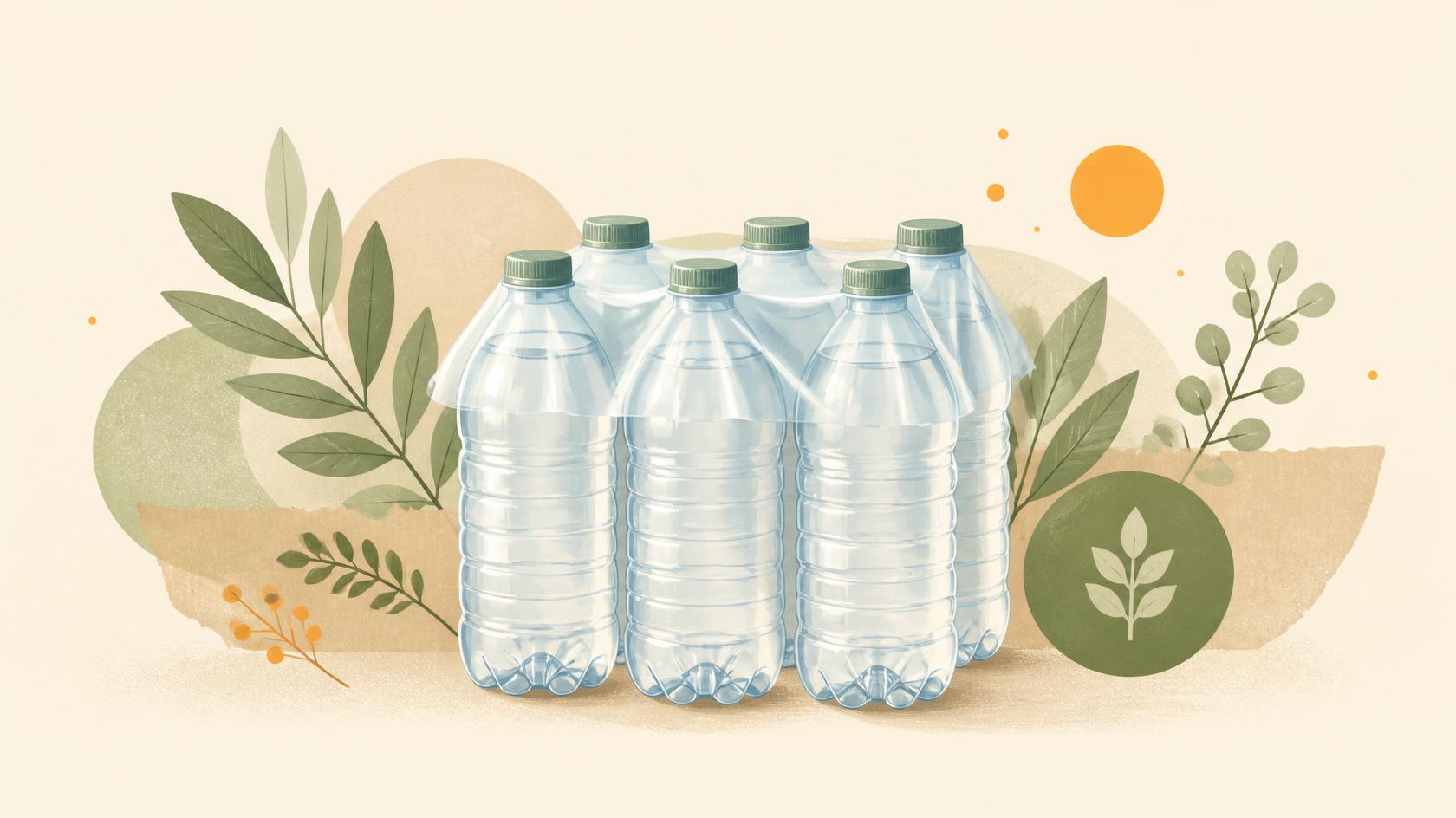
From 2030, no more plastic-wrapped water six-packs: the law, the data, the future of packaging
A few weeks ago, I was at the supermarket near my place, standing in front of the water aisle, and I overheard two people arguing about whether only single bottles would be on sale come August. One said the European Union had already banned six-packs. The other said no, that was a 2030 thing. They were both half right, and that’s exactly where I want to start: the topic of sustainable packaging is full of alarming headlines and blurry deadlines, while the actual regulation takes a bit more than a minute to understand properly.
The story going around social media, and the real one
For about a month, a story has been circulating, claiming that starting on August 12, 2026, multipacks will disappear and only single bottles will remain on shelves. That’s not accurate. That date marks the start of the application of EU Regulation 2025/40, known as the PPWR (Packaging and Packaging Waste Regulation). Still, it mostly concerns chemical substances in food-contact packaging, and the checks manufacturers need to carry out. The handle-wrapped six-pack we all grab at the supermarket stays exactly where it is, at least for now.
What the law on multipacks actually says
The rule behind the alarm does exist, but it has a different date: January 1, 2030. Article 25 of the regulation, together with Annex V, introduces a ban on secondary plastic packaging designed to group products at the point of sale, the classic film wrapped around six bottles. There’s a meaningful exception, though: packaging needed to facilitate transport and handling of goods stays outside the ban, and that’s exactly where the supermarket six-pack might fit. The European Commission has also clarified that composite packaging, such as cardboard-based packaging, is exempt from the ban if plastic accounts for less than 5% of the total packaging weight. A six-pack made mostly of cardboard, with just a thin layer of plastic film, could well slip through.
The most surprising part, and the least reported, is that the Commission still has to specify in detail which wrappings will remain banned and which won’t, with a decision expected by 2027. Industry groups are already lobbying to scrap the measure entirely, so the ban might never take effect as described today.
The numbers in the regulation that matter more
Beyond the multipack chapter, the PPWR sets broader targets that get far less airtime. Every member state will have to cut per capita packaging waste by 5% by 2030, 10% by 2035, and 15% by 2040. For transport, e-commerce, and grouped packaging, the space ratio inside a box can’t exceed 50% by 2030, a direct hit on those oversized boxes containing one small item that we’ve all received at least once. By the same year, barring exceptions for the transport of dangerous goods, all packaging will have to be recyclable by design. On the bottle front, a deposit return scheme arrives in 2029, but only in countries that fail to collect at least 90% of their plastic bottles: in Italy, where collection rates are already high, the measure might not even be needed.
Who has already moved, without waiting for Brussels
Some Italian companies got ahead of the regulation by years. Sanpellegrino worked on lightweighting, cutting the glass and plastic weight of its bottles, and became the first Italian company to launch a bottle made from 100% recycled plastic, aiming for an average of 50% rPET across its range by 2025. Levissima follows a similar path, with bottles made entirely from recycled PET. CONAI, Italy’s national packaging consortium, has spent eight editions rewarding the most effective eco-design projects: the latest call alone received more than three hundred and twenty proposals, with combined benefits estimated at 28% less CO2 emissions, 21% less energy used, and 10% less water consumed along the supply chain.
The world of carbonated drinks tells a similar story: I touched on this in a piece about a bottling plant in Abruzzo, where recovering the water used to backwash carbon filters saved more than five million liters in a single year, and where every plastic bottle in the portfolio is already made from 100% recycled PET. These are signs that sustainability in packaging doesn’t come only from European obligations; it’s often driven by industrial reasons that came first.
The research looks beyond recycled PET
Recycling remains the most mature path, but research is working on alternatives that could reshape shelf materials altogether. Bioplastics made from corn starch, potato starch, or sugar cane are already the most promising large-scale option among renewable materials. Companies like Switzerland’s Mycrobez and America’s Ecovative are developing mycelium-based composites, grown from the root structures of fungi, that are fully biodegradable and designed as a substitute for polystyrene in transport packaging. Biosampak has developed a fully compostable film made from wood fiber, one that can break down even in home compost. In Italy, the startup IUV is developing edible, biodegradable films that slow the growth of mold and bacteria, extending food shelf life without any plastic involved.
Seaweed, paper, and other ideas from abroad
Outside Italy, a few projects have already reached an interesting scale. Notpla, a startup founded by two Imperial College London researchers, produces a material derived from brown seaweed: a resource that grows fast, doesn’t compete with food crops, and can be used for coatings, films, and even edible capsules, the Ooho pods that became famous at the London Marathon. Just Eat has already adopted Notpla-based packaging for its delivery orders. On the beverage side, both Coca-Cola and Carlsberg are investing in sugar-based coatings for paper bottles, a concrete attempt to replace PET in categories where plastic once seemed impossible to swap out.
Why custom packaging matters more than it seems
Among the least discussed levers in sustainable packaging is customization. A box designed to fit a product’s exact dimensions, rather than a standard format with half a pack of empty air inside, already follows the same principle that the PPWR will legally require for space by 2030. That’s the model behind Packly, which lets brands order made-to-measure packaging starting from a single unit, using pure cellulose paper certified FSC and PEFC and sourced from responsibly managed forests, with production powered entirely by renewable energy. For an emerging brand, being able to choose exact formats and recyclable materials without committing to huge print runs means cutting waste before the law ever asks for it. It’s the same principle I touched on when writing about Made in Italy and product storytelling: attention to detail, packaging included, remains a competitive edge just as much as a regulatory obligation.
The unknown that few are talking about
It’s worth repeating, because it changes the perspective on everything else in this piece: the ban on multipacks isn’t set in stone yet. The Commission still has to clarify the details by 2027, industry groups are actively lobbying to cancel it, and the transport exception could end up hollowing out the rule entirely. Anyone claiming that multipacks will fully disappear by 2030 is getting ahead of an outcome that nobody can yet guarantee.
What we can do already, today
Waiting until 2030 to change habits doesn’t help much, not for companies and not for anyone doing the grocery shopping. The data already points in this direction: recycled PET, compostable materials, custom packaging designed to cut space, research on seaweed and mycelium that could leave the lab within a few years. The law, whenever and if it lands in its current form, will simply put a formal stamp on a path that attentive manufacturers, in Italy and elsewhere, have already started walking.
Related sources
- Regulation (EU) 2025/40 on packaging and packaging waste, EUR-Lex
- I pacchi d’acqua da sei bottiglie non spariranno dai supermercati, Open
- PPWR e bevande, cosa cambia davvero dal 12 agosto, Beverfood
- Sta per finire l’era degli imballaggi di plastica monouso nell’UE, greenMe
- Imballaggi, dal 2030 stop a prodotti monouso e confezioni di ortofrutta, Il Sole 24 Ore
- L’uso di packaging sostenibile per l’imbottigliamento dell’acqua, Sanpellegrino
- Packaging sostenibile, CONAI premia gli esempi più virtuosi, Cose di Casa
- Notpla, il packaging sostenibile prodotto dalle alghe brune, Canale Energia
- Packaging 2026: sfide e innovazioni per un futuro sostenibile, Diatecx
- Sustainable packaging, the right choice for a green future, Packly Blog
- Custom boxes perfect for your brand, Packly
