
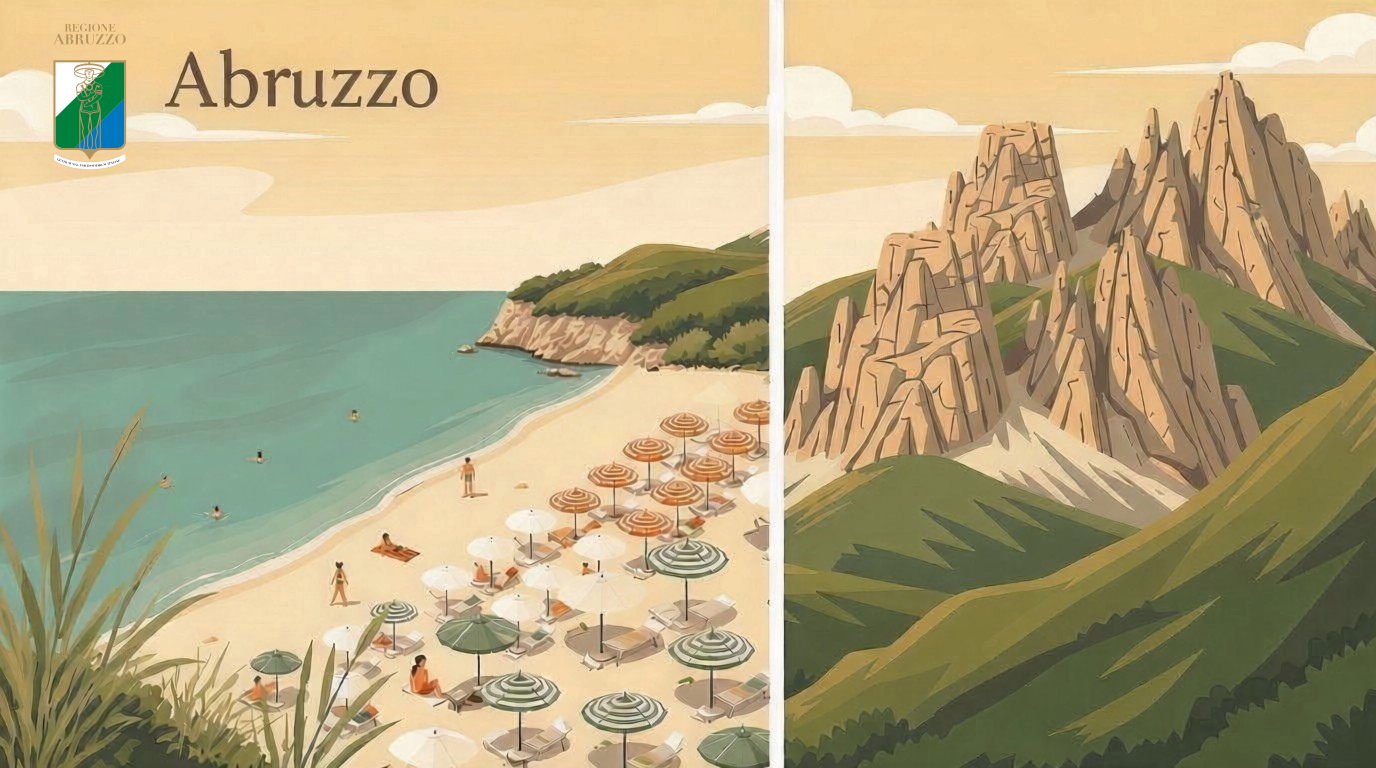
I read a piece on Milano Città Stato about empty sunbeds and umbrellas along Italian coasts, right in the middle of peak season. It made me think of my own summer, the one I spend in the town where I was raised, in Abruzzo, where I bought a small apartment with the idea of living my old age there, if life allows it. This year, looking at the rows of sunbeds at my beach club, I noticed something those numbers seemed to confirm: fewer people, quite a bit fewer.
Fewer swimmers under this summer’s umbrellas
The piece described operators along the Romagna coast reporting attendance down 15 to 20% compared with 2025, while local hotels held steady. In Abruzzo, according to Federalberghi-Confcommercio, the season should close roughly in line with last year. From my own spot, though, the feeling is different: shorter queues, empty umbrellas even on Ferragosto, a quiet that wasn’t there before. On TikTok, of all places, I came across several clips filmed in Roseto degli Abruzzi showing exactly this: half-empty seafronts in the middle of August, with comments full of people just as surprised as I was. Maybe I’m simply paying closer attention, or maybe I’ve started counting empty sunbeds out of boredom. Either way, something along the coast is shifting.
The steep bill for a spot shared with friends
One explanation lies in the prices. A spring survey by Altroconsumo found that umbrella and sunbed rates rose by an average of 6% compared with 2025, and by 24% over the past five years, with peaks of 16% in some towns. I manage by splitting the spot with friends, which keeps the seasonal pass lighter on the wallet, but I understand why some people give up altogether. A week at the seaside shouldn’t cost as much as a flight across the ocean.
Only 10% free beach: the Pescara case
There’s one issue I care about more than the rest: the shortage of free shoreline, dune beaches especially, which Abruzzo should be promoting far more than it does. In Pescara, things got more complicated: an amendment to the regional Milleproroghe decree allows coastal towns with over 70,000 residents to cut the minimum share of free, publicly accessible beach from 20% to 10%. Pescara, with its 118,000 residents, is the only town that meets that threshold, and the change has drawn criticism from environmental groups such as Forum H2O, who call it discriminatory ahead of the European tenders for beach concessions due in 2027. As a swimmer, I just want more stretches of open, natural shoreline, without having to rent a spot every time I want a swim.
When the beach turns into a daily obligation
Habits are changing too, mine included. I don’t like going to the beach every single day: it starts to feel like clocking in at an office, with a schedule to keep and the same routine on repeat. I’m not the only one who feels this way. According to tourism operators in Abruzzo, visitors are shortening individual stays but taking more trips over the summer, and cultural destinations or historic villages are holding up better than traditional seaside tourism. Nationally, too, hotel guests increasingly choose the pool, a trip inland or a cultural visit over fixed hours under an umbrella.
Mountains and villages minutes from the coast
This is where Abruzzo has a huge card to play, one it still leaves largely unused. A few minutes’ drive from the shoreline is enough to reach a heritage that has nothing to do with the sea: I’m no hiker, mountain trails just aren’t for me, but a village like Castel del Monte wins me over every time, and so does Santo Stefano di Sessanio, with stones that seem stuck in the Middle Ages. Then there’s Campo Imperatore, home to the hotel that once served as Mussolini’s prison, now finally at the centre of a restoration project after years of neglect: the perfect setting for my own urbex habit, that pull toward exploring abandoned places layered with history, which I’ve indulged only now and then, like the time I visited Frattura Vecchia, the hamlet near Scanno abandoned after the 1915 earthquake. A dirt road near the lake leads there, and inside the houses old furniture is still visible, left behind as if time had simply paused. I already touched on this in the Coca-Cola plan for Abruzzo, an investment aimed squarely at the region’s visibility, and the theme comes back in a piece I wrote on the digitalization of tourism, just as useful for making the inland areas known to people who arrive thinking only of the sea. Telling these places better wouldn’t compete with the coast; it would complete it.
A model to rethink, not to mourn
Coming back to the question in the headline that started this whole train of thought: I don’t think the pay-to-access beach club model is over, but it’s clearly changing shape. Fairer prices, more open sand and an offer that looks beyond the shoreline could restore meaning to a summer that, at least for me, shouldn’t turn into an extension of my professional daily grind. That’s why I don’t think Abruzzo, beyond my own wild native town (Ortona a mare, ed.), will ever tire me out.
Related sources
- Sdraio e ombrelloni deserti: è la fine del modello «tutto italiano» delle spiagge a pagamento?, Milano Città Stato.
- Stabilimenti balneari, prezzi ancora in aumento: rincari fino al 16%, Altroconsumo.
- Pescara può avere solo il 10% di spiagge libere, nel Milleproroghe norma ad hoc, rischio impugnazione, AbruzzoWeb.
- Estate 2026: la stagione nata sotto buoni auspici ma il turismo balneare deve rinnovarsi, Cityrumors Abruzzo.
- L’hotel di Campo Imperatore rinasce: via ai lavori per un futuro da resort di lusso, Rete8.
