
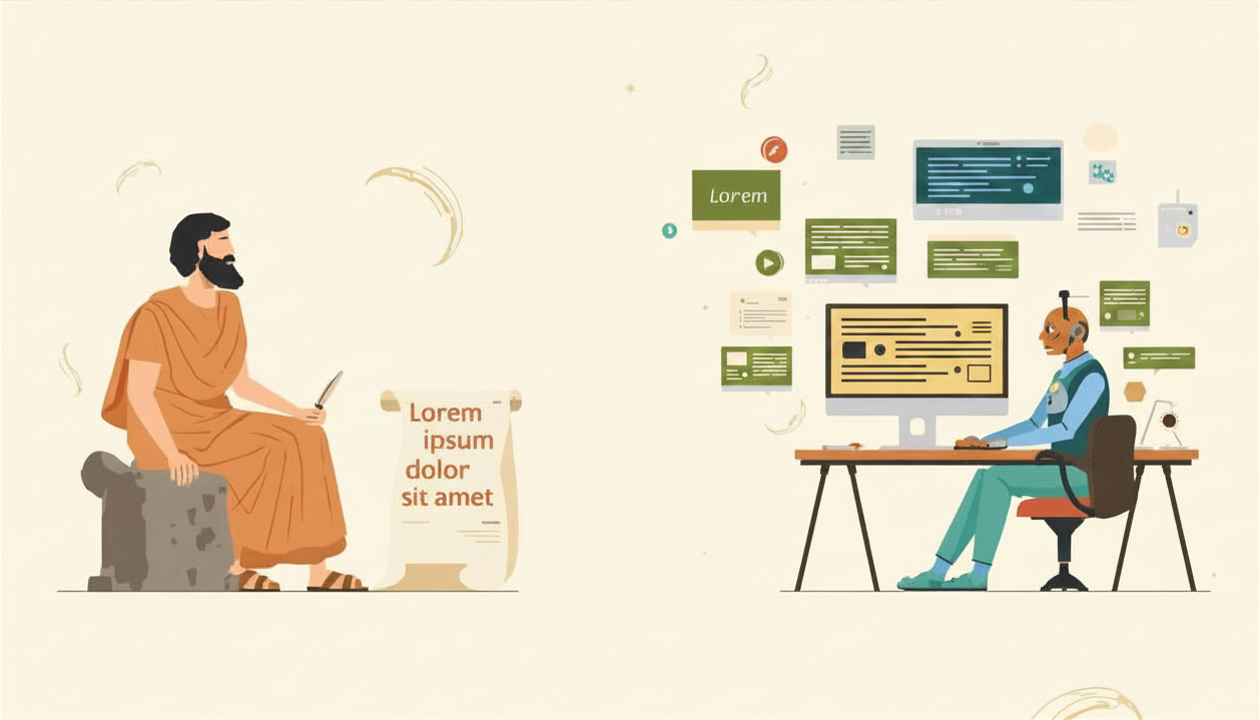
Lorem ipsum: the placeholder that minds its own business
I have a soft spot for “Lorem ipsum dolor sit amet.” Not for what it says, because it says nothing, but for exactly that reason. It is the one piece of text in a mockup that does not try to sell me anything, does not pretend to be finished, and does not whisper opinions into the design before the design has earned them. It holds the space and stays quiet. After a few decades of writing words that have to fight for every pixel, I find that restraint almost touching.
So let me give this quiet little nonsense paragraph the attention it usually never gets, and then tell you why I am starting to miss it.
Where lorem ipsum actually comes from
The text is not random gibberish, even though it reads like a Latin teacher sneezing. It comes from Cicero, specifically from “De Finibus Bonorum et Malorum” (“On the Ends of Good and Evil”), written in 45 BC. The relevant line lives in the first book, in a passage about pleasure and pain: “Neque porro quisquam est qui dolorem ipsum quia dolor sit amet.” Somebody chopped “dolorem ipsum” in half, and “lorem ipsum” was born, grammatically broken and semantically hollow, which is the whole point.
For a long time, nobody knew this. The mystery was solved in 1982 by Richard McClintock, a Latin professor at Hampden-Sydney College, who noticed the unusually rare word “consectetur” in the dummy text and chased it straight back to Cicero. Twenty centuries between the original sentence and the person who finally checked the receipts. I respect the patience.
How a scrambled Roman became an industry standard
The placeholder career started in the 1500s, when an unknown printer needed filler for a type specimen book, a catalog showing off how fonts looked at different sizes. Real sentences were a problem because anyone flipping through would read the words rather than judge the letterforms. So the printer scrambled Cicero into something that looked like language but carried no meaning. Five hundred years later, we are still using his workaround.
It survived every shift in the craft. Metal type, phototypesetting, then the digital jump. In the 1960s, the Letraset company printed lorem ipsum on dry-transfer lettering sheets, which put it in the hands of every designer in the building. In the 1980s, desktop publishing software, such as Aldus PageMaker, bundled it in, and from there it walked into Word, web templates, Figma, and basically any blank box that needed something to look busy.
The reason it stuck is almost boring in its cleverness. Lorem ipsum imitates the rhythm of text written in the Latin alphabet, the one shared by English, Italian, French, Spanish, German, and most languages a Western designer is laying out. Word lengths vary, letter frequencies feel familiar, the paragraph has texture, so your eye reads it as “content” without your brain reading it as anything. English filler made of actual English keeps pulling focus. A wall of “test test test” looks fake and breaks the illusion. Lorem ipsum sits in the sweet spot between meaning and noise, which is harder to fake than it sounds.
Its weirder cousins
Lorem ipsum has a whole family of placeholder relatives. There is “etaoin shrdlu,” the run of the twelve most frequent English letters that Linotype operators produced when they ran a finger down the keyboard, and that occasionally slipped into printed newspapers during the hot-metal era. There is the typing-class classic “Now is the time for all good men to come to the aid of the party,” and the “asdf” home-row mash that every keyboard student knows. Old B-movies had their own version: those spinning newspapers narrating offscreen plot points reused the same fake filler headlines over and over, so “New Petitions Against Tax” and “Building Code Under Fire” turn up in film after film once you start noticing.
When the filler escapes into the wild
Placeholder text has one job: to be removed before launch. It does not always cooperate.
The most common accident is mundane and a little sad. A team builds a site, fills it with lorem ipsum, swaps in the real copy under deadline, misses two boxes, and ships. A clothing shop did exactly this: managers replaced most of the layout with product details, overlooked a few spots, and published Cicero by mistake. SEO tools like Screaming Frog now have a dedicated check for leftover lorem ipsum, partly because search engines treat a page full of it as unfinished or abandoned, and visitors do too. Nothing erodes trust faster than landing on a “professional” page and reading half a sentence of dead Latin.
My favorite incident is with a stranger. In 2014, the security writer Brian Krebs noticed that typing “lorem ipsum” into Google Translate, with Latin auto-detected, returned the single word “China.” Capitalize the words, and you get “NATO.” Rearrange them, and you get “The Internet” or “The Company,” which is old slang for the CIA. The internet, predictably, smelled a government conspiracy. The truth was nerdier and better: it was a cryptographic Easter egg tied to a Def Con badge puzzle run by a hacker known as 1o57. Google quietly patched the translation once people started asking questions. A scrambled Roman philosopher, briefly weaponized into a spy-themed scavenger hunt. Cicero would have had notes.
Why am I writing a love letter to empty text?
Here is the part I actually care about. I like lorem ipsum because it is honest about being empty, and that honesty protects the writer.
A blank placeholder makes no claim about tone, message, length, or angle. It tells the designer, “words go here, ask the person whose job is words.” That gap is where a content designer does the real thinking. If you want the long version of what that thinking involves, I wrote about it in the discipline of UX writing and in the difference between UX writing and content design, because the two are not the same job, and both deserve more than a leftover slot.
What is quietly replacing lorem ipsum now is not empty at all. Designers open Claude or ChatGPT, generate plausible-sounding copy straight into the mockup, and present it as “design is ready, just polish the words.” The placeholder used to say nothing. The new placeholder says something specific, confident, and generic, and everyone in the room starts treating it as the answer rather than the question.
What the research says about anchoring
This is not me being precious. The effect has a name and a growing pile of studies behind it.
In July 2024, Anil Doshi and Oliver Hauser published a study in Science Advances on AI and creative writing. Individually, writers using AI ideas scored about 8 percent higher on novelty and 9 percent higher on usefulness, which sounds great. The catch lay at the group level: the AI-assisted stories looked far more alike. More polish, less variety. They called it a social dilemma, in which each writer is better off while the collective output narrows.
A 2025 study presented at the CHI conference, “Timing Matters,” went straight at my point. When writers used a large language model from the very start of a task, they produced fewer original ideas, reported lower creative self-efficacy, and ended up with output that closely mirrored the AI’s suggestions, a textbook case of fixation. When the same model was introduced after people had thought on their own first, the number of ideas increased, and the similarity to the AI decreased. Timing is the whole game. Pre-canned copy dropped into a mockup is the worst possible timing, because it anchors everyone before the writer has said a word.
That is the mechanism behind my unease. Brainstorming research has shown for years that seeing someone else’s idea early shrinks the range of ideas you generate afterward. An AI draft in the design file is exactly that early idea, except it arrives dressed as a finished decision and carrying the authority of the layout around it.
The job I do not want to lose
I am not anti-AI, and my blog is proof. I use it daily, I have written about the struggles that come with it, about content creation in the era of AI, and I built my own ten-step copywriting process that leans on it on purpose. The difference is sequence and ownership. AI, after the brief and after human thinking, is a tool. AI before either one is a cage with nice wallpaper.
When you hand a writer pre-written copy and ask them to “tidy it,” you have quietly redefined the role from author to post-editor. The brief never happened, the strategy never happened, and the most interesting solution, the one no model would propose because it depends on context and a wink, never gets a chance. I once wrote copy for a panettone-shaped product called Culomba, where the entire joke lived in timing and double meaning. No machine saw that. A human did. That is the work, and a clever empty placeholder leaves room for it in a way that a confidently generated paragraph never will. It is also why I keep banging on about where our attention actually goes when the words are an afterthought.
So yes, I will defend lorem ipsum. Not because Latin nonsense is precious, but because it knows its place: it holds the door open and waits for the writer to walk through. The new habit of pre-filling that door with synthetic certainty closes it before anyone arrives. Give me the honest blank every time.
Related sources
- Lorem ipsum and Filler text, Wikipedia, on origins, McClintock’s 1982 discovery, and placeholder relatives like etaoin shrdlu.
- The History of Lorem Ipsum: From Cicero to Modern Design, FedTech Magazine, on Cicero, Letraset, and PageMaker.
- The unexpected origins of Lorem Ipsum, the world’s most famous filler text, WBUR Here & Now, June 2026.
- Lorem Ipsum: Of Good & Evil, Google & China, Krebs on Security, and The Mystery Of Lorem Ipsum, TechCrunch, on the 2014 Google Translate Easter egg.
- Lorem Ipsum Placeholder content issue, Screaming Frog, on placeholder text leaking into production.
- Generative AI enhances individual creativity but reduces the collective diversity of novel content (Doshi and Hauser, Science Advances, July 2024).
- Timing Matters: How Using LLMs at Different Timings Influences Writers’ Perceptions and Ideation Outcomes, CHI 2025, on fixation when AI is used too early.
