
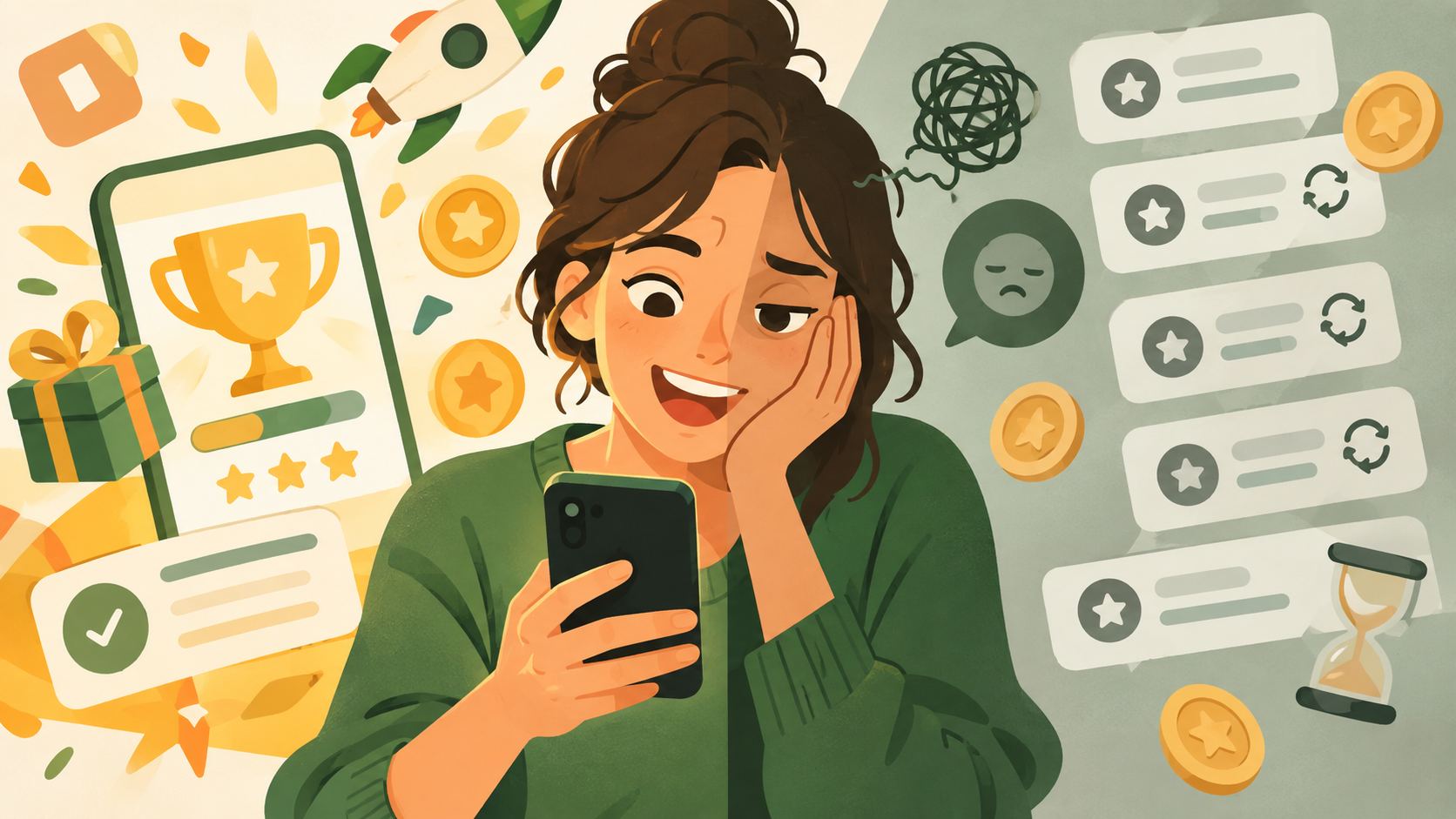
Gamification: how points, leaderboards, and rewards spark engagement
Gamification is the use of typical game elements in settings that are not games: points, levels, badges, leaderboards, timed challenges. The most widely cited definition comes from a 2011 paper by Sebastian Deterding and colleagues. Fifteen years later, it still describes what we find in everyday apps, from language learning to fitness, from banking to the supermarket.
The underlying idea is simple: turn an activity that takes consistency into a small match, with a visible finish line and instant gratification. It works because it taps into deep needs, such as the desire to progress, comparison with others, and the pleasure of surprise. For that very reason, though, it can wear out quickly or slide into manipulation.
Let me say right away where I stand: repetitive mechanics bore me almost immediately. Either the system works for me automatically and invisibly, or after the first visit I never come back to redeem prizes that, more often than not, turn out to be disappointing. I doubt I’m an isolated case.
Why streaks, badges, and leaderboards work
Behind every progress bar there’s a bit of behavioral psychology. Variable rewards, the ones whose timing and size nobody can predict, follow the same logic as slot machines and hold attention far better than a predictable prize. Streaks, the count of consecutive days, exploit loss aversion instead: after weeks of consistency, breaking the chain weighs more than the pleasure of extending it.
Leaderboards add a social dimension. Watching your name climb a few spots fires up those who love to compete but discourages those who always end up at the bottom. That’s why the same mechanism thrills some people and drives others away.
Duolingo and the streak you can’t break
The textbook example is Duolingo, where the streak has become almost an institution: according to PocketGamer.biz, more than 10 million users have passed 365 consecutive days. Around that counter the company has built weekly leagues, challenges with friends, “freezes” that save the streak after a bad day and, of course, the famous green owl that keeps reminding you of the forgotten lesson.
Duolingo’s merit is tying the game to a real goal: learning something every day, even for just five minutes. The drawback, which many users admit, is that at some point you end up defending the number more than studying the language, picking the quickest exercise just to keep the streak alive.
When the reward arrives on its own
My favorite cases are those in which the mechanics disappear into the service. Apple Watch rings close while you walk or climb a flight of stairs, with no need to open any app: the satisfaction comes as a side effect of what you do anyway. The same goes for loyalty programs where points pile up at checkout, with no cards to show or codes to enter.
Starbucks Rewards is one of the most studied programs for exactly this reason. Stars are earned by paying with the app, which meanwhile records preferences and suggests the usual order. The game is there, but it runs under the surface and asks for no attention in return. Perhaps that’s why it holds up over time.
The risk of rewards that kill motivation
There is a well-documented flip side, though. A 1999 meta-analysis by Edward Deci, Richard Koestner, and Richard Ryan covering 128 experiments showed that tangible, expected rewards tend to reduce intrinsic motivation. People who act for the badge stop doing it for the pleasure of the activity, and when the badge loses its value, nothing is left.
Back in 2012, Gartner predicted that by 2014, 80% of gamified applications would miss their business objectives because of poor design, with points and badges slapped onto experiences that didn’t need them. A 2014 review of 24 empirical studies by Juho Hamari, Jonna Koivisto, and Harri Sarsa reached a more nuanced conclusion: the positive effects are real, but they depend heavily on context and on the kind of users involved.
Robinhood and the confetti: when the game touches money
The most slippery ground is finance. The trading app Robinhood used to celebrate trades with a shower of digital confetti, an animation that only looked harmless. In December 2020, Massachusetts regulators accused the company, among other things, of using gamification techniques to push inexperienced investors to trade more often, and at the end of March 2021 Robinhood dropped the confetti.
Here the line between engagement and manipulation grows thin enough to resemble that of dark patterns, which now carry a steep legal price too. When savings, health, or addiction are at stake, celebrating the most frequent action instead of the wisest one is a design mistake with concrete consequences.
Foursquare and the boredom of repetitive mechanics
Even without crossing into abuse, the game wears down. Foursquare proves it: in the early 2010s, check-ins, badges, and the title of “mayor” of a venue won over millions of people. I fell for it too: I used to battle another regular for the title of mayor of a Tuscan trattoria in Milan, one check-in against another, until the contest slowly fizzled out. In 2014 the company moved check-ins to the new Swarm app and removed mayorships, only to bring them back the following year after protests from its most loyal users. By then, however, many had already left.
It’s the arc I recognize in my relationship with apps full of collections to complete. The first time they spark curiosity, the second they bore me, and by the third I’m already somewhere else. And when the prize finally arrives, maybe a tiny discount or a digital sticker, disappointment closes the loop. It’s the same fatigue I described when writing about aggressive personalization: too much participation demanded, too little value given back.
What makes a reward system sustainable
A few constants emerge from the successful examples. The game must serve the goals of the people using the product, not just retention metrics. Friction should be kept to a minimum, with rewards that accrue automatically during use. Rewards need real perceived value, otherwise it’s better to skip them, because a disappointing prize does more harm than none at all. Finally, there must be respect for time and for attention, by now a contested resource, measured notifications, and the freedom to leave the game without guilt, a theme close to the design of silence.
Those who write the copy for these experiences also carry a responsibility for language: microcopy that celebrates without being childish, reminders that invite without guilt-tripping, program rules understandable in a single line. The best gamification is the kind you barely notice.
Related sources
- From game design elements to gamefulness: defining “gamification”, Deterding, Dixon, Khaled, Nacke, 2011
- Does gamification work? A literature review of empirical studies on gamification, Hamari, Koivisto, Sarsa, 2014
- A meta-analytic review of experiments examining the effects of extrinsic rewards on intrinsic motivation, Deci, Koestner, Ryan, Psychological Bulletin, 1999
- Badges beware: 80% of gamification apps will end up being losers, says Gartner, TechCrunch
- More than 10 million Duolingo users have a 365-day streak, PocketGamer.biz
- Robinhood gets rid of confetti feature amid scrutiny over gamification, CNBC
- Foursquare and Swarm: breaking up is never easy, Engadget
