
Navigating reorgs and layoffs in tech
I have spent twenty years inside two big corporations, and in all that time, I never once held the same role long enough to get bored. There was always a wave coming. Centralize, then decentralize. Build the team here, then move it there. Pack up, change countries, learn a new org chart, meet a new set of stakeholders. And every so often, the envelope: your role is redundant. I have lived through enough of these to stop being surprised by them, which is its own strange kind of skill.
So this is not a how-to from someone who has read about restructuring. It is a field report from someone who kept getting reshuffled and is still standing.
The slide that told me to pack my bags
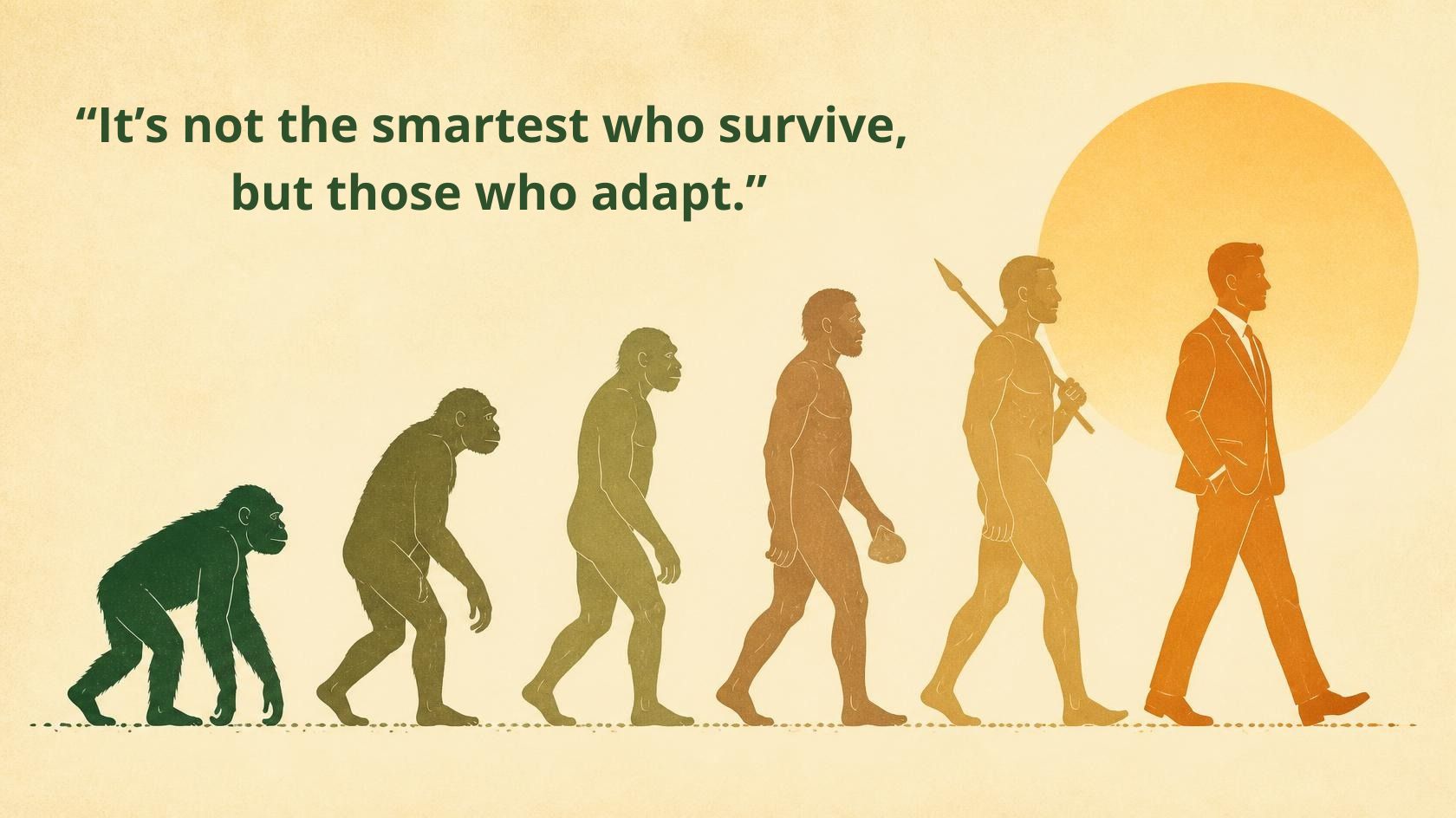
One day, in one of those all-hands meetings that blur together after two decades, a slide came up that I can still picture exactly. Almost no words on it. Just a row of figures evolving from hunched to upright, and a single line of verbiage about how the ones who survive are not the smartest, but the ones who adapt. (It usually gets pinned on Darwin, though he never actually phrased it that way.) I sat there and felt it in my gut: time to pack my bags and move to yet another country.

I did not end up moving that time. Something else came along, as it tends to. But the message stuck, and it has walked beside me through every reshuffle since.
The wave never really stops
If reorgs feel relentless, that is because they are. McKinsey found that 70% of executives said their most recent restructuring occurred within the previous two years, and a majority expected another within the next two. That is a higher churn rate than companies redesigning their websites or replacing their computer systems. The machine you work inside is rebuilt more often than the software running it.
Here is the part that always stung me: most of that upheaval does not even work. Over 80% of restructuring efforts fail to deliver the value they promised within the timeframe they promised, and only 23% of executives said their reorg actually met its objectives. You can pour your sleep, your weekends, and your loyalty into surviving a transformation that the data says probably will not land. Knowing that helped me take the next one a little less personally.
The scarlet letter R
There was a time when being made redundant felt like a secret you buried. I know, because I carried it. Your performance was never in question; the decision had nothing to do with you, and yet you walked around feeling like there was a red letter R stuck to your forehead. Shame is a funny thing. It does not wait for logic.
That bias has genuinely faded, especially in tech. Reporting on the shift found that as layoffs became common, fewer people treated them as a private mark of shame, and coworkers started showing up publicly to vouch for each other’s strengths. Older workers, interestingly, tend to be the most willing to talk openly about job loss, while younger ones still worry it signals they did something wrong.
Today, people post a warm thank-you to their managers and peers and announce their next chapter with real confidence. I will admit the polish of it feels a touch too rehearsed for my taste. But I am genuinely glad the stigma is gone because it never helped anyone find their next thing.
What landing a new role actually looks like
My first time out, I found work within a couple of weeks. It felt right, it felt easy, almost suspiciously so. The catch was that it was temporary, and after it ended, I landed at a startup where things did not work out. I have written about that chapter in The Startup Disillusionment, and the short version is that culture beats everything else, every time. Then I was back on the market, and my next real opportunity came together in a few weeks. That was roughly eight years ago.
I share the timeline because expectations matter. In 2025 and 2026, the average job search runs about five to six months, and the hiring rate for unemployed workers has slipped to around 45%, down from the year before. Fewer companies are hiring, and the ones that are have raised their bar. If your search is taking longer than you hoped, you are not failing. You are living inside the numbers.
When older meets one more centralization
My most recent exit was due to yet another centralization. I was doing UX in the EU for US content, and leadership decided to consolidate everyone stateside. I was older this time, and I moved through it without sleepless nights and without tears. That part felt like progress, the quiet confidence that comes from having done this before. If you want the broader picture of how age plays into all of this, I dug into it in “Generational clash at work.”
But composure is not the same as enthusiasm. I felt disappointed and realized I was not ready to pour my heart and soul into another company’s mission. Protecting your own energy is part of the work too, something I keep coming back to in The importance of wellness at work.
So I went back to freelancing
I broke back into freelancing on purpose, partly to reclaim the entrepreneurial side of myself I had set aside for two decades of payroll. The first year was fine. Now, rounding out year two, let me be honest with you: the market is hard. Competition is fierce, and rates have taken a beating thanks to the chorus of “AI can do that too.”
The data backs up what my inbox already told me. Research published in Organization Science found freelancers in AI-exposed fields saw roughly a 5% drop in earnings after generative tools arrived, and rates for commodity work like basic content writing have fallen close to 20% since 2020. The flip side, and this is where I am placing my bets, is that specialized and AI-augmented skills are commanding premiums of 40% and up. The middle is getting squeezed. The edges are paying. I wrote more about this split in AI and the labor market, and about the human side of going solo in Freelancing and networking.
Enjoying the ride, mostly
Two years in, I am a bit on edge; I will not pretend otherwise. I am also proud. I took on hard briefs, stretched into new areas of expertise, and remembered that I can build something on my own. I may be ready to return to a full-time seat, and I have not yet found the right one, but I will. I have a long enough track record of landing on my feet to trust the pattern, something twenty-five years in this industry keeps confirming, as I traced in From fax machines to AI.
If there is one thing two decades of waves taught me, it is to hold the destination loosely and pay attention to the ride. The org chart will change again. It always does. The trick is to keep your skills sharp, your network warm, and your sense of self separate from whatever box you happen to occupy this quarter.
Related sources
- McKinsey & Company, “The secrets of successful organizational redesigns” and “Reorganization rules that work”, on reorg frequency and failure rates.
- Layoffs.fyi via Statista and Network World, 2026 tech layoff totals and the AI connection.
- Marketplace, “As stigma lifts around layoffs, fewer people view them as a secret mark of shame”
- Careerminds, “How long does it take to find a job after a layoff? [2026 data]”
- Resumas, “Job search reality in 2026: expect longer waits”, on hiring rates.
- Winvesta, “AI cut freelance rates 30%”, and Jobbers Global Freelance Hourly Rate Index 2026, on rate pressure and premium skills.
- Organization Science (INFORMS), research on generative AI exposure and freelancer earnings.
