
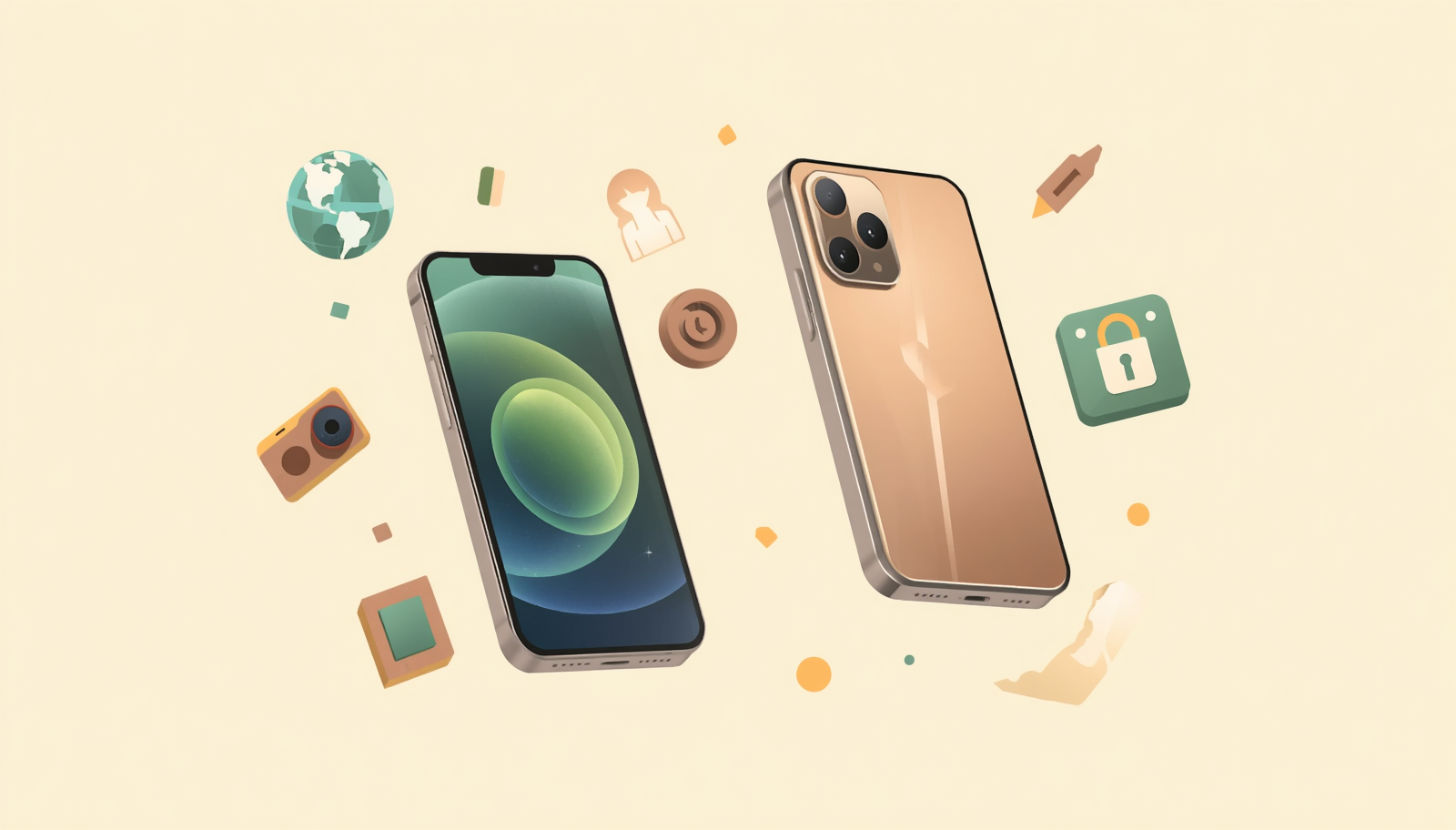
iOS vs Android: a never-ending battle that’s quietly changing
I’ve been using smartphones for over a decade, and at some point, I made a choice: Android. Not because I hate Apple; I genuinely think iPhones are remarkable devices. But because a 500-euro midrange Android phone does everything I actually need, and I can swap it out every couple of years without feeling like I’ve thrown money into a furnace. My sister and my mom, on the other hand, both use iPhones, and honestly, that’s probably the right call for them, which is kind of the whole story in a nutshell.
But the iOS vs. Android debate is about more than personal preference. It shapes how developers build apps, how designers think about mobile experiences, and, in genuinely interesting ways, reflects something about who we are and where we live.
The numbers tell two very different stories depending on where you look
Globally, Android dominates. As of 2026, it holds roughly 70% of the worldwide mobile market, leaving iOS with about 29%. Those numbers might make Android sound like the obvious winner, but they tell a misleading story if you stop there.
In the United States, the picture flips almost completely: iOS sits at around 60% market share, with Android trailing at 40%. The US is one of the few places in the world where Apple is actually the majority platform, and it shows in everything from app monetization strategies to how developers prioritize which platform gets a feature first.
Europe is different, and this is what I find most interesting. Android leads across most of the continent, with a market share of about 65-68%. In France, Android is at 64%, in Germany at 60%. The UK is the outlier in Europe, where iPhones barely edge out Android with 52% vs 47%. The farther east or south in Europe you go, the more Android dominates, largely because price-sensitive markets respond to Android’s wide range of hardware. A flagship Samsung and an affordable Xiaomi both run Android, and Apple has no equivalent entry-level offer.
Who actually uses which phone (and what it says about them)
This is where things get sociologically interesting, and also a little uncomfortable, because income is a big part of it.
Studies consistently show that iPhone users earn more on average. The gap is notable: iPhone users report average yearly incomes around $53,000, versus roughly $37,000 for Android users. About 43% of iPhone users fall into the high-income bracket, compared to 27% of Android users. In the US specifically, iPhones are particularly popular with Gen Z and Millennials. At the same time, Android skews older: more Gen X and Boomers, which is a bit counterintuitive if you picture the typical Android user as a tech-savvy tinkerer.
The personality research is interesting too, though you should take it with some skepticism. A study published in Frontiers in Psychology found that the brand image of iOS centers on “consistency, convenience, and security,” while Android aligns with “diversification, personalization, and freedom.” That tracks with lived experience. People who want things just to work tend toward the iPhone. People who want to tweak, customize, or simply spend less money tend toward Android.
One more data point: iPhone users spend an average of $101 per month on technology overall, nearly double the amount spent by Android users. And despite having far fewer users globally, the App Store generates about twice the revenue of Google Play, roughly $80 billion in the first half of 2026, compared to Google Play’s $36 billion.
The price myth that’s mostly dead now
For a long time, choosing Android meant choosing affordability. That’s still true at the lower end of the market, but at the top, the price gap has basically closed.
A Google Pixel 10 Pro or a Samsung Galaxy S26 Ultra costs as much as an iPhone 17 Pro. We’re talking 1,000 to 1,300 euros for a flagship Android phone, the same territory as Apple. The narrative that “Android is for people who can’t afford an iPhone” has become outdated when comparing flagship to flagship. And Android’s hardware diversity now even extends to form factor: the comeback of flip phones is largely an Android story, with Samsung and Motorola leading a category Apple hasn’t touched.
Where Android still genuinely wins on price is in the midrange. For 400-600 euros, you can get a Samsung A-series or a Pixel 10a that performs smoothly for everyday use, takes decent photos, and will last a few years without drama. Apple has no real answer to this segment. The iPhone SE exists, but its small screen and older design feel like leftovers rather than a genuine budget option.
For me personally, this midrange sweet spot is the reason I stay on Android. I’m not a photographer, not a content creator, not someone who needs spatial audio or ProRes video. At 500 euros, I get a phone that handles everything I throw at it, and in two years, I can upgrade again without a massive outlay.
Camera and audio: where iPhone still has an edge
I want to be honest here because I think a lot of Android fans (myself included) sometimes get defensive about this: iPhones are still genuinely exceptional at camera and audio quality, especially for video.
The iPhone 17 Pro ranks among the top camera phones of 2026 by virtually every benchmark. Apple’s color science, video stabilization, Dolby Vision HDR recording, and directional microphones with spatial audio support give footage a consistency and polish that’s hard to match. If you’re creating content (YouTube, TikTok, short films), an iPhone is still a serious tool.
High-end Android flagships are competitive and, in some respects (extreme zoom, megapixel count, hardware flexibility), exceed what Apple offers. The Samsung Galaxy S26 Ultra has a legitimately great camera. But the average quality ceiling across iPhone models is more reliably high. Apple controls both the hardware and the software, which means the camera system is tuned with a coherence that Android manufacturers have to work harder to achieve.
For everyday photos and casual video, a modern midrange Android is perfectly fine. But if camera and audio are high priorities, that’s still a genuine point in Apple’s favor.
Battery life: the tables have turned
Battery used to be a clear advantage for Android. Manufacturers compensated for Apple’s tighter hardware control by packing in bigger cells, and for years, it worked. A lot of people switched to Android partly because iPhones didn’t last a full day under heavy use.
That story has changed. In a large-scale CNET test across 35 smartphones conducted throughout 2025, the iPhone 17 Pro Max ranked first overall for battery life, and Apple tied with OnePlus as the top-performing brand. The iPhone 17 came second, despite having one of the smallest batteries in the test group. Apple’s advantage comes from silicon efficiency: the A-series chips squeeze more out of fewer milliamp-hours than most Android processors manage.
Where Android still has a genuine edge is charging speed. The Samsung Galaxy S26 Ultra leads in wired charging in the same round of tests, and many Android flagships support 65W charging or faster. At the same time, Apple deliberately caps charging speeds to reduce heat and preserve long-term battery health. So it depends on what you value: lasting longer between charges, or getting back to full faster.
The ecosystem lock-in: feature or trap?
Apple’s closed ecosystem is one of the most written-about aspects of the iPhone experience, and it cuts both ways.
On one hand, the integration between iPhone, MacBook, iPad, AirPods, and Apple Watch is genuinely seamless. iMessage, AirDrop, Handoff, and Continuity Camera: these features work so well together that once you’re in, leaving feels painful. Brand retention for iOS is around 86-94%, and iPhone users keep their devices for an average of 4.2 years, compared to 3.1 years for Android. The ecosystem creates loyalty partly through genuine quality and partly through switching friction.
On the other hand, that same integration is why my mom uses an iPhone. She’s not interested in customizing her home screen or sideloading apps. She wants something that works predictably, syncs with her iPad, and doesn’t ask her to make decisions about permissions or storage management. The closed ecosystem that feels restrictive to a power user feels safe and simple to someone who just wants to call people and take photos.
Android’s openness is a real advantage for people who know how to use it. You can install apps from outside the Play Store, use any browser engine, swap default apps for practically anything, and connect your phone to a much wider range of accessories and services. But that openness can also mean more complexity and more inconsistency, which is fine for some people and genuinely alienating for others.
What this means for app and mobile web design
This split has real consequences for anyone building digital products.
The iOS vs Android divide means designers have to think in two parallel systems. iOS favors tab-based navigation at the bottom of the screen, San Francisco typography, and Apple’s Human Interface Guidelines. Android’s Material You design system, introduced in recent years, goes the other way: dynamic color theming based on the user’s wallpaper, more flexible layout patterns, and a hamburger menu in the top-left corner rather than tabs at the bottom. The Google icons redesign is a good example of how carefully Google manages visual continuity even when it updates its design language across platforms.
These differences aren’t just stylistic. They reflect different user expectations. An Android user who opens an app that feels heavily “iOS-styled” will notice something feels off, even if they can’t articulate why. The same goes in reverse. This is exactly why UX writing and microcopy need to be adapted per platform, not just translated.
For mobile web specifically, the audience split matters a lot. If your analytics show a predominantly US-based audience, you’re likely talking to a majority iOS user base, and those users are significantly more likely to make in-app purchases or pay for subscriptions. CTAs that convert are not a universal formula: what works on the App Store doesn’t automatically translate to Google Play, where users skew toward free apps and are slower to convert to paid. If your audience is European, you need to take Android seriously as the primary platform, not an afterthought. A case like the PayPal signup button in Italy is a reminder that even a single word can determine whether a European user converts or bounces.
Developers also deal with the practical asymmetry: iOS targets a limited set of Apple hardware, making testing and optimization more straightforward. Android’s fragmentation across hundreds of devices and screen sizes is a real development cost. This is one reason some apps still launch on iOS first, not out of preference but for logistical reasons.
A genuinely personal choice that keeps being more interesting than it sounds
I’m not going to pretend there’s a correct answer to the iOS vs Android question. There’s a right answer for different people and different contexts, and that’s precisely what makes it interesting.
The old story that iPhone is for people with money and Android is for everyone else has become too simple. At the top end, these platforms have converged on similar price points and, often, similar performance. The real differences lie in philosophy: closed vs. open, polished uniformity vs. flexible diversity, premium-everything vs. a genuinely strong midrange.
I’ll stay on Android because it works for how I live and what I spend. My sister and my mom will stay on iPhone because that ecosystem suits them perfectly. And the people who build apps for both of us will keep trying to figure out how to make experiences that feel right on either side of the fence.
Related sources
- iPhone 17 Pro Named Fastest-Charging Smartphone – MacRumors
- Mobile OS Market Share 2026: iOS vs Android Statistics
- Android vs iOS Statistics 2026: Users, Revenue, and Global Trends – Tekrevol
- Android vs iOS Market Share: Most Popular Mobile OS in 2026 – Mobiloud
- iPhone Market Share by Country 2026 – World Population Review
- iPhone Users vs Android Users: Personality and Behavior – Fireart Studio
- iPhone vs Android Users: Key Differences in 2026 – Wezom
- iPhone vs Android User Market Share – DemandSage
- Research on the brand image of iOS and Android based on mixed methods – Frontiers in Psychology
- Users of the main smartphone operating systems differ only a little in personality – PMC
- iOS vs. Android UI Design: 9 Key Differences – UXPin
- Best Camera Phones 2026: iPhone, Samsung, Xiaomi Ranked – Cashkr
- iPhone 17 Pro Max vs. Android Battery Life: New Test Reveals Winner – MacRumors
