
What changes in Google Search in Europe under the DMA
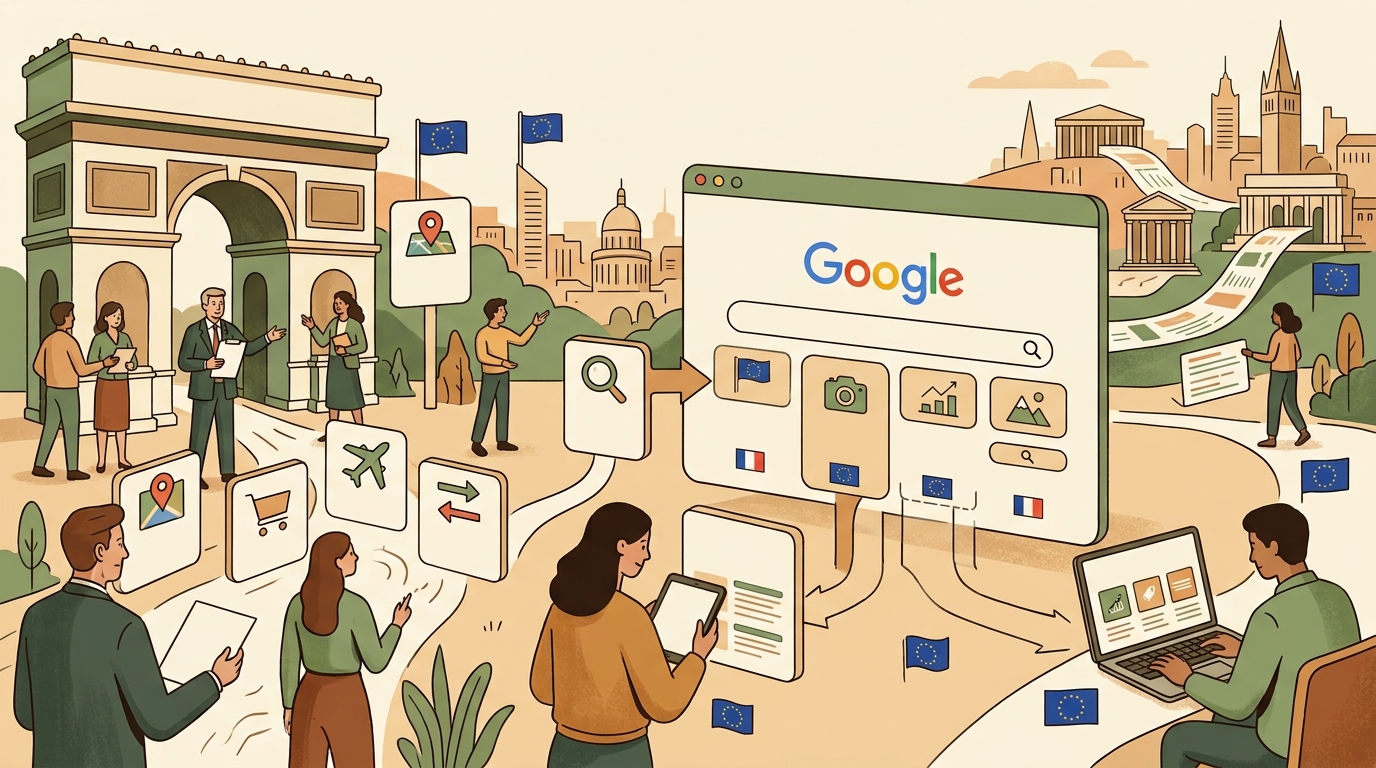
On 8 September 2026 Google’s results page changed shape across the whole European Economic Area. Queries about hotels, flights, long-distance trains and buses, and products now return a different arrangement, and Mountain View has explained that this amounts to compliance with the Digital Markets Act. On 23 July the European Commission had fined the company 890 million euros in total: 460 concern self-preferencing in search, meaning the advantage granted to its own vertical services in the ranking and display of results, while 430 relate to the restrictions imposed on developers through Play. Article 6(5) of the regulation forbids a gatekeeper from treating its own offering more favourably than those of third parties. Sixty days were granted for the remedy, and the overhaul landed close to the deadline.
The two new units, aggregators and direct suppliers
The mechanism rests on two blocks. The first gathers vertical search services, so online travel agencies, comparison sites and metasearch engines, with the top-ranked operator already expanded and fitted with photos, prices and ratings where available. The second reserves a slot for businesses that sell directly, and shows up only alongside the preceding block. Entering the first requires formal approval as a vertical search service and data delivery through feeds or real-time APIs; the second only calls for letting the crawler in, although a feed improves visibility. Ordering stays in the hands of the algorithm. Local queries about restaurants, services and things to do remain under construction, with no announced date.
The least discussed detail concerns what has been taken away. Some carousels have lost live pricing, and moving from one aggregator to another forces the request to be typed again. Google reports having measured, during testing, a high level of dissatisfaction around exactly that friction.
Why Google calls it the worst quality drop in 29 years
The sentence that travelled around newsrooms comes from an interview with Reuters: according to the company this is the largest reduction in the quality of its services across twenty-nine years of history. In support it cites 2024 tests where traffic to hotel websites fell by more than 10%, recorded satisfaction worsened, people searching had to repeat the same question several times and abandonment grew, while intermediaries held broadly steady. An earlier intervention driven by the same regulation is said to have eroded up to 30% of free visits to European businesses that take online bookings.
It is worth remembering that whoever supplies these figures has an obvious interest in painting compliance as damage. The Commission reads the situation the other way round: without rebalancing, comparison services and vertical rivals find no way to be seen. Both accounts coexist, and meanwhile anyone running a hotel in Ortona or a guest house in Abruzzo now finds Booking and Expedia above their own site.
My impressions sliding after four months of growth
Here a tiny and therefore instructive data point comes in. Since the blog went live in May, the impressions curve in Search Console has always pointed upward, with the slightly naive enthusiasm of someone watching their own vegetable patch grow. Now, for the first time, it points down.
I have no grounds for pinning the dip on the European overhaul: these pages talk about neither hotels nor flights, they never land in comparison carousels, and a young site wobbles for a thousand reasons, from seasonality to algorithm updates. The combined effect deserves attention all the same. Impressions count how many times a page gets displayed; if the results screen fills with panels that keep people inside it, the chances of appearing in a useful position thin out for everyone, not only for the categories named in the Brussels decision.
AI Overviews and the searches that send no clicks
The European revision grafts onto a far wider phenomenon. According to SparkToro’s analysis of Similarweb clickstream data, in the first four months of 2026 68% of Google searches in the United States ended with no click through to an external site, against 60.45% in 2024. The share of queries producing at least one visit dropped by 9.51 points, nearly a quarter less within two years. AI Overviews show up on more than 20% of requests and, where present, cut the willingness to click by roughly 60%. The Pew Research Center, measuring the actual behaviour of a panel, had already recorded 8% of clicks on a traditional result when a generated summary appeared, against 15% without one.
Translated for whoever writes: visibility carries on existing, while the referral thins out. This is the shift I described when walking through the road from SEO to GEO, and it now reads plainly inside the Search Console panels, where impressions and clicks have taken divergent paths.
The European publishers’ complaint against AI Overviews and AI Mode
On the disintermediation front the legal contest is open. On 9 December 2025 the Commission opened a formal investigation into the unauthorised use of editorial content for artificial intelligence purposes. On 9 February 2026 the European Publishers Council filed an antitrust complaint accusing Google of exploiting its dominant position to feed AI Overviews and AI Mode with journalistic material without permission or adequate payment, asking for control, transparency and a licensing system. In August roughly three hundred French newspapers brought a similar challenge before their national authority. The matter intertwines with the still unresolved question of who answers for what Google’s AI asserts.
What follows for anyone publishing content
The picture emerging is one of double-entry search. On one side the regulatory intervention redistributes room among platforms, and within the verticals it touches it rewards the large aggregators over individual operators: a paradoxical outcome for a rule designed to protect competition, though it has the merit of taking away from a single player the power to decide who gets seen. On the other, generative summaries reduce how often an answer points back to the source, and that holds for a provincial hotel just as for a personal blog.
Content producers can work on a few concrete levers. Branded queries, local ones and those with strong transactional intent keep their value, because no summary replaces the decision to buy or to book. Structured data and, for sellers, feeds into the new units become a technical requirement rather than an indulgence. Measurement needs separating: watching impressions alongside clicks, without reading them as a single indicator, avoids mistaken diagnoses. Above all it pays to cultivate the channels that depend on no intermediary, from the newsletter to communities, because an archive reachable without going through an engine is worth more than any ranking. It also helps the mental hygiene of whoever writes, who can then stop debunking SEO myths at every update.
One last thought remains, perhaps the most awkward. An engine that answers in place of the sources, and a results page redesigned by a public authority, tell the same story: access to the web still runs through a chokepoint that is far too narrow. The direction of digital travel, which I looked at elsewhere while discussing the digitalization of tourism, shows it clearly. As long as that point stays single, every correction shifts the problem instead of solving it.
Related sources
- Commission fines Google €890 million for breaches of the Digital Markets Act, European Commission, 23 July 2026
- Google Rolls Out Redesigned Search Results Across The EEA, Search Engine Journal
- Google Says EU DMA Changes Resulted In Largest Reduction In Search Quality, Search Engine Roundtable
- In 2026, Less than One Third of Google Searches Still Send a Click, SparkToro
- Google zero-click searches reach 68% in early 2026, Search Engine Land
- Google users are less likely to click on links when an AI summary appears in the results, Pew Research Center
- European Publishers Council files formal antitrust complaint against Google over AI Overviews and AI Mode, EPC
- Google cambia Search in Europa per adeguarsi al Digital Markets Act, la Repubblica
