
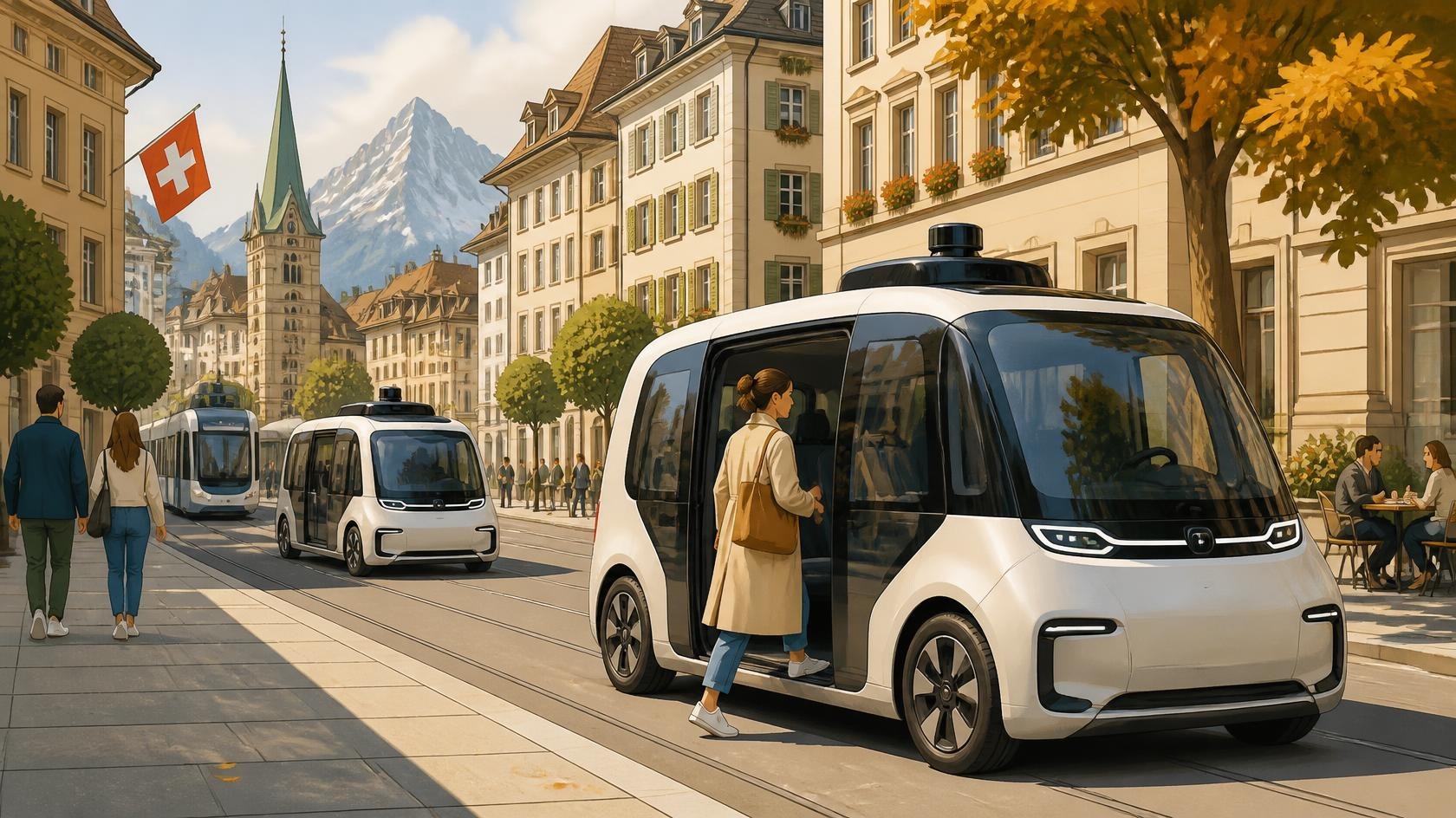
I’ll admit it right away: I’m a terrible driver. I can barely handle my Citroën Ami, a tiny quadricycle that tops out at 45 km/h (28 mph), and I still managed to have the silliest accident with it, because the door suddenly flew open. After-sales service did the rest, with months of waiting for spare parts. So when I read about robotaxis and self-driving cars, I don’t feel anxious, I feel something close to hope: a driverless car is my secret dream, and I hope to own one someday.
The news that got me dreaming again comes from Switzerland, and I found it in an online paper from Como, just across the border.
Robotaxis in Switzerland: Zurich talks about the end of taxi drivers
George Botonakis, president of the Zurich taxi drivers’ association, told the NZZ that within five years 80% of the trade will be gone. About 5,500 taxi drivers work in the canton of Zurich, so the prediction affects thousands of people. The interview was picked up by Tio.ch and by ComoZero, which lined up the signs of this acceleration.
The first is Waymo, the Alphabet (Google) company that dominates the sector in the United States: it has opened an outpost in Zurich, although it doesn’t offer commercial rides in Switzerland yet. The second is a pilot project launched in September in Otelfingen, in the canton of Zurich, run by the Swiss Federal Railways (SBB) together with the cantons of Zurich and Aargau. Vehicles are booked through an app and cost 4.70 Swiss francs at pickup plus 38 centimes per kilometer. For now, a safety operator still sits behind the wheel.
Uber and WeRide set their sights on the Zurich region
The third sign is called Uber. In June 2026 the platform and China’s WeRide announced a commercial robotaxi service in the Greater Zurich Region, their second European launch after Madrid. Rides will be booked in the Uber app, subject to approval by the Federal Roads Office (FEDRO). WeRide already obtained a driverless permit for the Furttal region in November 2025, while day-to-day fleet operations are handled by Rydera, a local mobility and logistics operator.
The plan is to grow in stages, eventually reaching fully driverless rides in core urban areas. Zurich is the fifth of the fifteen cities covered by the global agreement between the two companies.
Swiss rules on automated driving since March 1, 2025
If Switzerland can move this fast, Bern deserves part of the credit. Since March 1, 2025, the ordinance on automated driving has allowed three uses:
- a level 3 motorway pilot, where the car drives itself on the highway and the person in the driver’s seat only has to be ready to take back control;
- driverless vehicles, allowed on routes approved by the cantons and supervised by operators;
- automated parking, only in areas separated from traffic and approved by the authorities.
The legal basis is articles 25a to 25g of the Swiss Road Traffic Act, which let the Federal Council approve levels 3 and 4. FEDRO’s guidelines for authorizing vehicles without a driver have applied since January 1, 2026. As for insurance, the vehicle’s keeper is liable for damage, and their insurer can then seek recovery from the system’s manufacturer. A black box must record data on board.
Not everyone is satisfied, though. Barbara Schaffner, mayor of Otelfingen, sees autonomous mobility as an opportunity for villages served by few buses, but criticizes the federal government for lacking a vision.
What the data says about robotaxi safety
People who fear driverless cars tend to picture them as runaway missiles. The numbers tell a different story, at least the ones available. Waymo passed 220 million miles with nobody at the wheel by March 2026 and, compared with a human benchmark on the same roads in Phoenix, San Francisco, Los Angeles and Austin, reports 94% fewer crashes with serious injuries or deaths and 82% fewer injury crashes.
To be clear, these are the company’s own figures, built on a modeled comparison rather than a head-to-head test. Outside confirmation came from the reinsurer Swiss Re, which analyzed 25.3 million Waymo miles against more than 500,000 claims and over 200 billion miles driven by people. The result: 88% fewer property damage claims and 92% fewer bodily injury claims. Even against newer cars with driver assistance systems, the advantage stays above 85%.
For someone who crashed because a door swung open, those figures speak for themselves.
American hiccups: school buses and illegal U-turns
The picture has its shadows too. The Austin school district in Texas documented 19 cases of Waymo vehicles passing stopped school buses, in one case while a student was still crossing. Nobody was hurt, but the federal road safety agency NHTSA opened an investigation and in December 2025 the company recalled its software.
Then there’s the episode that went viral. In San Bruno, California, during a DUI checkpoint, a Waymo made an illegal U-turn right in front of the police. Officers pulled it over but couldn’t ticket it, because the law only provided for penalties against flesh-and-blood drivers. On social media the police joked: “Our citation books don’t have a box for ‘robot’.” Waymo had racked up 589 parking tickets the year before, but for moving violations there was a complete void.
Who gets the ticket when nobody is driving
To fill that void, California passed AB 1777, in force since July 1, 2026. Police can now cite manufacturers with a “notice of noncompliance”, which the company must report to the state DMV. Companies must also give first responders a priority phone line staffed around the clock, two-way communication with remote operators, and the ability to receive a digital “geofence” order: within two minutes the vehicle has to reroute or leave an emergency area.
The law sets no fines and leaves it to the DMV to decide how the notices affect permits. The Teamsters union criticized it as preferential treatment. In Arizona and Texas, on the other hand, police can already ticket robotaxis.
In Italy, the traffic code still assumes a human driver
And what about Italy? The Italian traffic code is built around a person driving, and the only real opening remains the 2018 Smart Road decree, which allows road testing only with authorization, case by case, for manufacturers, universities and research bodies.
Something is moving. About sixty mayors, including those of Milan, Turin and Genoa, have joined the European network for testing, and in June 2026 Italy was among the 18 European governments that signed a declaration of intent on cross-border trials of driverless vehicles. Federtrasporto, however, speaks of significant legislative obstacles and points out that about 90% of crashes stem from human error.
Italy’s own figures confirm the point. According to the ACI-Istat report, road deaths in 2025 fell below 3,000 for the first time since the pandemic, but crashes rose by 2.2%. Distracted driving (with smartphones in first place), failure to yield and speeding together cause more than four crashes in ten. Those are exactly the behaviors an automated system doesn’t have: it doesn’t check notifications, it’s never in a hurry, it doesn’t get distracted.
Europe: Zagreb, London and the economics
The first commercial service in the European Union launched in Zagreb, where Croatian startup Verne runs electric SUVs with Pony.ai software, once again booked through Uber, across a 90 square kilometer area between the city center and the airport. In London, Wayve and Uber have announced a service with a safety operator on board, at the same prices as a regular ride.
Boston Consulting Group forecasts more than a million robotaxis worldwide by 2035, about 120,000 of them in Europe. Costs remain the sticking point: opening a new city takes 15 to 30 million dollars and up to two years of paperwork, and breaking even requires fleets of 15,000 to 20,000 vehicles. Narrow medieval streets, many vulnerable road users and strict insurance rules explain why Italy is described as a market on hold.
Taxi drivers, chauffeurs and remote operators
And what about the people driving taxis today? One option is to turn them into operators who supervise fleets and automated minibuses remotely. Botonakis is skeptical: someone who loves cruising around the city, he argues, is not the same kind of person who spends the day in front of ten monitors, and only a small share will manage to adapt. For the rest of the trade, ComoZero points to personalized service, assistance and the luxury segment: if the cabbie disappears, the chauffeur remains.
It’s a delicate transition, much like the one I described when writing about BYD and Chinese cars, where the market moves faster than the people who work in it. Car software has also become a place where historic brands reinvent themselves, as BlackBerry did with QNX.
Why I’m still waiting for my self-driving car
I understand the taxi drivers’ fears and I don’t dismiss the Austin school buses. Still, looking at the numbers, it’s hard to argue that a distracted human is more reliable than a system that sees 360 degrees and never looks at a phone. On Italian roads, where I’ve already written about how dangerous tampered fat bikes can be, a little predictability would help everyone.
Meanwhile I keep getting around in my Ami, carefully and with a few prayers. But the day I can get into a car, say where I want to go and start reading, I’ll be first in line. Preferably with the door firmly shut.
Related sources
- Uber e la nuova sede della società di Google: la Svizzera si prepara alla “fine dei tassisti” in 5 anni, ComoZero, October 11, 2026
- WeRide and Uber Plan to Launch Commercial Robotaxi Service in Zurich, WeRide, June 17, 2026
- Uber e WeRide, presto taxi senza conducente a Zurigo, Swissinfo
- Guida automatizzata, Federal Roads Office FEDRO
- Waymo safety update: 220 million miles, 94% fewer crashes, EVwire, June 24, 2026
- Waymo, Swiss Re study finds Waymo’s autonomous driving safer than human driving, Repairer Driven News, January 16, 2025
- Waymo will recall software after its self-driving cars passed stopped school buses, NPR, December 6, 2025
- Police can’t ticket driverless Waymo for illegal U-turn, Jalopnik, October 2, 2025
- California’s “robotaxi crackdown”: new law allows police to cite driverless cars, FOX 11 Los Angeles, June 24, 2026
- Smart Road: arriva il decreto che autorizza i test di guida autonoma, SicurAUTO.it, March 7, 2018
- L’Europa accelera sulla guida autonoma: anche l’Italia si candida per i test, Open, June 10, 2026
- L’auto senza guidatore tra etica e algoritmi: l’Europa apre ai robotaxi, Avvenire, June 8, 2026
- La sicurezza sulle strade: aumentano gli incidenti e i feriti ma diminuiscono le vittime, L’Espresso, August 27, 2026
