
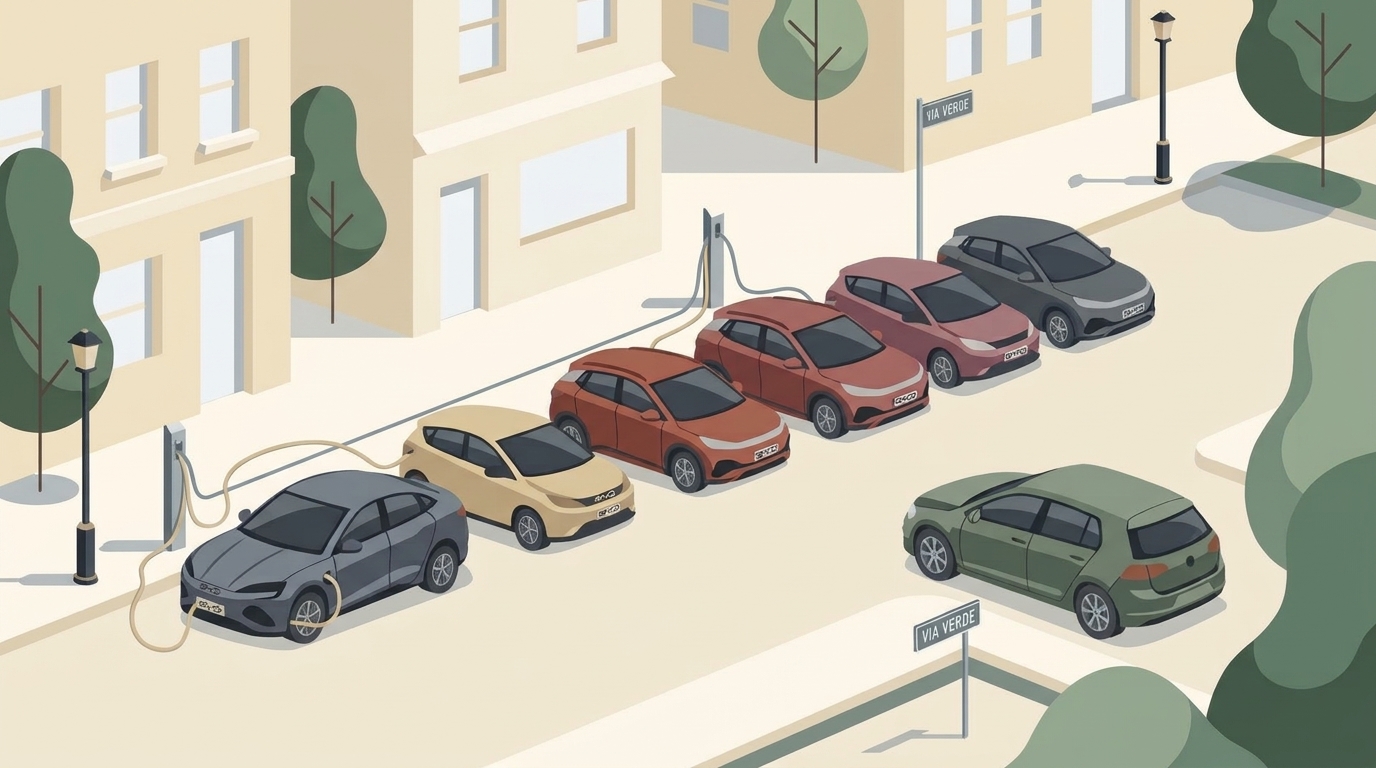
On 8 September Il Post ran a piece on the rise of BYD, and anyone who lives in Milan can find that rise parked outside their building. Three years ago the Shenzhen marque was little more than a motor show curiosity, today it holds a slice of the Italian market that no newcomer had ever captured at this speed. Worth asking why, and above all at whose expense.
The numbers behind BYD’s climb in Italy
In 2024 the company founded in 1995 by Wang Chuanfu, a chemist who specialised in batteries, closed its Italian year with 2,800 registrations. In 2025 the figure reached 23,621, equal to 1.55% of the market. Between January and July 2026 the count climbed to 34,000 units and 3.2%, making it the thirteenth best-selling marque in the country. June marked the peak: 6,071 new plates, up 208.5% on the same month a year earlier, a 4.1% share and ninth place nationally. The Atto 2, the model I will come back to for personal reasons, ended the first half as the most registered SUV in Italy.
The continental picture points the same way. According to ANFIA’s analysis of June data, Chinese groups reached 10.5% of the European market against 6.4% twelve months earlier, with volumes up 85.6% and roughly 550,000 registrations in the first half. Over the same stretch BYD’s net profit rose by 30% and its stock market value hovers around 100 billion euros, slightly below the combined worth of Mercedes-Benz, Volkswagen and BMW.
The gap left by Europe’s small cars
Here comes the part that really interests me. The Chinese surge is unfolding inside a space that the established carmakers had already cleared out on their own. On 7 July 2023, after 47 years, the Cologne line produced the final Ford Fiesta. The Volkswagen Up bowed out shortly afterwards. The Golf survives, carrying a price tag with nothing in common with that of an affordable family hatchback. I had a Fiesta for ten years: it cost little, it parked anywhere, the garage bills stayed reasonable. Nothing of the kind sits in a showroom today.
The Jato Dynamics study of the four big European markets measures that retreat. Between 2018 and 2025 the B segment grew dearer by 34% and the C segment by 36%, while compact SUVs went from an average of 28,448 to 39,672 euros. The analysts’ summary remains the best line I have read on the subject: a Polo now costs what a Golf cost in 2018. The very manufacturers complaining about Asian rivals spent seven years pushing their range upmarket, because the margin on a mid-size SUV is far more generous than the one on a city car. Something similar happened in consumer electronics, and I wrote about it when looking at Apple and the price surge.
What it takes to buy a new car today
The result shows up in the price lists. The Grande Panda, heir to what was for four decades the Italian car by definition, starts at 20,400 euros as a hybrid and 23,900 in its battery version. On the other side the Leapmotor T03 sits at 18,900 euros and the BYD Atto 2 at 29,990, with equipment that in German catalogues stays on the paid options page. According to figures from Quattroruote Professional quoted by Il Post, BYD models undercut the average by 12.2% in the B segment and by 26.7% in the D segment.
The vehicle fleet tells the rest. ACI’s statistical yearbook puts the average age of Italian cars at thirteen years, with 42.5% of the total past the fifteen-year mark. Replacement keeps getting postponed because a new vehicle has turned into a luxury item, and when someone finally walks back into a dealership, whoever offers more for less gets a long look. The reasoning recalls the one behind those Chinese marketplaces under scrutiny in Europe, applied though to a purchase worth tens of thousands.
The long-term lease and the workshop that never called back
In Milan we had picked the seemingly easiest route: a long-term lease on a diesel from the Volkswagen group, signed at a dealership out in the hinterland, predictable instalments and no worries. The theory worked beautifully. The practice started creaking at the first service.
The ordinary mishaps of city life, a smashed window, a tyre ripped open by a kerb, a rear-end shunt in traffic on the ring road, turned into months of immobility at the manufacturer’s own workshop, with no replacement vehicle and nobody reachable by phone who could say how the repair was progressing. I wrote some time ago that customer support defines branding and I still believe it: loyalty to a carmaker wears away in front of a silent switchboard long before it wears away in front of a price list.
Two thousand euros in fines with my father-in-law’s BMW
The decisive episode arrived during one of those spells off the road. Stranded for two months, we accepted the loan of a 2014 BMW from my partner’s father, convinced we had solved the problem in the simplest possible way. Neither of us knew that this engine was no longer allowed to circulate in Milan. Thirty days later the bill came to almost two thousand euros in penalties for entering Area B, issued one after another and every one of them perfectly legitimate. That is where the final push towards electric came from, in a city capable of tightening its traffic rules year after year until going electric becomes a form of administrative self-defence.
The day my partner walked into a BYD dealership
After yet another mishap, my partner did the thing that according to every forecast from European analysts no Milanese past forty would do: he walked into a BYD dealership. Within a few days he owned an Atto 2, kitted out almost embarrassingly well for the money, with services bundled in that the previous contract would have billed separately. On long journeys the battery makes itself felt and planning the stops becomes part of the schedule, while around town nothing comes close: a charging point outside the house, silent queues, no dread of the traffic gates.
Meanwhile I bought a Citroën Ami, despite holding a licence I barely use. Three hundred kilometres in total, one utterly trivial knock and then a very long wait for spare parts, with a Stellantis after-sales operation as absent as the German one. Worth remembering, because Leapmotor reaches Italy through that very same Franco-Italian network: on service, the distance between established carmakers and newcomers gets measured case by case, far more than it does on catalogues. And now, everywhere I turn, I count Atto 2s by the dozen. The wind has changed, and anyone who grew up with an Alfa Romeo in the family registers it with a touch of melancholy.
What Italian drivers actually think
The impression gathered from the passenger seat matches the surveys. The instant poll run by Areté in January 2026 shows that more than seven Italians out of ten say they would buy a car designed in China, and the detail that overturns the cliché concerns their reasons: 51% cite overall quality, covering reliability, materials and onboard systems, while price stops at 45%. The lingering doubts land on the sore spot of my own account, given that 28% fear inadequate after-sales care. A second survey from the same institute, released in June, raises the bar among younger respondents: three out of four are ready to buy, and Massimo Ghenzer speaks of a “reputational gap now almost closed”. Anyone who followed the shift in habits of the generation that stopped dreaming about mopeds will hardly be surprised.
Tariffs, Hungarian plants and the bill arriving in Wolfsburg
The European Union responded with duties on imported electric cars, and according to Transport & Environment they achieved something: the share of vehicles built in China fell from a 22% peak in 2024 to 17% of the continental battery market. Chinese cars, however, remain on average 21% cheaper than their European rivals, and BYD’s counter-move is elementary, because when the barrier applies to imports you produce inside the perimeter: the Szeged plant should start up by the end of 2026, in a country where the group has operated since 2017 and where labour costs stay competitive, as I noted when writing about the talent that speaks Hungarian.
The incumbents’ accounts tell the other half of the story. In the second quarter of 2026 Volkswagen posted net profit down 32.9%, at 1.54 billion euros, with the operating margin sliding from 4.7% to 4.2% and a savings plan worth ten billion by 2030. The common reading blames tariffs, geopolitics and unfair competition. Part of that bill, though, was signed in and around Wolfsburg long before anyone uttered the word BYD: by scrapping small cars, pushing price lists upwards and arriving late to electrification, the historic manufacturers left exposed precisely the territory where most drivers live. Somebody else occupies that ground now. Anyone who has waited months for a replacement bumper will have no trouble understanding how it happened.
Related sources
- BYD car sales keep growing, Il Post, 8 September 2026
- Anfia: Chinese brands take 10.5% of the European market, ANSA, 23 July 2026
- BYD accelerates in Italy, over 6,000 registrations in June and a 4.1% share, ANSA, 1 July 2026
- Car prices are soaring: a city car now costs what a mid-size saloon cost a few years ago, Il Fatto Quotidiano on the Jato Dynamics study
- Chinese cars, trust is growing: 73% of Italians willing to buy them, Il Fatto Quotidiano on the Areté survey
- Trust in Chinese cars grows, three young people out of four ready to buy, ANSA, 4 June 2026
- Electric cars: are the tariffs working?, Transport & Environment Italia
- Volkswagen: the quarterly results confirm the crisis, MilanoFinanza, 24 July 2026
- Average age of the car fleet, ACI: in Italy it is over 13 years, Fleet Magazine on the ACI statistical yearbook
- Farewell Ford Fiesta, production ends today, Motor1, 7 July 2023
