
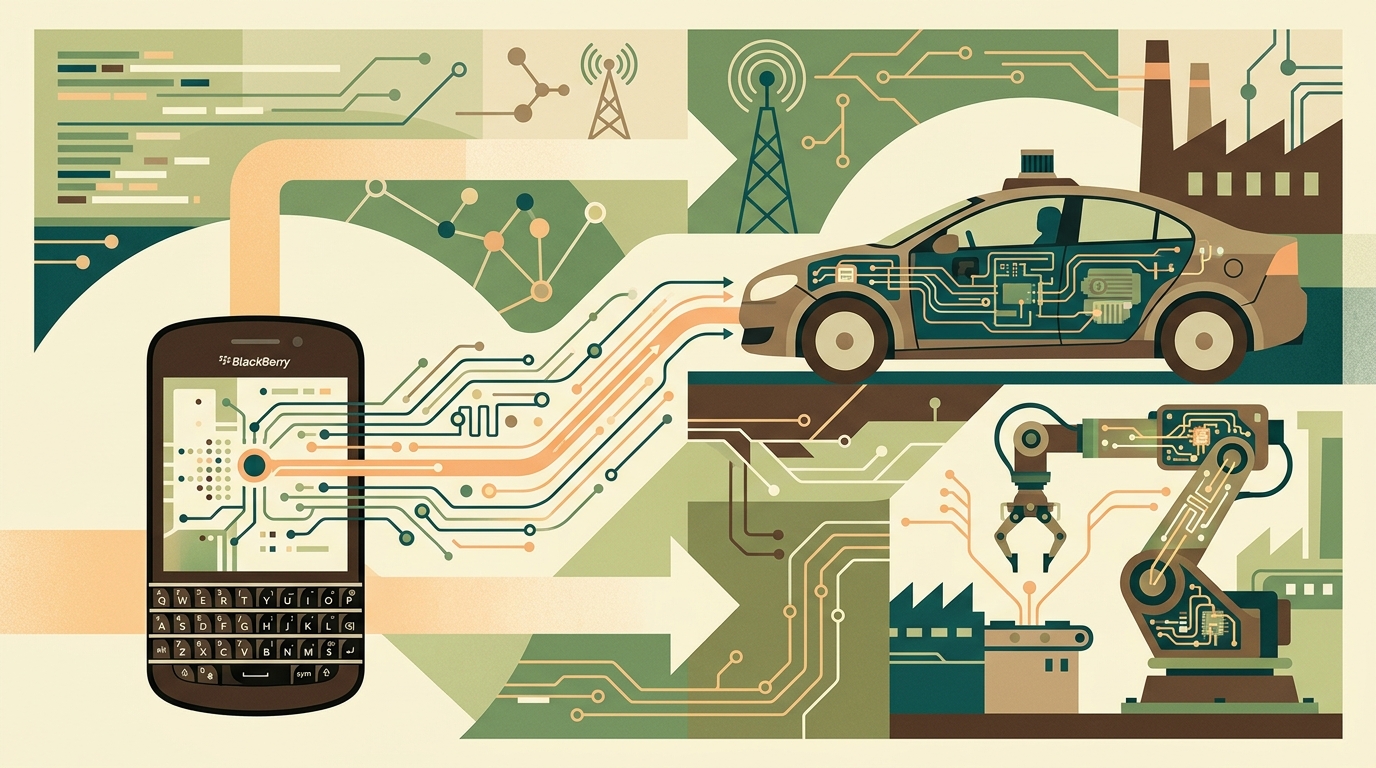
BlackBerry and QNX: from the keyboard phone to automotive software
Anyone who worked in an office between 2005 and 2010 remembers thumbs clicking on tiny keys and the red light blinking with every new email. BlackBerry was the executive status symbol, the device Barack Obama insisted on keeping even as president. Then touchscreens arrived and the Canadian brand slipped out of everyone’s pockets. Today, as Corriere della Sera reports, the company is enjoying a revival that has nothing to do with physical keys: its QNX operating system runs inside 275 million vehicles worldwide.
How BlackBerry lost the smartphone race
The arc is well known. Research In Motion, as the Waterloo, Ontario company was originally called, ruled the business market until the iPhone landed in 2007, with Android close behind. Its answer, BlackBerry 10, came too late. In September 2016 the group stopped designing its own handsets and licensed the brand to third-party manufacturers such as TCL. On January 4, 2022, it shut down services for legacy devices for good.
My detour from touchscreen to keyboard and back
I have to confess a zigzag path here. While the iPhone was driving everyone wild, I decided to swim against the tide with the very first keyboardless Samsung: a dreadful experience of ignored taps and wrong letters. Disappointed, I retreated to a Nokia with a QWERTY pad that had everything a BlackBerry had except the logo. Then the big players fixed their aim: screens became precise and autocorrect reliable. Since then I have never owned, or wanted, a physical keyboard again. The market followed the same reasoning, just with somewhat bigger numbers than mine.
What QNX is and what it does inside cars
QNX was born in Canada in 1980, and BlackBerry bought it in 2010, when its phones were still flying off the shelves. It is a real-time operating system, built for settings where a few milliseconds of delay can make all the difference. In vehicles it runs digital instrument clusters, driver assistance features and braking, and thanks to a hypervisor it keeps safety-critical functions apart from entertainment ones. Its customers include BMW, which built it into its Neue Klasse platform, Mercedes-Benz, Audi, Volkswagen, Toyota, Honda, Hyundai, Volvo and the Chinese automakers Geely and Dongfeng.
The installed base has grown fast: about 120 million vehicles in 2018, 235 million in 2023, 275 million today. The best part is that hardly any driver knows it is on board.
BlackBerry’s 2026 numbers: QNX drives growth
After the Corriere piece came out, BlackBerry reported its second quarter of fiscal 2027 on September 24. QNX posted record revenue of $80 million (up 27% year over year), with an adjusted gross margin of 87%. Total sales reached $163 million (up 26%). The company raised its annual outlook for the second time, now between $616 and $636 million, with $315 to $325 million expected from QNX alone. Its backlog of signed deals is worth about $950 million. It includes the largest agreement in the division’s history, with Coretura, the Volvo and Daimler Truck joint venture for heavy vehicles, plus a deal with Uber for robotaxis.
The rest of the group has slimmed down. Cylance, the cybersecurity firm acquired in 2019, was sold to Arctic Wolf in early 2025. Alongside QNX sits Secure Communications, which supplies encrypted messaging to governments and large organizations.
From cars to robots: the physical AI bet
CEO John Giamatteo told analysts the company is just at “the beginning of the second inning.” The horizon stretches beyond four wheels. In April 2026 BlackBerry expanded its partnership with Nvidia to bring QNX to industrial robots, surgical tools, drones and humanoids, the field now known as physical AI. According to the company, more than twenty firms are already building projects on the joint platform.
Competition is real: Google is pushing Android Automotive, and some automakers have already switched suppliers for their infotainment systems. On systems that simply cannot afford to freeze, though, decades of accumulated safety certification remain a hard lead to close.
Why I admire companies that reinvent themselves on time
I respect businesses that know how to diversify when it matters, admitting that the product that made them famous has had its day. BlackBerry took a long while to accept it and paid dearly for the delay. Yet it had a technology in-house that nobody was watching, and it found the nerve to bet on it. Not every story goes this way: just look at how European carmakers are struggling against the rise of BYD. Then there are those who favor caution, like Sony with the PS6, and those who try hybrid paths, like Motorola between watch and phone.
We will never see the BlackBerry name printed on a screen again. Chances are, though, it is already riding along with us, tucked away in the electronics of the family car.
Related sources
- Corriere della Sera, L’inaspettata resurrezione di BlackBerry (ma non c’entrano i telefoni con tastiera)
- Quotidiano Motori, QNX BlackBerry: il sistema operativo dentro 275 milioni di auto
- Automotive World, QNX software now embedded in 275 million vehicles
- Reuters via BNN Bloomberg, BlackBerry lifts annual revenue forecast on strength in automotive software business
- The Motley Fool, BlackBerry Lifts Fiscal 2027 Guidance on Record QNX Revenue
- CNBC, BlackBerry CEO says robotics is one of its fastest-growing businesses
- Arctic Wolf, Arctic Wolf and BlackBerry announce closing of acquisition for Cylance
- BlackBerry, BlackBerry 10 and BlackBerry OS Services: end of life
