
Every so often a story comes along that gets tech fans dreaming while quietly exposing a very practical problem. That is exactly what happened with the patent Motorola just made public: a smartwatch that unfolds into an actual smartphone. A fascinating concept on paper, one that immediately raised a question I could not shake off.
How the device works: a display ready to unfold
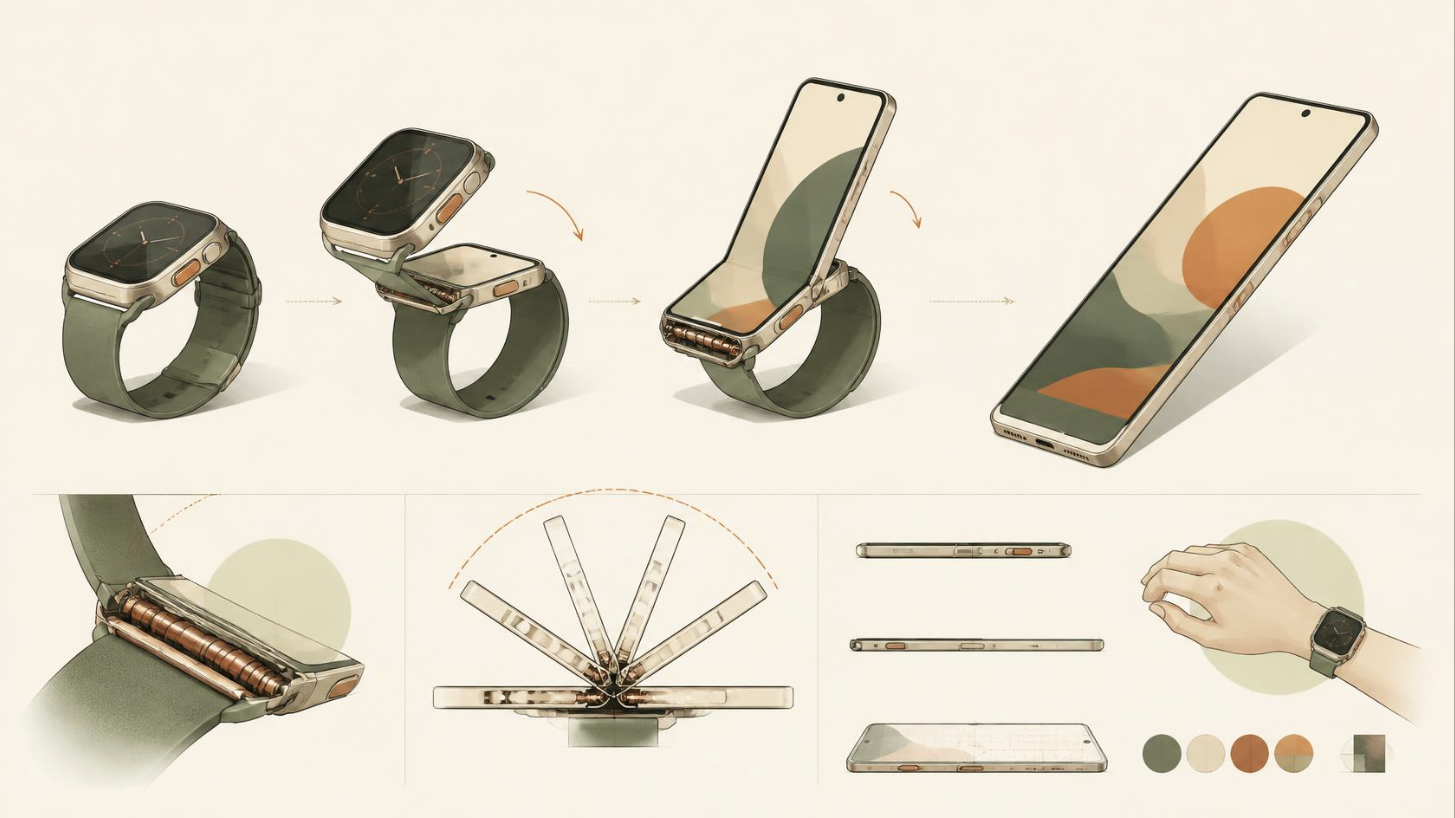
The filing, published on August 7, 2026, describes a hybrid device that combines the functions of a smart watch and a mobile phone through a flexible panel. Closed, the gadget behaves like an ordinary smartwatch and wraps around the wrist. Once removed, the wearer can unfold it into a wider surface, built for a use closer to that of a complete handset.
The mechanism relies on hinged sections that align themselves automatically as they open, held together by magnetic components and locking systems. Sensors round out the picture, detecting whichever configuration is active at any given moment and adapting the interface accordingly: icons and controls rearrange themselves both in wearable mode and in phone mode.
What the filing still leaves out
As often happens with documents of this kind, the text does not specify the intended operating system, final dimensions, battery life, price, or a launch date. For now it remains a project pinned only to legal paper: no prototype has been shown, and no timeline has been announced for a possible retail arrival.
Worth remembering, because between an application at the patent office and an actual product, years can pass, at best. Plenty of companies in the industry stockpile inventions of this sort simply to guard against competitors, with no immediate intention of building them.
A tech déjà vu
The concept of a device that changes shape is hardly new. Not long ago we covered the comeback of flip phones ourselves, and the underlying logic is similar: a surface that folds or extends to offer more room when needed. The American brand, though, is aiming for something more ambitious: not a handset that closes in half, but a watch that turns into a phone in every sense.
The real upside: no more cases and bulging pockets
To be fair, this solution would solve a problem as old as the smartphone itself: how to carry it around without hassle. No more bulky cases clipped to a belt, neck straps that look like conference badges, or trouser pockets stretched out of shape. Having everything on the wrist, ready to unfold only when needed, would be convenient, almost elegant in its simplicity: one less pocket to fill, one less object to leave behind somewhere.
The real limit? Reading on such a tiny screen
Here comes the personal part of this piece. I gave up on my own smartwatch a while back, simply because I could not read comfortably on such a small face. And this has nothing to do with age or eyesight: even on a phone, with the font size bumped up, some apps become nearly unusable, full of clipped text, overlapping buttons, and layouts clearly never designed for that setting.
If that already happens on a normal-sized handset, it is fair to wonder what would happen on an even smaller pane of glass, before it gets unfolded. The core issue, ultimately, is not just the ability to fold or stretch a panel, but how apps get designed in the first place: if interfaces do not genuinely adapt to every format, the promise of a “two in one” gadget risks staying a theoretical exercise rather than a practical one.
What the market will decide, now
It is hard to make predictions about a project still stuck at the filing stage. The brand could push the initiative through to a working unit, or shelve it alongside dozens of other proposals that never saw the light of day. One thing is certain: the wearables industry keeps searching for a new direction, after years in which smartwatches have looked more or less the same.
In the meantime, I remain convinced that the bigger challenge is not folding or unfolding that technology, but making it comfortable to use for anyone, like me, who struggles to make out small characters. We will see whether Motorola can prove that wrong, and how the public reacts once, and if, this invention actually leaves the lab.
Related sources
- Motorola sta lavorando a uno smartwatch che diventa uno smartphone: il brevetto – HDblog.it
- Motorola receives a patent for a smartwatch that unfolds into a smartphone screen – PhoneArena
- Motorola brevetta uno smartphone che si avvolge al polso – Tom’s Hardware
- The comeback of flip phones – Content Benefit
