
When should you take a stand? Politics, communication, and the art of knowing when to speak
The Springsteen effect
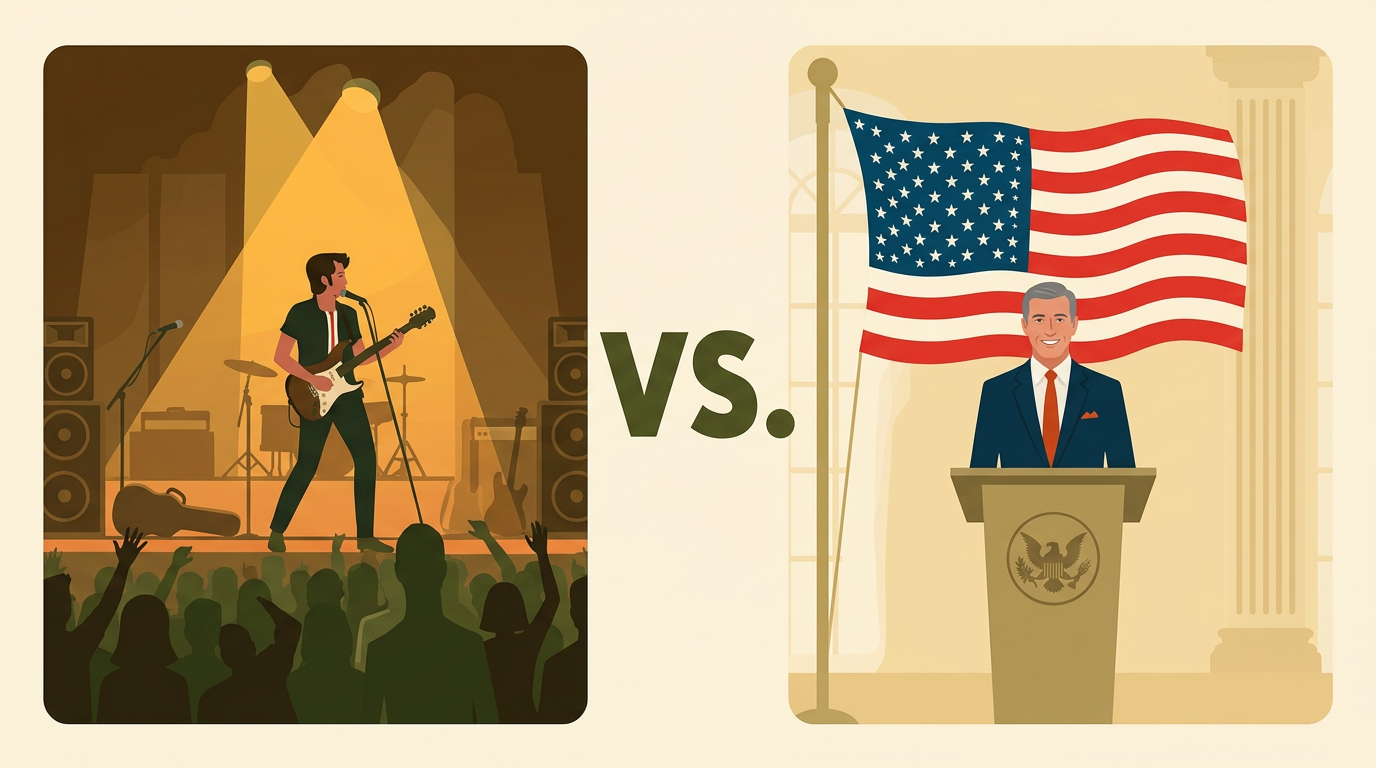
Bruce Springsteen has never been shy about where he stands. Over the past several years, he has been vocal in his opposition to Donald Trump, using his concerts, interviews, and public platform to make his views unmistakably clear. For many of his fans, that kind of moral clarity is exactly what they want from an artist of his stature. For others, it feels like an intrusion, a distraction from the music, or worse, a form of arrogance dressed up as conscience.
In Italy, the singer-songwriter Francesco De Gregori offered a perspective that cuts to the heart of the matter. “Does Springsteen need to say his piece on Trump?” he asked in an interview. “I feel embarrassed when someone promoting a show takes such a clear and apodictic stand. It is a role I feel I cannot share. I do not feel superior to my audience. I do not think I am in a position to lecture anyone on Gaza or Iran. I do not give lectures, and I do not want to receive them from a singer or a film actor either.” Whether you agree with him or not, De Gregori is raising something worth sitting with: the difference between having an opinion and believing your platform gives that opinion special authority.
An old debate with no easy answer
The debate around artists and political engagement is as old as art itself, and it tends to produce more heat than light. On one side, you have the tradition of the engaged intellectual, the artist as witness and conscience of their time, from Picasso’s Guernica to Gil Scott-Heron, from Joan Baez to Kendrick Lamar. On the other side, there is a long and honorable tradition of artists who believe that their job is to hold up a mirror to the world, not to tell people what to think about what they see. Both positions are coherent. Both can be defended. But neither of them is always right, and that is precisely what makes this conversation so slippery.
My own view, shaped less by aesthetic theory than by years working at the intersection of communications and corporate responsibility, is that there is no universal answer. Every case stands on its own, and the right question to ask is not “should I take a stand?” but “am I genuinely equipped to defend this one?” That means being well-informed, being prepared to explain your reasoning clearly, and being willing to back your position with facts rather than just sentiment or social pressure.
I learned this the hard way, and I also learned it in the right way, which are not always the same lesson.
When the facts leave no room for silence: PayPal and the march on Rome
When I was head of communications for PayPal in Italy, a group of right-wing extremists had started a fundraising campaign on the platform with the explicit goal of replicating the infamous March on Rome on its anniversary, recreating the moment in 1922 when Mussolini’s Blackshirts marched on the Italian capital and effectively ended parliamentary democracy. The external PR agency we worked with had not flagged it. I escalated it immediately and pushed leadership to take serious action. Apologizing for fascism is a criminal offense in Italy under the Mancino Law, and regardless of any commercial calculus, the platform had a legal and moral obligation to act. There was some backlash, as there always is when a company takes a visible stand, but I am convinced we made the right call, and I would make it again without hesitation. The reasoning was not complicated: this was not a matter of opinion, it was a matter of law, of documented historical harm, and of elementary human dignity. The facts were clear, the legal framework was clear, and the consequences of inaction were clearly worse than the consequences of acting.
When restraint is the braver choice: Kijiji and the contest
A different case, and in some ways a more instructive one, came during my time at Kijiji. The idea was to run a contest in which user participation and interaction would generate a total that the chosen influencer could donate to a charity of their choice. It was only once we were deep into the process that I found out the influencer we had been considering wanted to direct that donation to an association advocating for euthanasia. Personally, I am not opposed to that cause at all. But at the time, more than a decade ago, the debate in Italy was still in its earliest stages. It was raw, divisive, and deeply contested across religious, political, and cultural lines.
Choosing that influencer would have dragged a consumer platform into a controversy where we could not meaningfully add to the conversation, could not defend a position with the depth it deserved, and would almost certainly have alienated large parts of our audience without advancing the cause by a single inch. I chose a different influencer instead, one who worked on the rights and protection of children, an important cause, uncontroversial in its basic premises, and one where our involvement could be genuinely constructive. That decision was not about cowardice or cynicism. It was about reading the room and understanding that wading into a sensitive debate without the tools to navigate it responsibly is not courage; it is noise.
Threshold and preparation
The point that connects these two stories is the same: the threshold for speaking should be proportional to your preparation to be heard. When the facts are clear, when the legal or ethical stakes are unambiguous, and when silence would itself be a form of complicity, speaking up is not optional. It is the minimum. When the issue is genuinely contested, when reasonable people can and do disagree based on deeply held values, and when your platform gives you reach but not necessarily depth, the more courageous choice is often to step back and let the conversation happen without your megaphone drowning it out.
De Gregori is right that there is something uncomfortable about the artist who uses a concert stage as a pulpit. The asymmetry of that relationship, one person with a microphone in front of thousands of people who came to hear music, not a political speech, creates a kind of captive audience that is not quite the same as genuine democratic dialogue. But Springsteen is not necessarily wrong either. There are moments when silence from people with large platforms becomes its own kind of statement, and not always the one they intended.
The skill is in the gauging
The skill, in the end, is in the gauging. What is the nature of the issue? How clear are the facts? What is your genuine relationship to the subject, and can you articulate it with honesty and precision? What are the consequences of speaking, and what are the consequences of staying quiet? These are not easy questions, and anyone who tells you they have a formula for answering them is probably selling something.
Taking a stand on the right thing at the right moment, with the right evidence and the intellectual honesty to explain your reasoning, takes more courage than following the trend of the day. It also takes more discipline than retreating into comfortable silence whenever things get complicated. The goal is not to be liked, nor to be provocative. The goal is to be right and to show your work.
That is the standard I try to hold myself to, imperfectly and with plenty of revisions along the way. I think it is the right one.
Related sources
- De Gregori: “C’è bisogno che Springsteen dica che è contro l’amministrazione Trump? Non credo” — Il Fatto Quotidiano. Interview with Francesco De Gregori on the role of artists in public debate. See also Rockol.
- Springsteen, B. (2020). Letter to You. Columbia Records. The album release was accompanied by extensive press commentary on Springsteen’s political positioning throughout the Trump era. “
- ‘The Republic Is Under Siege By a Moron’: Everything Bruce Springsteen Has Said About Trump” — Rolling Stone.
- Legge 25 giugno 1993, n. 205 (Legge Mancino). Italian law prohibiting the public defense or apology of fascism, racial discrimination, and incitement to hatred. Gazzetta Ufficiale della Repubblica Italiana.
- Gramsci, A. (1971). Selections from the Prison Notebooks. Lawrence & Wishart. Foundational text on the concept of the organic intellectual and the political responsibility of public figures.
- Chomsky, N., & Barsamian, D. (2001). Propaganda and the Public Mind. South End Press. Explores the obligations and risks of public intellectuals in political discourse.
- Bivens, J. (2022). “When brands speak: Corporate political speech and the limits of stakeholder communication.” Journal of Communication Management, 26(2), 112–129.
- Edelman Trust Barometer (2025). Annual report on public trust in institutions, businesses, media, and NGOs, with specific sections on corporate political communication and brand activism.
