
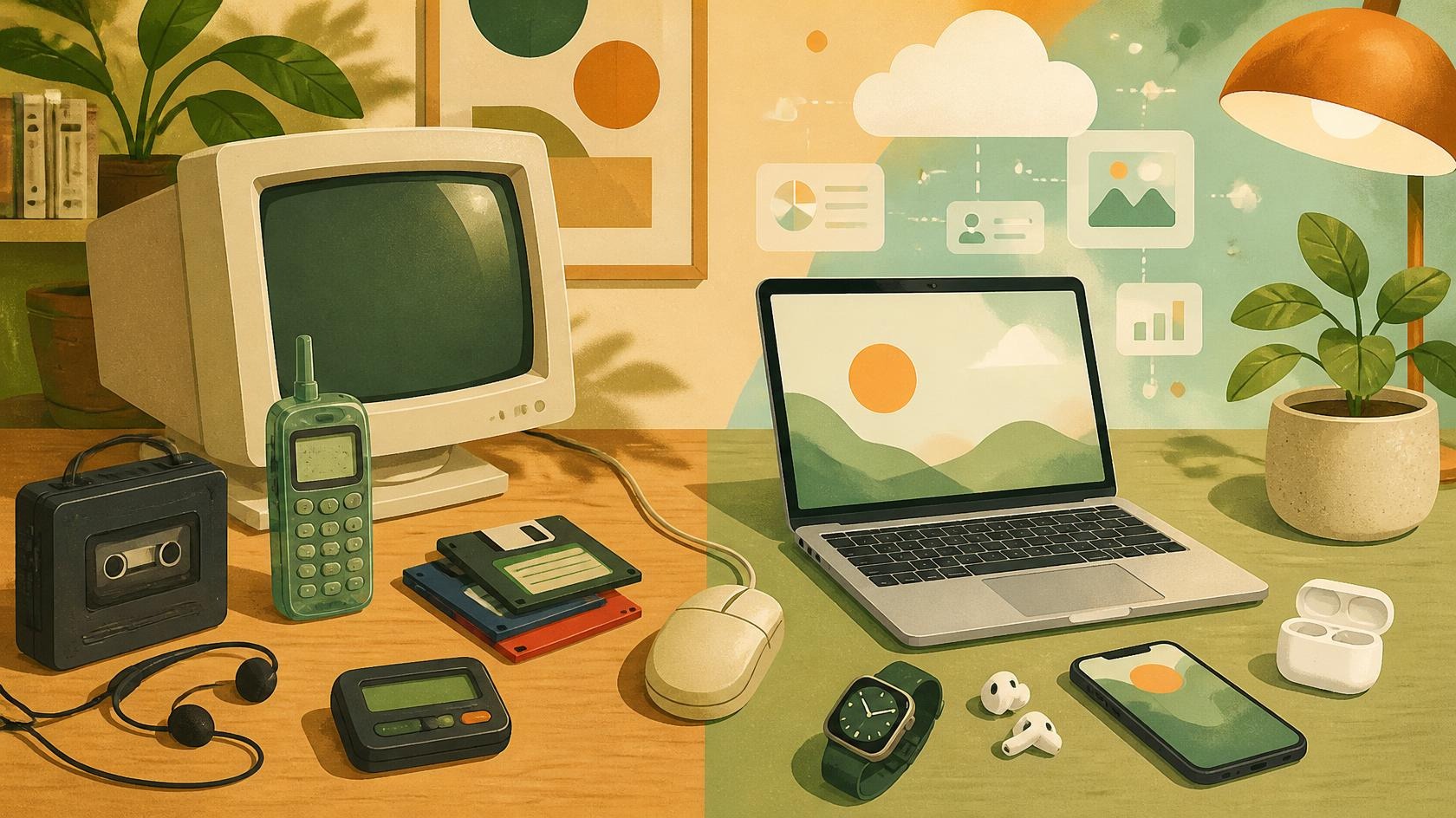
’90s gadgets on our desks: iPods, Tamagotchi, and mini consoles
Between an ultrawide monitor and a mechanical keyboard, objects we thought were long archived are making a comeback: Tamagotchi, tiny arcade cabinets, cassette recorders, and above all iPods. Everyeye covered this in a piece on the return of ’90s and early-2000s gadgets to office and shop counters. One observation struck me: the buyers are mostly people who grew up in that decade, looking for a fragment of childhood to keep next to their laptop.
Manufacturers have caught the scent. Bandai has relaunched the most famous plastic egg with new editions. The latest, Tamagotchi Paradise, came out in July 2025, just as the brand passed 100 million units since 1996. Panic, with its crank-equipped Playdate, has opened up a mini-console segment that ranges from retro emulation to original games. What has changed is the purpose. Back then, a Tamagotchi was for fun and for learning to look after something. Today it gets collected, or tended between one call and the next.
The iPod comeback: Gen Z and modding
The most intriguing case is the iPod. Apple wound down the line in 2022, when it pulled the iPod touch from sale. And yet, according to Axios, eBay searches for the iPod Classic rose 25% in 2025 compared with the previous year, and searches for the Nano 20%. On Facebook Marketplace a used Classic changes hands for around $100, while a refurbished unit can reach $350.
A small repurposing culture has grown up around these players. The old hard drive gets swapped for flash storage, the worn battery for a fresh one. Some owners install alternative firmware such as Rockbox to play formats Cupertino never supported. Much of the push comes from Gen Z, who have no direct memory of these devices.
Why single-purpose devices appeal to the screen-weary
The most convincing explanation comes from Cal Newport, author of Digital Minimalism: the technology of that era was “single-purpose,” meaning it did just one thing. An MP3 player plays music, period: no notifications, no feed, no algorithm nudging you toward the next step. Libby Rodney of The Harris Poll links the trend to so-called “friction-maxxing,” the deliberate search for a bit of resistance in a digital experience that has become far too smooth.
The author of the Everyeye piece offers a personal example. He owns an iPad but has never finished a book on it, while on his basic Kindle, which does nothing but display text, he devours novels. It’s the same need for quiet I wrote about in the design of silence and in the attempt to live with less screen, more presence.
What I really miss about the ’90s
I lived through that decade in my twenties, and yes, I miss some of it. The music first of all, which I now hear over supermarket speakers, between the dairy case and the detergent aisle, and which always catches me a little off guard. Then youth, of course, which no refurbished gadget can give back.
The hardware of the time, on the other hand, I don’t miss at all. Cables, cases, batteries to replace, and media to look after hold no appeal for me. I’m holding tight to today’s essentialism, which for me means doing without physical objects: music arrives by streaming, everything else lives in the cloud, and my workspace stays clear. The same thing happened with physical keyboards, which I’ve never wanted again after the phase I described in my piece on BlackBerry.
Two different roads to the same simplicity
Come to think of it, Gen Z with their iPods and I with my streaming are after the same goal: less noise. Younger people find it in a device that does one job and does it well. I find it in the immateriality of a service that takes up no space and needs no upkeep. Both choices come at a cost. Those who prefer a dedicated player give up convenience; those who rely on platforms give up ownership, because subscription music is something you listen to, not something you have.
Italy’s music market between streaming and vinyl
Italian figures confirm that the two impulses coexist. According to FIMI, the Italian recorded music market reached €513.4 million in 2025, double its 2019 value, overtaking even movie box office takings. Streaming accounts for about two-thirds of the total, but physical formats are racing ahead too: €74.7 million (+21.9%), with vinyl up 24.2% and even CDs up 15.1%.
For many people, then, records and players remain an emotional bond before they are a format. For me they’re a memory, pleasant to come across in the background while I push my shopping cart, but nothing I feel any need to bring home.
Related sources
- Ritorno al futuro: perché i gadget anni ’90 stanno conquistando le nostre scrivanie moderne, Everyeye Tech
- Why people are buying iPods again, Axios, February 21, 2026
- Why Gen Z and young adults are embracing iPods again, AppleInsider, February 23, 2026
- Tamagotchi, Y2K nostalgia and 100 million sales, nss magazine, September 2025
- Streaming e vinili spingono la musica: in Italia vale più del cinema, Punto Informatico, March 2026
- Report FIMI 2026, FIMI
