
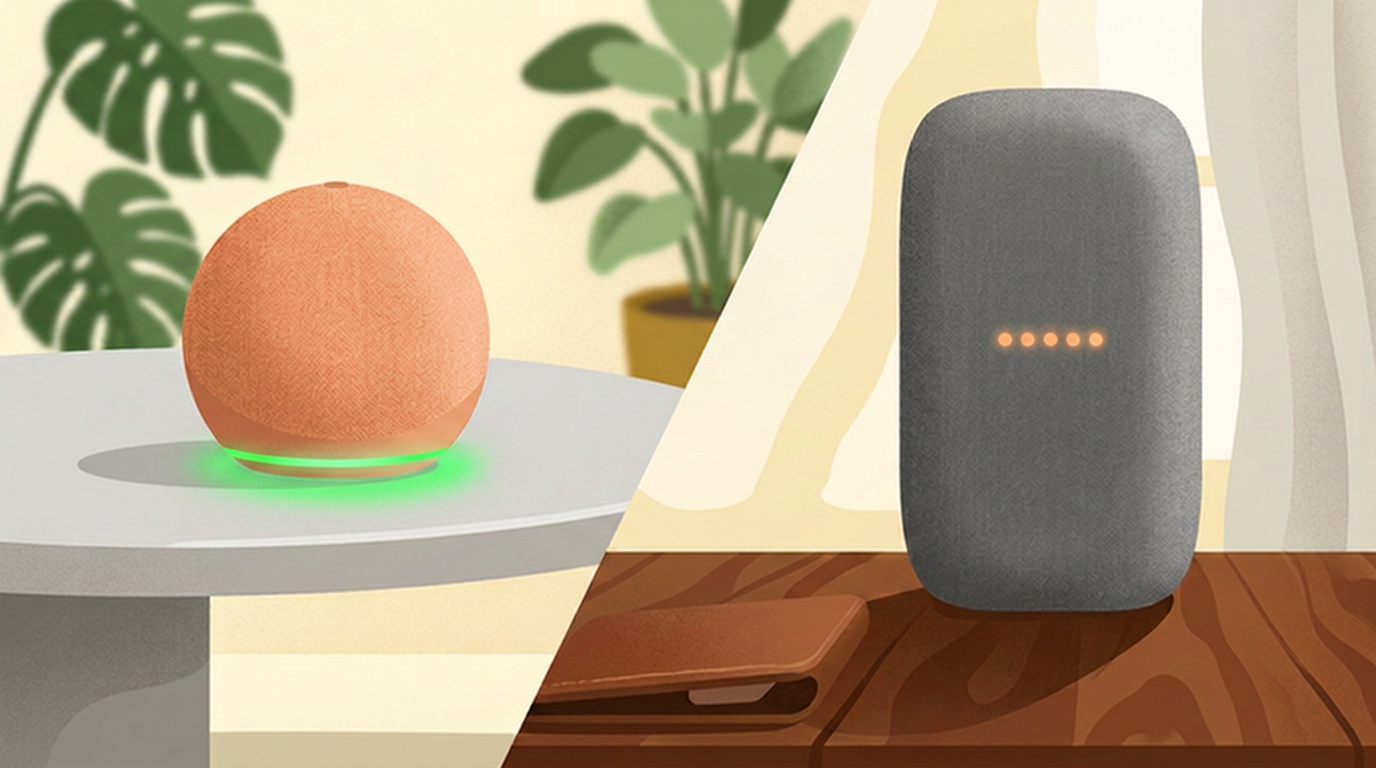
OpenAI challenges Alexa: maybe smart speakers weren’t retired after all
For years I treated the smart speaker in my kitchen as an appliance that had already given up on itself: play a playlist, tell me the weather, and, in its finest hour, let me know when the pasta was ready to drain. That was it. No further ambition. Then I read that OpenAI is working on a screenless speaker built around ChatGPT, designed specifically to challenge Alexa on its own turf, and I realized I might have written off the whole category a bit too soon.
What OpenAI is actually building
According to reporting from Reuters, picked up by several other outlets, OpenAI’s first hardware device would be a speaker with no display, equipped with a small camera and environmental sensors, able to hold fluid, uninterrupted conversations thanks to an advanced voice model (referred to in the sources as GPT-Live) with real-time, two-way capability. The stated goal goes well beyond following simple commands: the device is meant to learn the habits of the people living in the house, handle reminders and messages like a personal secretary, and suggest content based on the context of the moment.
Launch is expected no earlier than early 2027, at an estimated price of 200 to 300 dollars. Behind the project is Jony Ive, Apple’s former design chief, whose company, io Products, was acquired by OpenAI for roughly 6.5 billion dollars. Other Apple veterans have joined the team too, including Evans Hankey and Tang Tan, and a prototype was reportedly already in place by late 2025. Betting on the home rather than the already crowded smartphone market, where Apple and Samsung dominate, looks like anything but a random choice: the living room is where Amazon built its dominance over the past decade, and it’s now where the next round of the conversational AI race is being fought.
Jony Ive and design as a strategy
What stands out about this move, even before the technology, is the underlying bet: if an object is going to sit in your living room around the clock and listen to you, it also has to be something you enjoy looking at. Sources describe the device as designed to “feel alive,” with mechanical elements able to move on their own to make the interaction feel less robotic. It’s a philosophy that echoes how Apple made products desirable even when, on paper, they did the same things competitors had already been doing for years.
Alexa+ isn’t sitting still either
Amazon hasn’t exactly been idle in the meantime. Alexa+ launched in Italy last April, backed by a research and development hub in Turin dedicated to Italian cultural and linguistic nuance. The new version handles incomplete thoughts, regional expressions, and layered requests, recognizes who’s speaking through voice or face, remembers preferences like a favorite coffee brand or dietary restrictions, and can book a restaurant or suggest a recipe based on what’s in the fridge. The list price is 23 euros a month, though it stays free during the early access period and comes included for anyone with a Prime membership.
Amazon is still starting from a massive base: an estimated 600 to 700 million Alexa-enabled devices are in circulation worldwide, with a market share that reaches close to 65% of smart speakers in the United States and similarly high numbers in Canada, Australia, and Brazil. Those figures explain why, for anyone trying to break into this space, the real challenge isn’t the technology itself but convincing millions of people to walk away from an ecosystem they’ve already invested time, habits, and often dozens of connected devices into.
The market, in numbers
Beyond the individual headlines, the sector as a whole is growing faster than I expected. The global smart speaker market was worth about 15.1 billion dollars in 2025 and is projected to reach 34 billion by 2034, with an annual growth rate around 9.4%. Europe already accounts for 22.7% of the total, second only to North America. Rather than a mature market on its way out, this looks like a category reinventing itself, shifting from following commands to actually understanding context.
And how is Italy doing?
Here the picture is more cautious, but still moving. According to Samsung’s 2026 Trend Radar, 45% of Italians already interact with devices using natural, conversational language, even though 59% admit that talking to technology still doesn’t feel spontaneous to them. Those who do use conversational AI turn to it mostly for practical information (60%) or to make complex content easier to digest (56%), often during short breaks in the day or in the evening, to unwind. On the smart home side, adoption still lags: only one Italian in four owns any connected home device, even though more than half say they’d welcome tools that simplify managing the house and cut down on repetitive chores.
That gap is worth noting: voice as an interface seems to be gaining ground faster than the physical objects meant to carry it. Which, thinking about it, explains why both OpenAI and Amazon are pouring so much into this right now. There’s an audience ready to talk to AI, just not yet a device that fully convinces them to do it every single day.
The hidden cost of a microphone that’s always on
There’s one thing worth weighing before getting swept up in enthusiasm for the next hardware release. A more capable voice assistant needs more computing power, and that power comes with a real environmental and energy cost, something I already touched on when I wrote about AI and its sustainability and the growing pushback against the data centers that keep these systems running. Add a small camera pointed at your living room, built to recognize faces and observe habits, and the privacy questions stop being a footnote: the same dynamics I described when writing about cybersecurity’s growing pains apply just as well to an object that lives permanently in your kitchen or living room.
So, was I wrong?
Partly, yes. I thought home assistants had already peaked and were destined for a supporting role, good for nothing more than a morning alarm and a pasta timer. The numbers tell a different story: a sector going through a second act, driven not by louder speakers but by language models that can genuinely hold a conversation. The question I’m left with isn’t whether an assistant like this belongs in my home anymore. It’s which company will manage to make me comfortable talking to it every day, without me having to wonder who else might be listening in.
Related sources
- OpenAI sfida Alexa con uno speaker senza schermo con ChatGPT – FastwebPlus
- ChatGPT sfida Alexa con uno smart speaker che si muove da solo – SmartWorld
- Jony Ive’s First OpenAI Device Will Be Smart Speaker With Camera, 2027 Launch Planned – MacRumors
- Arriva Alexa+ in Italia: ora ci sono conversazioni naturali. Amazon sfida Gemini – Il Sole 24 Ore
- Smart Speakers Market Size, Share, Trends – Fortune Business Insights
- Amazon Alexa Usage Statistics 2026: Market Share, Trends – GrabOn
- Italiani e tecnologia, cresce il dialogo con l’AI – Business People
