
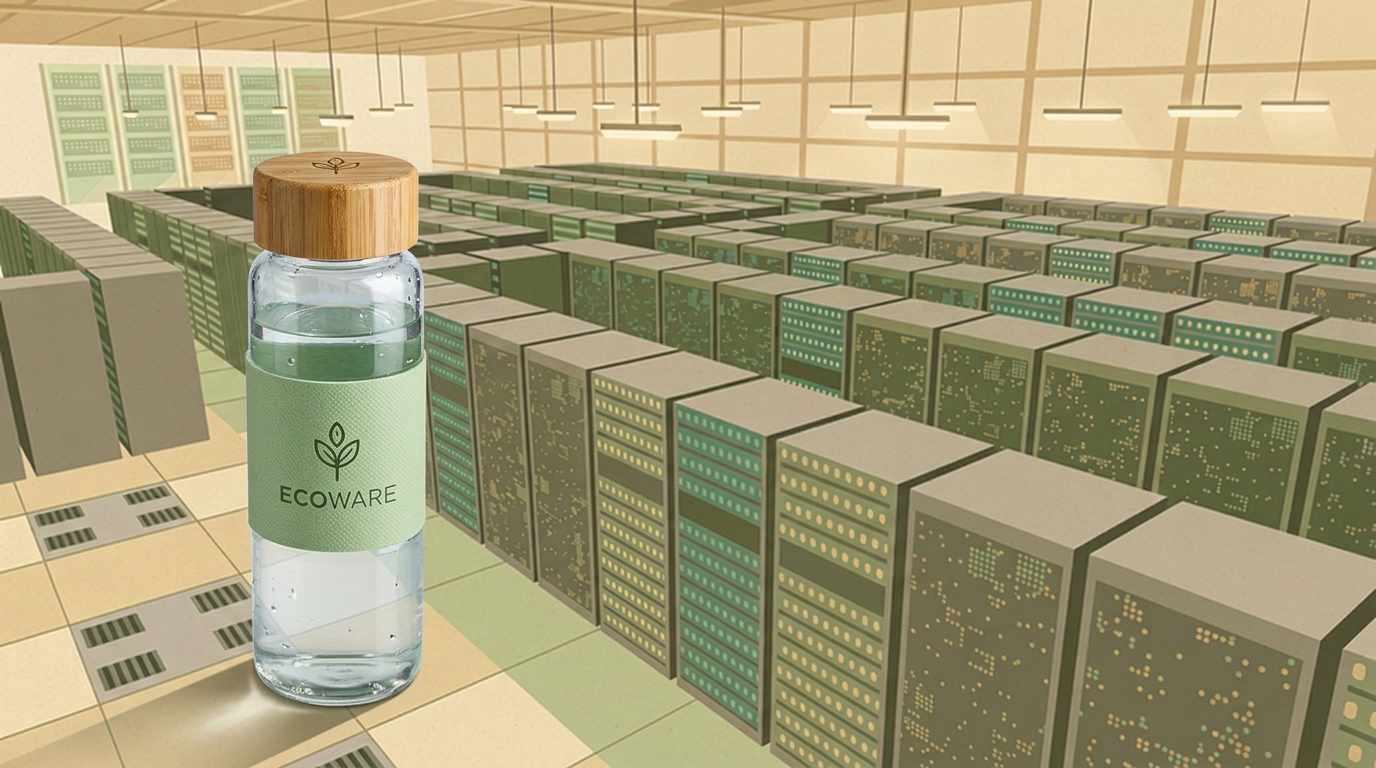
AI is thirsty: America protests while we look the other way
On Saturday, July 18, in more than forty American cities, thousands of people will take to the streets against data centers: the very tangible buildings that make artificial intelligence run, enormous warehouses consuming electricity like a mid-sized city, and water like an entire neighborhood. Il Sole 24 Ore covered this mobilization with a headline that captures the idea perfectly: AI is thirsty. And thirst, when water tables drop, and utility bills rise, becomes a political matter.
A grassroots, cross-party revolt
The most striking figure comes from a Gallup poll: 70% of Americans don’t want a data center near their home. According to Data Center Watch, opposition committees have grown within months to 833 active groups across 49 states. The protest unites worlds that rarely talk to each other: environmentalists worried about water resources, conservatives angry over rising electricity rates, and residents exhausted by the cooling systems’ noise running day and night.
The reasons are concrete. The United States already hosts over 4,000 data centers, and the AI race keeps adding to the number of construction sites. Each facility brings demands for land, grid connections, and evaporative towers. In some counties, communities discovered that water promised to agriculture had been redirected to servers.
The numbers behind the thirst (and the hunger for energy)
A few figures help grasp the scale. According to the International Energy Agency, data centers consumed about 485 TWh of electricity globally in 2025, a 17% increase in a single year; AI-dedicated facilities grew by 50%. Projections for 2030 point to roughly 945 TWh, more than double the 2024 level.
On the water side, AI-related data centers absorbed nearly a trillion liters in 2025. A United Nations report estimates that by 2030, the total could reach 9.3 trillion liters, equivalent to the annual domestic needs of over a billion people.
There is a detail, though, that complicates the picture: the impact depends enormously on where and how you build. Microsoft’s plants in Arizona use 1.52 liters per kWh, those in Singapore 0.02. Same company, same technology, different climate and cooling system. Translation: the problem can be solved, but it requires deliberate choices.
And Italy? Two hundred data centers and no national law
While America protests, the topic is almost absent from public debate here. Yet the Italian numbers are racing: according to Il Post, the country already hosts 200 data centers and 83 more are on the way. The Politecnico di Milano’s dedicated Observatory forecasts 25 billion euros of investments between 2026 and 2029. The heart of this expansion is the province of Milan, which concentrates 68% of the national installed capacity, with Rome trailing behind.
In 2025, requests for connection to the high-voltage grid exceeded 60 gigawatts, nearly 100 times the sector’s current footprint. Not every project will materialize, but the size of the demand says a lot about the operators’ ambitions.
The regulatory framework, meanwhile, lags. Lombardy has just approved the first regional law governing where and how to build, while the national bill is still under discussion in the Senate. In the meantime, municipalities around Milan negotiate fees and compensation on a case-by-case basis, and the first opposing committees have already appeared in the Rho area. Sound familiar? Yes, because the pressure on land and resources in big cities is a theme I know well, having written about the housing crisis: same territories, same competition for space.
The scenarios: between technology and rules
The future is unwritten, and there are at least three possible directions.
The first is technological. Closed-loop liquid cooling cuts direct water consumption by 70-90% compared to evaporative systems. Italy already offers virtuous examples: in Pont-Saint-Martin, in the Aosta Valley, a geothermal plant has reduced consumption by 35%; in Ponte San Pietro, near Bergamo, groundwater is recovered. Microsoft has brought its average water efficiency down to 0.30 liters per kWh, a 39% improvement over 2021.
The second is urban planning. Requiring new facilities to be built on abandoned industrial sites, as Parliament proposes, would enable the regeneration of old production areas and the reuse of grid connections from coal plants now switched off. In Pregnana Milanese, three data centers will be built on the former Citroën, Iveco, and Olivetti factories.
The third is political. Without national rules on consumption transparency, siting, and giving back to local communities, the risk is replicating the American experience: first the enthusiasm for investments, then the anger of residents. The window to choose a different model is now, while the projects are still on paper.
My part (and ours)
I say this as someone who works with AI every day: giving up these tools is hardly a realistic option, for me as for most people in the content field. I have also touched on this while recounting my experience with vibe coding. What we can do is demand transparency: know how much water and power the services we use consume, prefer providers that publish their environmental data, and support those calling for clear regulations. AI sustainability rests on collective choices, and collective choices start with informed citizens. The Americans marching on Saturday, whatever one thinks of their reasons, have understood at least one thing: the cloud, despite its name, sits on the ground, takes up space, and drinks.
Related sources
- L’AI ha sete: così l’America si ribella alla corsa ai data center – Il Sole 24 Ore
- In Italia ci sono già 200 data center, e altre decine ne arriveranno – Il Post
- National day of protest against data centers – Newsweek
- Map shows huge surge in data center opposition groups – Newsweek
- Energy and AI – IEA
- Data centers could consume 9.3 trillion liters of water by 2030 – Earth.org
- AI data center water usage statistics 2026 – Axis Intelligence
