
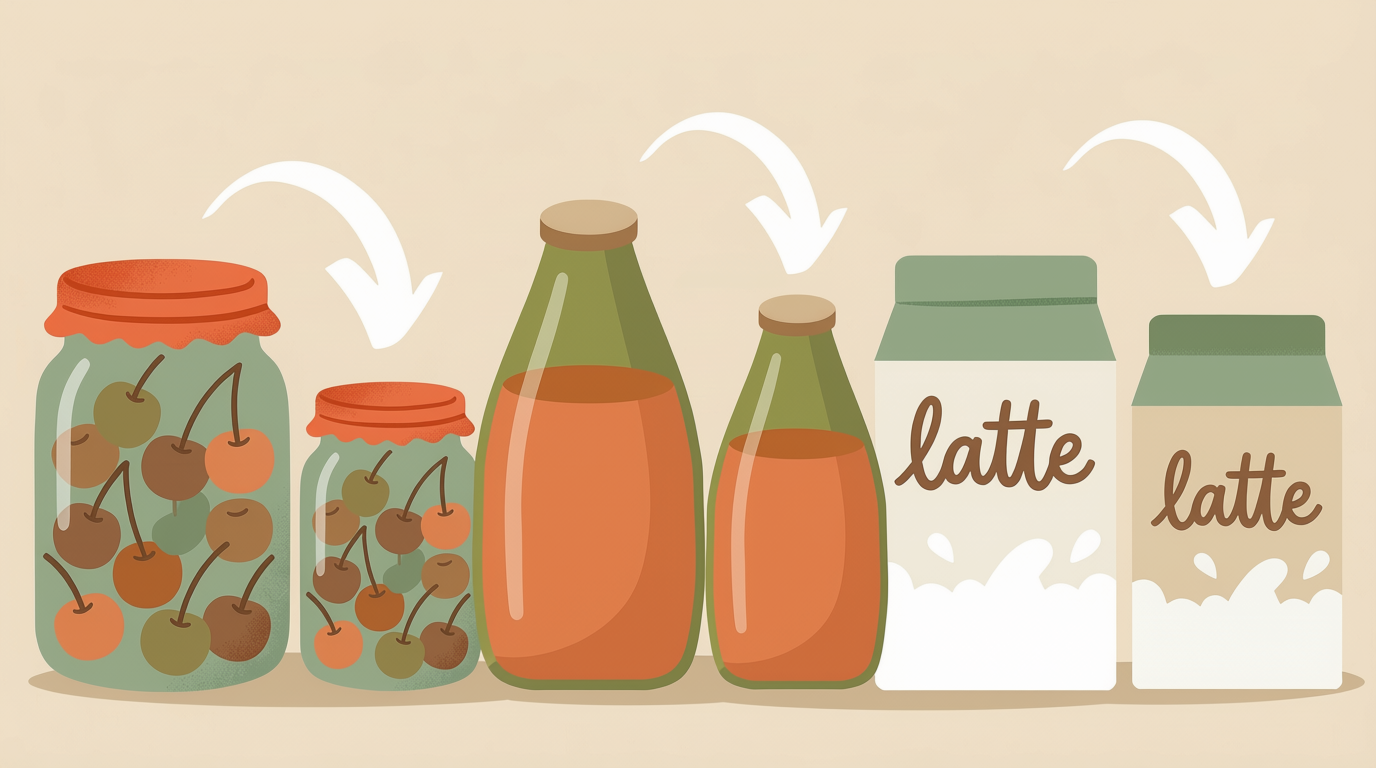
Shrinkflation: when the shopping cart shrinks and the price doesn’t
For a few months now, I’ve had the feeling that I’m buying toothpaste far more often than I used to. Same story with my deodorant: the price on the shelf hasn’t moved, yet the bottle runs out at a suspicious speed. And then there’s the detail that intrigues me every single time: I open the outer box, and the tube rattles around inside, as if someone had downsized the content and forgotten to update the container. With the snacks and ice creams of my childhood, the doubt gets even more Hamletian: has my hand grown, or has the product pulled back like a badly washed sweater?
I decided to dig into it, and the short answer is that my imagination has very little to do with all this. The phenomenon even has a name, shrinkflation, and over the past years it has generated studies, laws, lawsuits, and even an intervention by Cookie Monster.
What shrinkflation actually is
The term comes from the fusion of “shrink” and “inflation”, and it describes a precise commercial practice: reducing the quantity of product in the package while leaving the price untouched, or almost. The result is a hidden markup, because the cost per kilo or per liter goes up without the shopper noticing anything at the checkout. The Italian consumer association Altroconsumo defines it as the phenomenon that makes packages smaller but never cheaper, and the examples it collected speak volumes: a dish soap that went from one liter to 850 ml with the effective cost jumping from 1.30 to 2.55 euros per liter, crisps trimmed from 200 to 175 grams with a 22% surcharge.
Producers have their reasons, of course: pricier raw materials, energy, logistics. Between raising the list price and slimming down the pack, companies almost always pick the second option, because we are far more sensitive to the number on the tag than to the grams printed in tiny characters on the back. I’ve already written something about these perception mechanisms in The subtle art of influencing: marketing knows our blind spots very well.
The rattling box has an explanation
That noise of a tube knocking around inside its cardboard sleeve doesn’t come from my fantasy. In America, they call it “slack fill”: the outer packaging keeps its usual dimensions while the content drops, and the empty space does the rest. In the United States, this practice has triggered a wave of lawsuits against candy and snack makers, as documented by the ABA Journal, with courts asked to determine how much air inside a box is legitimate and how much constitutes deception. The most recent case involves PepsiCo, which was sued in 2025 over PopCorners bags deemed too empty.
The Italian numbers
The national observatory of the consumer group Federconsumatori has analyzed how packages evolved from 2022 onwards, and the data reported by Sky TG24 touch precisely the memories of my childhood: ice cream sticks went from 120 to 100 ml, a 16.67% cut, while their list price climbed by 14%. Cones lost 8% of their quantity, ice lollies almost 9%. So no, my hand has little to do with it: the ice cream has actually contracted.
The rest of the pantry follows the same script. Breakfast cereals with 15% less weight, yogurt down 11.6% with the cost per kilo moving from 9.35 to 10.60 euros, beer cans slimmed by 6%, yet paid 20% more. According to estimates reported again by Sky TG24, these disguised increases average between 10 and 18%, with peaks of 40%, for a cumulative outlay of 1.8 billion euros borne by Italian families over the last fifteen years. And precisely on 15 July 2026, a regulatory crackdown came into force: producers and distributors must communicate content variations along the supply chain for three months after the new format hits the market. The consumer association Codacons judges the measure watered down, also because it leaves skimpflation uncovered, the sneaky sister that degrades the quality of ingredients instead of the quantity.
What happens abroad
The textbook case comes from the United Kingdom. The Office for National Statistics counted 2,529 products downsized between 2012 and 2017, from chocolate to toilet paper, and calculated that in the confectionery segment, weight cuts alone added 1.22 percentage points to category inflation. The symbol of it all is the 2016 Toblerone, when the distance between the triangles widened to the point of turning the bar into a sort of Swiss comb. The outcry was such that the company later returned to its original shape.
In the United States, a LendingTree analysis covered by CBS found that roughly one-third of the supermarket items it monitors got reduced after the pandemic, with toilet paper wearing the black jersey at 60% of its category. The topic became so popular that Cookie Monster complained on X about the miniaturization of his cookies, receiving an official reply from the White House, and President Biden dedicated a passage of his 2024 State of the Union address to the issue, as NPR recounted. For the sake of completeness, a 2025 GAO report later scaled back the overall impact on American inflation: it matters, but less than the social media rage would suggest.
Japan deserves a chapter of its own. There, manufacturers have avoided touching list prices for decades out of fear of losing customers, so the forced diet of portions has become systematic, and consumers have responded with sites cataloging every “invisible markup”, as the Japan Times reports. On these collaborative platforms, users flag every slimmed-down snack, building a public archive of groceries that keep thinning out.
Consumers are fighting back
The most creative reaction came from France. In September 2023, Carrefour placed orange tags on its shelves saying, in essence, “this product has reduced its content, and the supplier has raised its price”, a move covered by CNBC and designed to put pressure on multinationals during commercial negotiations. Since July 2024, that warning has become mandatory by law in French supermarkets, as Euronews reports: dedicated signs must alert shoppers for two months whenever a format drops and the relative cost rises.
The grassroots movement is lively too. On Reddit, the r/shrinkflation community has been collecting comparative photographs of old and new packages for years, a sort of museum of contraction fed by its users. And a 2026 Pro Carton survey of five thousand people across five European countries, cited by Distribuzione Moderna, says that 73% of Italians notice the trick and 84% stand ready to punish the brand, switching to a competitor or abandoning the purchase altogether. So much for distracted shoppers.
What about online shopping?
I asked myself whether all of this can be seen when I fill my cart from the sofa, and the answer cuts both ways. On a screen, content trimming goes almost unnoticed: you can’t weigh the product in your hand, and the photo on the product page often stays the same as before. At the same time, the web is where reductions get cataloged best, between communities and collective photographic archives.
Regulations are adapting as well, at different speeds. The Italian implementing decree explicitly mentions the digital point of sale: whoever sells online will have to insert the notice directly on product pages, as PMI.it explains. In France, the opposite happened: the labeling obligation applies only to physical shops over 400 square meters, and e-commerce was excluded, a gap highlighted by lawyers at Osborne Clarke. In the United Kingdom, the competition watchdog examined the unit price displayed on shelves and on websites, finding inconsistencies that complicate comparisons between products and calling for a reform of the rules (CMA). In the United States, NIST is finally working on uniform standards for displaying the cost per unit of measure in digital stores. The moral: even in front of a screen, it pays to look for the value per unit of measure, whenever the site displays it honestly.
Nostalgia (almost) never lies
That leaves the question of my childhood snacks. Part of the memory is certainly distorted: a child’s hands are small, and everything looked gigantic, from the courtyard at home to grandma’s slice of cake. I’ve also reflected on how heritage brands work on memory in Vintage labels and identity, because nostalgia is an extremely powerful ingredient. Yet the observatory’s data on ice cream proves that at least part of the feeling matches measurable reality: today’s stick contains one-sixth less gelato than just a few years ago. My hand has grown, and the product has pulled back, both things together.
The most effective defense remains disarmingly simple: checking the price per kilo or per liter on the shelf label, the only number that marketing departments can’t dress up. Since I started writing this blog, I have done it systematically, and my cart is grateful. The toothpaste, meanwhile, keeps rattling in its box. At least now I know why.
Related sources
- Altroconsumo, Cos’è la shrinkflation
- Sky TG24, Stesso prezzo ma meno prodotto: i più colpiti dalla shrinkflation
- Sky TG24, Shrinkflation, dal 15 luglio stretta per contrastare i rincari nascosti
- Office for National Statistics, Shrinkflation and the changing cost of chocolate
- CBS News, Shrinkflation has affected one-third of grocery items
- NPR, Why Biden called out skimpy bags of potato chips
- CBS News, Cookie Monster complaint about shrinkflation
- CNBC, French grocery chain adds shrinkflation labels
- Euronews, Shrinkflation stickers come into force in French supermarkets
- Japan Times, Hidden inflation drives Japanese consumers to price-tracking sites
- ABA Journal, Candy and snack companies sued for packages with empty space
- Distribuzione Moderna, Shrinkflation: se ne accorge il 73% dei consumatori italiani
- PMI.it, Shrinkflation: addio all’etichetta sulla confezione, l’avviso passa al negozio
- Osborne Clarke, Shrinkflation: a new obligation for distributors
- Competition and Markets Authority, Unit pricing review
- NIST, Uniform unit pricing: tools for consumers to fight shrinkflation
