
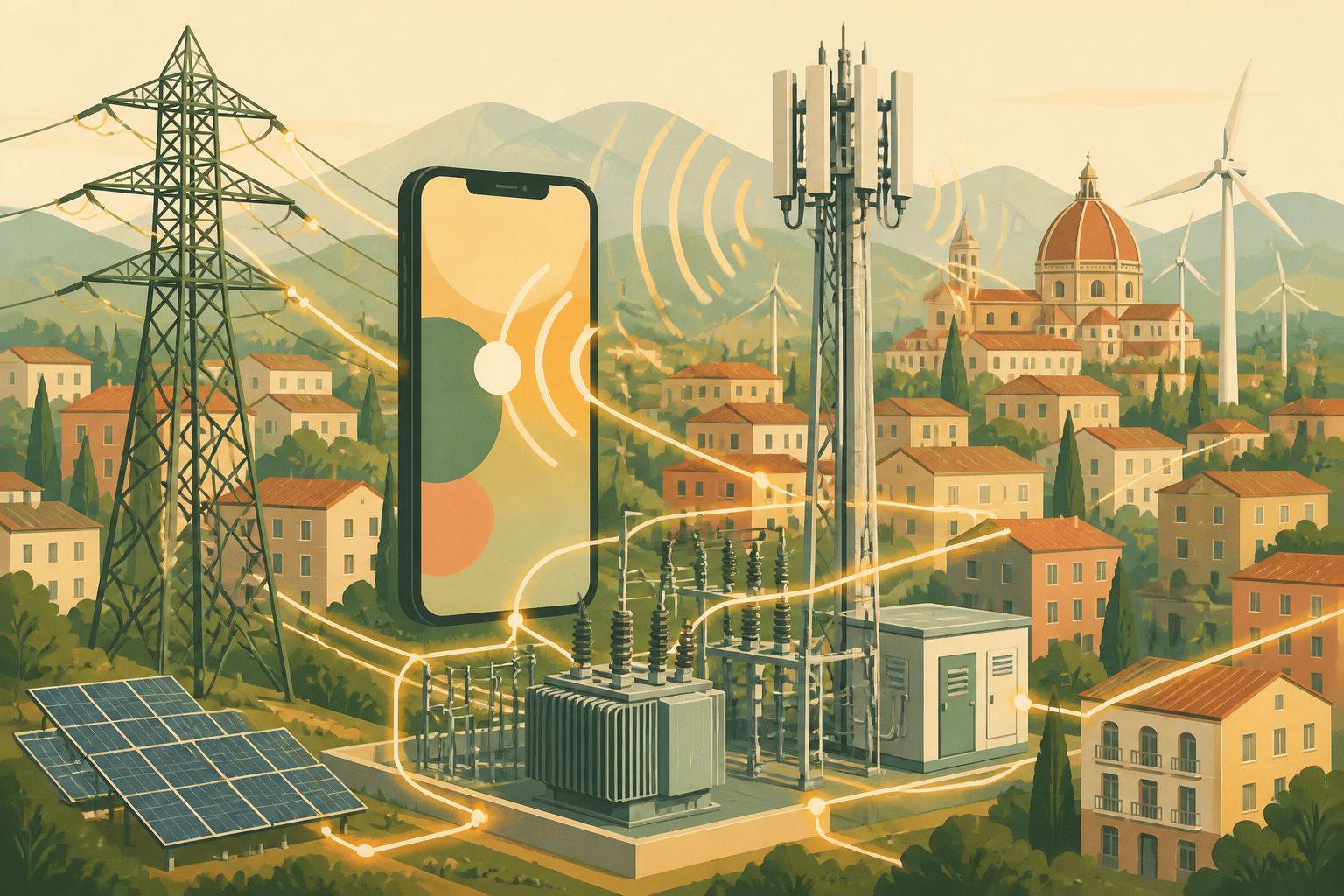
Mobile, power and gas: the market where everyone sells everything
Il Sole 24 Ore, Italy’s leading business daily, ran the headline “SpaceX lands in mobile telephony.” The news comes from the United States, but it’s a good excuse to look at what’s happening in Italy. Here the convergence of mobile telephony and energy has become the norm. Utilities hand out SIM cards, mobile carriers offer electricity and gas contracts, and each one is trying to get into the other’s backyard. Enel is the latest to arrive, though only in chronological order. Meanwhile the big groups keep merging, and in such a fragmented sector a polarization is starting to take shape that will leave room for only a few.
SpaceX and Starlink Mobile: spectrum, satellites and towers in the US
On October 9, SpaceX unveiled Starlink Mobile, the project through which it wants to become a nationwide mobile carrier in the United States. Forbes Italia, citing the Wall Street Journal, reports that Elon Musk’s company has agreed to buy 800 MHz licenses from Grain Management for about $8 billion. The deal still needs final approval from the FCC. Low-band spectrum helps signals reach indoors. Capacity comes from the 2 GHz band SpaceX already owns and from the 15,000 second-generation satellites the US regulator has authorized. The goal is to combine satellite and terrestrial spectrum in a single network.
A few days later, Bloomberg reported talks to lease at least 80,000 tower sites, roughly half the cell towers in the country. Wall Street reacted right away: AT&T, Verizon and T-Mobile lost billions in market value, while the companies that own the towers rose. Bernstein urges caution, since the competitive impact could be years away. Still, the signal is clear: even where the giants look untouchable, a newcomer with almost unlimited resources can reshuffle the deck. Musk does like to march into territory others already hold, as I wrote about X Money.
Enel Mobile, the free SIM for power and gas customers
In Italy, the most recent landing carries the Enel brand. On September 16, Enel Mobile was born: a “full” virtual operator running on the Fastweb + Vodafone network. The launch plan, Enel Mobile Go, includes 150 GB of 5G data, unlimited minutes and 200 texts for €11 a month. The fee drops to zero, though, for anyone keeping two active power or gas contracts with the group. On top of that, energy discounts reach 20% on electricity and 30% on gas. In short, a free SIM used as bait to pull new customers into the energy orbit.
And this is where it falls apart. So far the offer is only for people signing a new contract. It’s an irritating habit shared by nearly every provider: the best deals go to newcomers, not to those who stayed. I have power, gas and fiber with Enel for two apartments in two different cities, and I’m still waiting for my SIM. With six contracts on the books I’d say I’ve earned it, and I remain hopeful that sooner or later someone at Enel will notice.
For Enel it’s a comeback. In 1997 it was among the founders of Wind, the Italian carrier, and from 2003 to 2005 it was its sole shareholder. Back in 2009 it had already tried to tie the meter to the cell phone with an offer called Enel Mia.
WindTre, Fastweb and Poste: the telcos selling energy
The reverse path started earlier. WindTre has sold power and gas since 2022 through a partnership with Acea Energia, and Fastweb created the Fastweb Energia brand. TIM, for its part, spent a long time looking for a partner already active in the sector rather than becoming a supplier itself. Poste Italiane, the national postal service, built a complete ecosystem long ago: bank account, SIM cards with PosteMobile and energy with PosteEnergia. It looks a lot like the super-apps that digital giants are chasing. The end of Italy’s regulated energy tariffs put millions of households up for grabs. Whoever already bills them every month starts with a clear advantage.
Why power, gas and SIMs end up in the same bundle
The reason is simple: Italian mobile telephony is saturated. According to the AGCOM Observatory, run by Italy’s communications authority, at the end of March 2026 there were about 78.9 million “human” SIMs, meaning the ones used by people. That number has barely moved in twelve months. When there are no new users, the only way to grow is to poach them from competitors with ever lower prices, or to sell other services to existing customers. Bundles cut cancellations. Switching mobile carriers is easy, while untangling a knot of SIM, meter and boiler takes far more patience.
I already made this point about WhatsApp Pay: habit and inertia count for more than any promotion. Companies know this well and bank on it. They spread the savings across several services, so anyone thinking of leaving always has something to lose.
Swisscom and Poste: the Italian market is polarizing
While everyone is entering every field, the number of players who really matter is shrinking. Swisscom bought Vodafone Italia for about €8 billion and merged it with Fastweb. The new group has operated since January 2025, and the merger by incorporation took effect on January 1, 2026. Today Fastweb + Vodafone holds 25.2% of human SIMs, ahead of WindTre (23.6%) and TIM (22.3%). It’s no coincidence that Enel chose its network.
On the other side, in September Poste Italiane completed its takeover of TIM, rising to 66.6% of the capital. The former telephone monopoly thus ends up under the same roof as PosteMobile and PosteEnergia, with the post office network as an extra sales channel. The result is a landscape split into two blocs, Poste-TIM on one side and Swisscom on the other. Everyone else has to find a place.
Iliad and WindTre, talks for another merger
Among them are WindTre and Iliad. There has been talk of a combination for months. CK Hutchison, which owns WindTre, has explored a merger or alliance with the French group, and in early 2026 Il Sole 24 Ore described the talks as advanced. There’s an irony here: Iliad came to Italy as an antitrust remedy for the 2016 merger of Wind and 3, to guarantee a fourth operator. Ten years later, with 16.1% of human SIMs won through aggressive pricing, it could end up inside the very consolidation it was meant to prevent.
Who will stay afloat as telecoms and energy converge
The picture is being redrawn, and there isn’t room for everyone. Small virtual operators live on thin margins over other people’s networks. They risk being crushed between giants willing to give away the SIM just to sell the gas. Whoever sells only energy, or only telephony, will need to find an ally or a well-defended niche. In the background lies the Musk wild card: for now Starlink Mobile only concerns the United States, but a network that blends satellites and ground antennas has no natural borders.
For consumers, the season of all-inclusive offers has a pleasant side, at least in the short run. Over the long run, though, fewer competitors usually mean less pressure on prices. We’ll see how things settle and who manages to stay afloat. My hunch is that in a few years the names on our bills, of every kind, will be far fewer than today.
Related sources
- SpaceX sbarca nella telefonia mobile, Il Sole 24 Ore
- Elon Musk sbarca nella telefonia mobile Usa: 8 miliardi per sfidare Verizon, AT&T e T-Mobile, Forbes Italia
- SpaceX to become ‘major mobile carrier’ in US with Starlink Mobile upgrades, 9to5Mac
- SpaceX operatore mobile negli Usa? Secondo Bloomberg tratterebbe per 80.000 antenne, Capitalist
- Enel debutta nel mobile: 5G e accordo con Fastweb + Vodafone, Segugio
- Enel lancia Enel Mobile e amplia i suoi servizi per i clienti, Fortune Italia
- Luce e gas: le Telco puntano gli occhi sul Mercato Libero, Segugio
- Telefonia mobile, quote di mercato nelle SIM Human, MondoMobileWeb
- Fastweb ha ufficialmente incorporato Vodafone Italia, MobileNewsWeb
- Telecomunicazioni, dopo la fusione Fastweb-Vodafone il 2026 sarà l’anno del consolidamento?, Domani
- Possibile merger Wind3/Iliad nel 2026, Websim
