
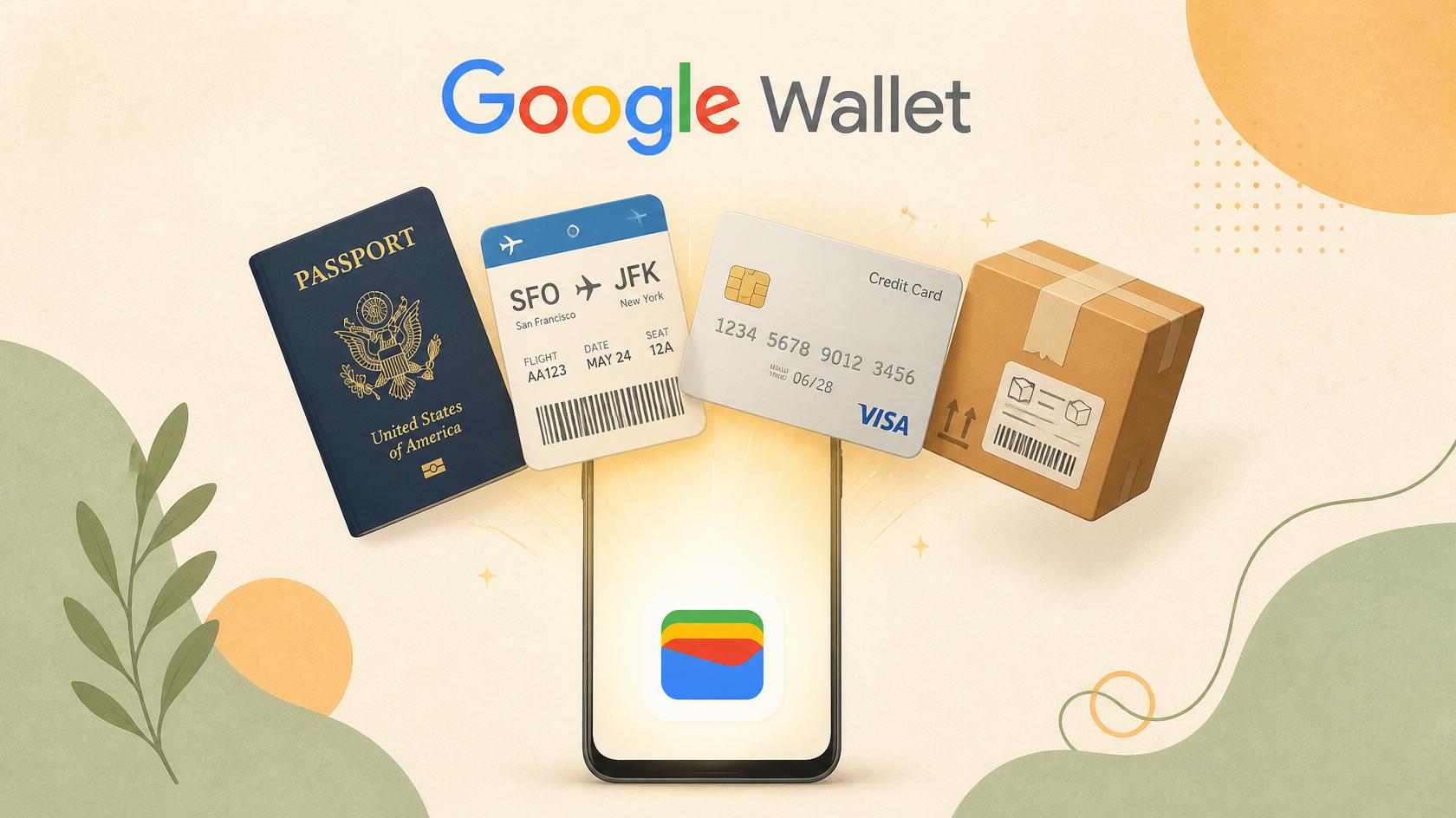
Google Wallet, the app that’s turning into (almost) everything
I use Google Wallet every day to pay at the coffee shop downstairs, to show my IKEA loyalty card when I’m stocking up on scented candles, and to board a train or a flight without digging through my email for the boarding pass. In just a few years, it has gone from a simple credit card substitute to a kind of digital drawer where an ever-growing chunk of daily life ends up. And the latest news fits that direction perfectly: first, automatic tracking of online purchases, now the announcement that we’ll soon be able to load our passports too.
Let’s take stock of where Google Wallet is heading, what really changes for its users, and how it stacks up against Apple Pay, PayPal, and emerging European alternatives.
The news: packages showing up inside G-Wallet
Let’s start with the story that’s caught everyone’s attention these past few weeks. Google has started letting Wallet read Gmail messages to automatically pull out receipts, tracking numbers, and shipping status, and show incoming orders right on the home screen, next to cards and tickets. Just hold down a tracking number, and you land straight on the carrier’s website, no need to open a single confirmation email.
For now,w the feature is only live in the United States. It comes with a step that’s worth pausing on: you need to turn on shipping tracking in Gmail and grant Google permission to share “smart features” across its products, the same permission that lets Big G use your inbox content to personalize Maps, Search, and Gemini. That’s the part worth thinking through. The convenience of having everything in one place comes at the cost of broader access to your own inbox. Whoever picks up this feature once it lands in Italy would do well to look closely at what they’re authorizing.
From payments to passports: ID Pass arrives
The most surprising news of all concerns documents. At Money 20/20 Europe in Amsterdam, Google announced ID Pass, a digital version of the passport that will roll out by the end of summer 2026 in several EU countries, including Italy. This isn’t a photo of your document saved on your phone: the process involves scanning the data page, reading the NFC chip on the electronic passport, and recording a short selfie video for facial recognition. The encrypted file then stays on the device, never touching the cloud.
The most interesting feature is selective verification: to prove you’re over 18 on a platform, you no longer need to show your entire document with your name, address, and date of birth, just that single piece of information. It’s a minimization principle worth keeping an eye on, because it touches on how we register for things online in general.
It’s worth being clear that ID Pass doesn’t replace your physical passport at border control. It has nothing to do with Italy’s own IT-Wallet inside the IO app, which today counts over 10 million activations and more than 17 million uploaded documents. Still, it remains built for in-person checks, like a traffic stop or picking up a prescription. Google is moving on a parallel track, the one made up of private, international digital services, and has left the door open to a future convergence with the European EUDI Wallet, mandated by the eIDAS 2.0 regulation, by November 2026.
How I use it, every day
In my own experience, Wallet moved past the experimental phase a while ago. My IKEA card was the first loyalty card I added, and since then I’ve stuffed a bunch of others I used to keep (badly) in my phone case. For in-store payments, it’s become my default method: the phone is always within reach, the tap is instant, and I no longer have to wonder where I left my card. The same goes for travel, with boarding passes and train tickets that update automatically if a time changes.
The numbers confirm I’m not an outlier. TEHA Group’s eleventh report on digital payments shows that 64.2% of Italians use a card or smartphone to pay every day or several times a week, up from 57.4% just two years ago. Daily cashless payments have, in other words, become the norm here too.
Google Wallet, Apple Pay, PayPal: who’s winning in stores
For years, I kept my loyalty cards tucked into my phone case, a small physical archive that slowly emptied as apps took over. But the shift to digital wallets for payments isn’t just my own story: according to Mollie’s 2026 report on European payments, digital wallet usage grew 57% between 2023 and 2025, and in 2025 alone, 24% of all card payments in Europe went through Apple Pay or Google Pay. In Italy, the Politecnico di Milano’s Innovative Payments Observatory reports that contactless payments made with a card, phone, or wearable reached 323 billion euros in 2025, up 11%, accounting for 62% of digital payments totaling 518 billion euros. A Nomisma study commissioned by Visa adds another useful data point: 68% of Italians used at least one payment app, such as PayPal, Satispay, or Revolut, at some point in 2025.
Apple Pay remains Google Wallet’s most direct rival in physical stores: the same encrypted-token logic instead of a card number, the same quick tap-to-pay convenience, except that it stays locked inside the Apple ecosystem. At the same time, Wallet runs on any Android phone. PayPal has taken a somewhat different path: born for online payments, it has gained ground in stores too through QR code payments, but it remains more of a tool for remote purchases, helped along by its buy-now-pay-later offering, than a daily habit at the local coffee shop. Satispay, Italy’s best-known case, plays an entirely different game: it draws directly from a bank account rather than cards and has increasingly shifted toward corporate welfare and investment products.
Wero, the European alternative, is trying to shake off cards
Another player is trying to shake off cards on a European scale. Wero, built by the banking consortium European Payments Initiative, moves money through instant SEPA transfers directly from account to account, bypassing Visa or Mastercard entirely. The project has already passed 43 million registered users and over 7.5 billion euros transferred since launch, with the app live for peer-to-peer payments in Belgium, France, and Germany. France alone accounts for around 16 million active users.
It’s no accident that the strongest traction shows up in exactly these three markets, soon to be joined by the Netherlands and Luxembourg later in 2026: these are places where direct bank transfers are already a deep-rooted habit, thanks to local schemes like iDEAL in the Netherlands and Bancontact in Belgium, which Wero is gradually absorbing. In Italy, where instant transfers have never carried the same cultural weight in everyday payments, Wero’s adoption is moving more slowly, even though the EuroPA alliance, which includes the Bancomat network, has started working on interoperability with Wero’s infrastructure for cross-border payments. Wero’s rollout in physical stores, in any case, isn’t expected before 2027: for now, it remains mostly a tool for sending money to a friend in Berlin or Brussels, not for paying for a coffee.
What’s happening in other countries
Google Wallet’s expansion has never been a purely European story. Digital identity support first arrived in the United States and the United Kingdom, then in April 2026 in India, Singapore, Taiwan, and Brazil, and is only now reaching the European Union, a more complex regulatory landscape given GDPR and eIDAS. In the UK, Google is already working with the Rail Delivery Group to let travelers buy certain Railcards using digital identity. At the same time, in the US, several states have introduced digital documents usable in official settings.
On the payments side, also at Money 20/20 Europe, Google unveiled an update to Secure Payment Authentication, designed to reduce verification steps during online checkout, and a partnership with Sparkasse Bank for age verification without sharing sensitive data. The thread running through all of it is the same: less friction, more trust built on identities that are verified but only partially disclosed.
What to expect
If I had to bet on where things are headed over the coming months, I’d say Wallet will keep chasing the idea of being people’s single point of access to their digital lives, rather than the best tool in any one category. Order tracking will likely reach Europe too, and so will ID Pass. Still, the real contest will play out over trust: how much we’re willing to concentrate in a single app, payments, documents, and purchase history, and how much value we place, in exchange, on never having to think about it again.
In the meantime, I keep using it for coffee, train tickets, and the loyalty cards I used to keep on apps like Stocard. The rest, between European wallets, national systems, and the slow convergence toward digital identity, will be settled over the coming months, one step at a time.
Related resources
- Google Wallet tracks online orders: all your packages in one app
- Google Wallet will let you track packages in real time
- Google Wallet ID Pass 2026: how the digital passport works on Android
- The digital passport arrives on Google Wallet: when it’ll be available in Italy
- How is Satispay doing after raising half a billion?
- Digital payments in Italy: growth and cashless challenges (TEHA Group Report)
- Google Wallet becomes ever more central to identity and payments
- Digital payments in Europe: wallets and AI drive 2026 (Mollie Report)
- Digital payments: a record 518 billion in Italy (Innovative Payments Observatory, Politecnico di Milano)
- Payment apps, wallets,s and AI: how shopping is changing (Nomisma for Visa)
- Wero: a new payment service in France
- Paying anywhere in Europe: the alliance taking on Visa and Mastercard
- Original story: Google Wallet, order tracking via Gmail
See also on Content Benefit:
